


Brightree has been a dominant name in DME software for over two decades. It handles billing, inventory, and revenue cycle management for thousands of home medical equipment providers across the U.S. But dominant does not mean the best fit for every operation.
Many DME owners and directors of operations reach a point where Brightree’s add-on pricing model, rigid workflows, or contract terms push them to explore other options. Some operations simply outgrow it. Others never felt it was built for their size or service mix.
This guide gives you a clear, side-by-side look at the strongest Brightree alternatives available in 2026. You will find out what each platform does well, where it falls short, and which type of operation it fits best.
Key Insight
The global DME software market reached $1.85 billion in 2024 and is projected to grow at a CAGR of 10.6%, reaching $5.06 billion by 2033.
Why Are DME Operators Looking for a Brightree Alternative?
Brightree is not a bad platform. It has a large feature set, strong industry integrations, and a long track record with Medicare-compliant billing.
But user feedback on Capterra and G2 consistently surfaces the same frustrations.
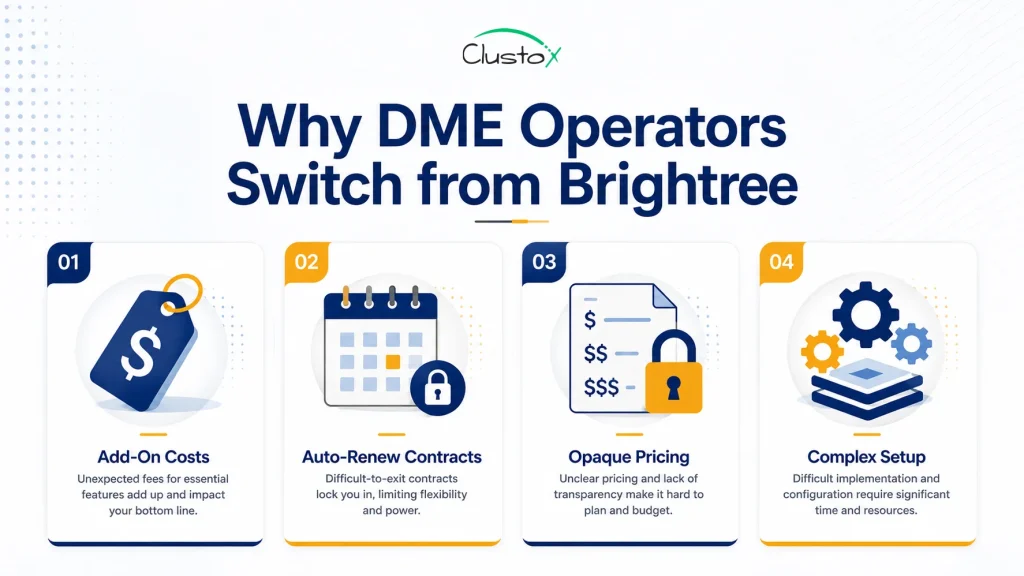
Table of Contents
Add-on pricing model
Brightree’s base package does not include everything you need to do your job. Core features like certain reporting tools, document management enhancements, and integration modules often require separate purchases. Multiple reviewers on Capterra describe being surprised by the volume and cost of these add-ons after they signed contracts.
Auto-renewing contracts
Several Capterra reviewers note that Brightree enforces a 90-day cancellation notice before contract renewal. Missing that window locks you into another full year of service fees, even if you have already migrated to a different platform.
Pricing opacity
Brightree does not publish pricing publicly. Custom quotes make it difficult to compare value across vendors before you have entered a sales conversation.
Complexity for smaller operations
Brightree is built to scale. That is a strength for large enterprises. For a regional DME provider with a lean team, the depth and configuration overhead can slow things down rather than speed them up.
None of this means you should leave Brightree. It means you should know your alternatives before you renew.
What Should You Look for in a Brightree Alternative?
Before you evaluate any platform, align your team on the criteria that actually matter for your operation. Every DME provider is different. A mid-size oxygen supplier in the Midwest has different software needs than a high-volume CPAP resupply operation in a metro market.
Below are the non-negotiable evaluation criteria for DME software in 2026.
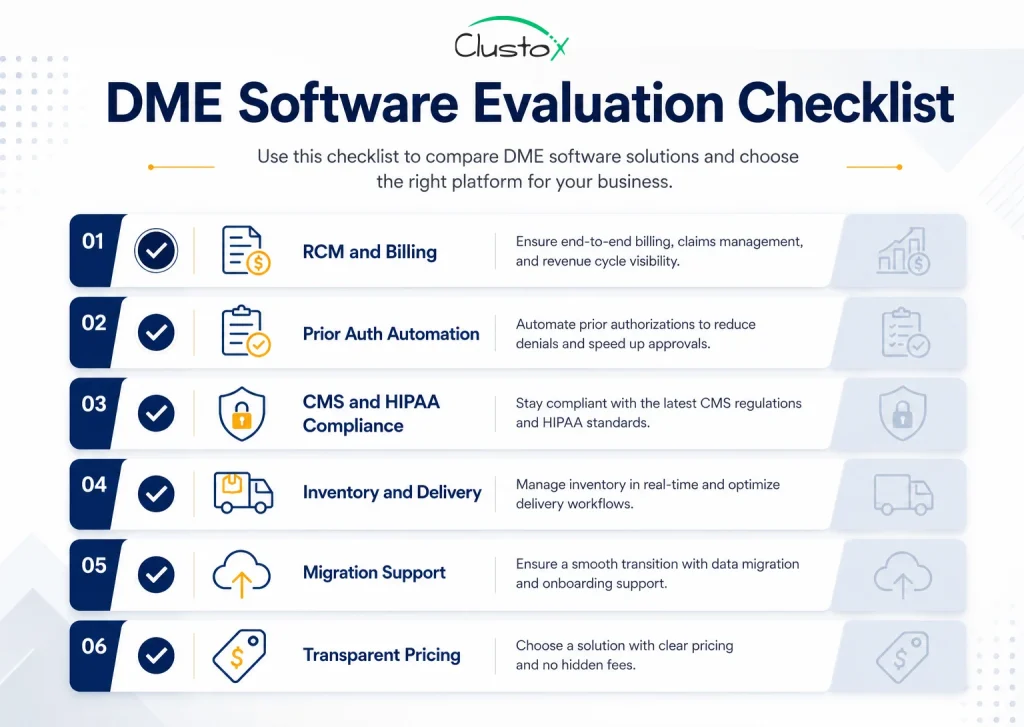
Revenue cycle management (RCM) and billing completeness
The platform must handle electronic claims submission to Medicare, Medicaid, and private payers without requiring a third-party clearinghouse bolt-on. Look for denial management workflows, automated eligibility verification, and remittance posting built into the core product.
Prior authorization automation
Prior authorization is still one of the most time-consuming processes in DME operations. The right software reduces manual touchpoints through automated status tracking, fax-to-digital conversion, and real-time payer connectivity. This is not optional in 2026.
CMS and HIPAA compliance architecture
Your software must support CMS documentation requirements, HCPCS code accuracy, and HIPAA-compliant data handling. Verify these are maintained and updated with CMS rule changes, not left to the provider to manage manually.
Inventory and delivery management
Real-time inventory tracking, serialized asset management, and route optimization for delivery teams should come standard. If they are add-ons, calculate the true cost.
Migration path and data conversion support
Switching platforms is disruptive. Vendors that offer structured data migration, parallel run periods, and dedicated implementation support will reduce your downtime and compliance exposure during the transition.
Transparent pricing
Flat-rate or published-tier pricing signals a vendor that is confident in its value. Custom-quote-only models are not inherently bad, but they slow your evaluation process and make budget approval harder.
The 5 Best Brightree Alternatives in 2026: A Detailed Comparison
Below are the platforms most actively evaluated by DME and HME providers as alternatives to Brightree. Each entry covers core strengths, known limitations, and the type of operation it fits best.
1. NikoHealth
NikoHealth is a cloud-based DME and HME platform built specifically for medical equipment providers. It covers the full workflow from order intake to final delivery, with billing and RCM, inventory control, intelligent scheduling, patient EMR, delivery management, and analytics in a single system.
What distinguishes NikoHealth from several competitors is its flat-rate pricing model. Unlike Brightree, which uses a per-feature add-on structure, NikoHealth positions itself as an all-in-one system with no hidden fees. The platform also offers a simplified migration process for providers coming from Brightree, Bonafide, DMEWorks, and Fastrack.
NikoHealth is well-suited for mid-size DME operations that have outgrown older platforms and need a modern interface without the complexity of enterprise-tier software.
Key strengths:
- Flat-rate pricing with no hidden add-ons
- Cloud-native with real-time operations visibility
- Structured migration support for providers switching from Brightree and other legacy platforms
- Robust APIs for third-party integrations
- Integrated delivery management and patient EMR
Limitations to consider:
- Specific pricing is not published publicly; a quote requires direct contact
- Smaller vendor footprint than some legacy competitors
Best for: Mid-size DME and HME providers looking for a modern, all-in-one cloud platform with no hidden add-on fees.
2. TIMS Medical by Computers Unlimited
TIMS (Total Information Management System), developed by Computers Unlimited, has served HME and DME providers for over two decades. The platform covers the full revenue cycle, including billing, patient intake, compliance document management, denial management, mobile delivery, and inventory control.
TIMS is available in both on-premise and hosted deployments, which gives operations with specific IT infrastructure requirements more flexibility than a cloud-only vendor. Starting pricing is around $250 per month, making it one of the more accessible platforms in this comparison.
User reviews on Capterra highlight TIMS’s strong customer support, daily claims submission capabilities, and serialized inventory management. The most common criticism is that add-on features carry additional cost, which mirrors the Brightree experience to some degree.
Key strengths:
- Full revenue cycle management with denial automation
- On-premise and hosted deployment options
- Serialized inventory and mobile delivery management
- Strong customer support reputation across the HME industry
- Published starting price of approximately $250 per month
Limitations to consider:
- Add-on features can increase total cost significantly over the base price
- Interface is less modern compared to newer cloud-native competitors
Best for: Mid-size DME providers that need deployment flexibility or prefer a vendor with a long, documented track record in the HME market.
3. Bonafide ERP
Bonafide ERP is a cloud-based DME and HME billing platform that focuses on patient intake accuracy and clean claims submission. Its real-time eligibility verification, document routing, and denial management workflows are designed for operations where billing accuracy and clean first-pass claim rates are the primary focus.
Bonafide does not publish pricing publicly. It is described by industry aggregators as comparable in total cost to Brightree, though the pricing structure may differ. The platform is considered affordable relative to enterprise-tier competitors.
Bonafide fits operations where the billing and revenue cycle team is the primary driver of software selection and where a streamlined, billing-first workflow is preferable to a broad all-in-one suite.
Key strengths:
- Strong real-time eligibility verification and patient intake accuracy
- Clean claims and denial management workflows built into the core product
- Cloud-based with good adaptability to changing payer rules
- Focused, billing-first user experience
Limitations to consider:
- Less comprehensive on inventory and delivery management compared to full-suite competitors
- Pricing is not publicly disclosed
Best for: DME billing teams that prioritize clean claims, denial prevention, and revenue cycle efficiency over a broader operational feature set.
4. Fastrack Healthcare Systems
Fastrack Healthcare Systems is a long-established HME and DME platform that has served the home medical equipment industry since the 1990s. The platform covers billing, inventory, routing and delivery, warehouse automation, workflow automation, and e-commerce storefronts. It also supports infusion pharmacy and home care agency billing, making it a strong option for providers operating across multiple care lines.
Fastrack’s workflow automation engine tracks real-time order status, assigns responsibility for each step in the order-to-delivery process, and uses wireless barcode-enabled warehouse picking. The routing and delivery module optimizes delivery routes and enables real-time delivery confirmation from patient locations.
Fastrack is now part of the WellSky family following a series of acquisitions. Providers evaluating Fastrack should confirm the current product roadmap and ongoing support structure directly with WellSky.
Key strengths:
- Comprehensive workflow automation spanning warehouse, routing, and delivery
- Supports HME, DME, infusion pharmacy, and home care agency billing in one system
- Strong order tracking and real-time delivery confirmation
- eCommerce storefront and business partner portal included
Limitations to consider:
- Legacy platform architecture; newer competitors offer a more modern UX
- The post-acquisition product roadmap should be confirmed directly with WellSky
- Pricing available by custom quote only
Best for: HME providers that also operate home infusion or home care lines and need multi-service-line billing in a single platform.
5. Universal Software Solutions (HDMS)
Universal Software Solutions (USS), based in Davison, Michigan, develops HDMS (Healthcare Data Management System), a comprehensive platform built for HME, DME, and infusion specialty pharmacy providers. HDMS covers billing and RCM, inventory and delivery management, document management through its StowPoint module, patient outreach, and workflow automation through its WorkLogix platform.
USS has built a strong integration ecosystem for DME providers. Its VendorLink module connects directly with major medical supply distributors, automating purchase orders and dropship delivery methods. Its Outreach Services module handles patient resupply through automated text and interactive voice outreach. The company has also publicly announced work on agentic AI workflows within HDMS, positioning it as a forward-looking platform for operations that want to automate beyond rules-based triggers.
USS serves a mix of mid-size and larger DME and infusion pharmacy operations. Pricing is available by custom quote.
Key strengths:
- Comprehensive HDMS platform covering DME, HME, and infusion pharmacy in one system
- Strong distributor integrations via VendorLink, including direct McKesson connectivity
- Automated patient resupply outreach through HDMS Outreach Services
- WorkLogix workflow management and StowPoint document management built in
- Active development of agentic AI workflows within the platform
Limitations to consider:
- Pricing is not published publicly; requires direct contact for a quote
- Platform depth may exceed the needs of very small operations
Best for: Mid-to-large DME and infusion pharmacy providers that need a deeply integrated, multi-service-line platform with strong distributor connectivity and a forward-looking automation roadmap.
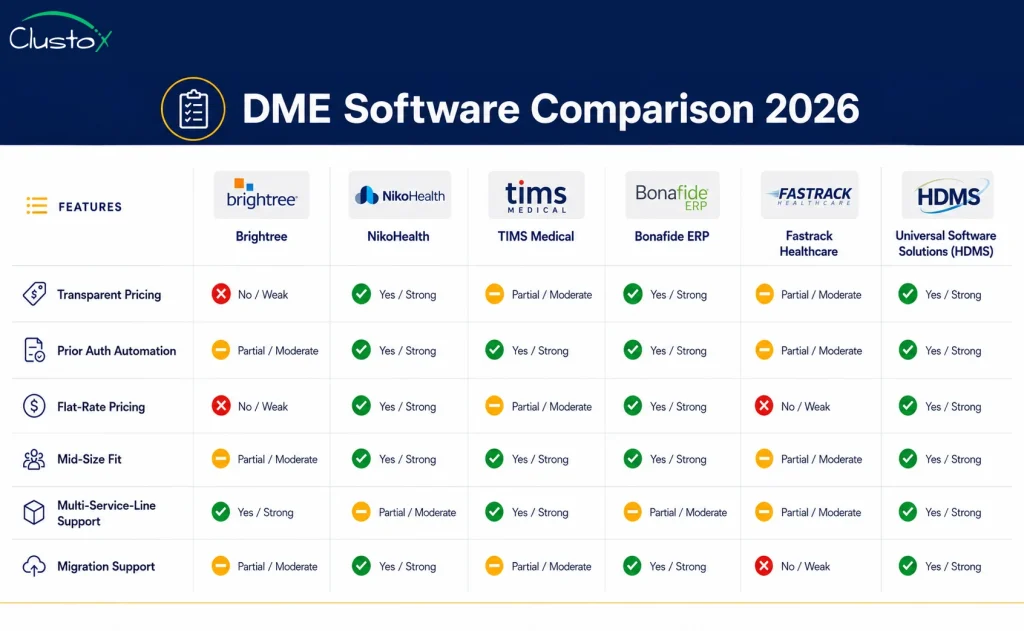
How Do These Brightree Alternatives Compare at a Glance?
The table below gives you a structured side-by-side view across the five platforms plus Brightree. Use it as a starting point for your shortlist, not as a final decision tool.
| Platform | Best For | Deployment | Prior Auth Automation | Transparent Pricing | Migration Support |
|---|---|---|---|---|---|
| Brightree | Large enterprises | Cloud | Yes (add-on) | No (custom only) | Yes |
| NikoHealth | Mid-size providers | Cloud | Yes | Flat-rate model | Yes |
| TIMS Medical | Mid-size, multi-location | On-premise / Cloud | Yes | Starts ~$250/month | Yes |
| Bonafide ERP | Billing-focused operations | Cloud | Yes | Contact for pricing | Yes |
| Fastrack Healthcare | HME / Infusion providers | Hosted / On-premise | Yes | Custom quote | Yes |
| Universal Software (HDMS) | Mid-to-large DME / Infusion | Cloud / On-premise | Yes | Custom quote | Yes |
Note: Pricing data is based on publicly available information and vendor-reported details as of June 2026. Confirm current pricing directly with each vendor.
AI-Augmented DME Alternatives and the Clustox Approach
The five platforms above are solid software choices. But software alone does not solve the deeper operational problems that DME providers face in 2026.
Prior authorization still consumes 3 to 10 days of manual work per case at many operations. Denial rates remain high. Eligibility exceptions pile up in staff queues. Resupply outreach falls through the gaps. Rules-based automation inside billing platforms handles the predictable workflows. It struggles with the exceptions, the edge cases, and the cross-system handoffs that drive the most labor cost.
This is where Agentic AI changes the equation.
What is Agentic AI in the DME context?
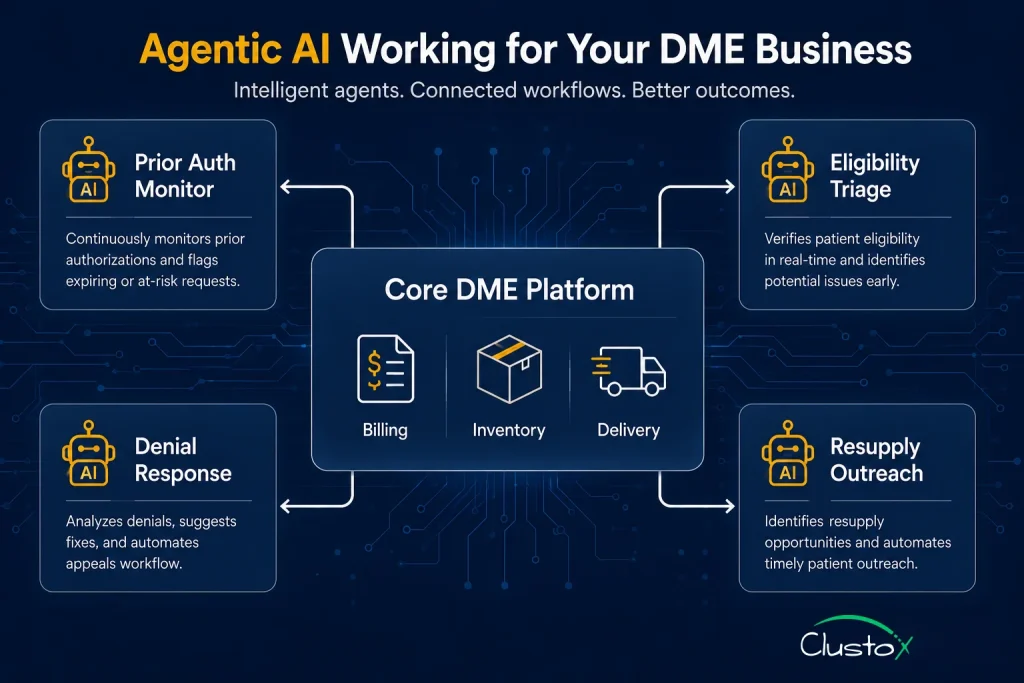
Agentic AI goes beyond answering questions or flagging issues. An AI agent can take a sequence of actions across systems, make decisions within defined boundaries, and escalate to a human only when genuinely needed. In DME operations, that means agents that monitor prior auth status across payer portals, draft and send payer correspondence, triage eligibility exceptions before they hit a billing queue, and trigger resupply outreach without a staff member initiating each action.
Universal Software Solutions has publicly announced agentic AI workflow development inside HDMS. NikoHealth and others expose APIs that make it possible to layer external AI agents on top of their core systems. The platforms that matter most are the ones with documented, well-structured APIs, because those are the platforms you can actually augment.
How does Clustox approach DME software automation?
Clustox is an Agentic AI engineering firm. We do not replace your DME platform. We build custom AI workflows on top of the platform you already run or the one you are migrating to.
Here is what that looks like in practice for a DME operation.
- A prior auth monitoring agent checks payer portals on a defined cadence, updates status inside your DME platform, and alerts your team only when action is required or a deadline is approaching.
- An eligibility triage agent reviews daily exception reports, runs secondary checks against payer rules, and routes only genuinely complex cases to your billing staff.
- A denial response agent drafts appeal letters based on denial code, payer, and patient record context, queuing them for one-click staff review before submission.
- A resupply outreach agent identifies eligible patients based on resupply intervals, sends compliant outreach via text or IVR, and logs responses back into your platform without manual data entry.
This approach works alongside any of the five platforms in this guide, provided the platform exposes adequate API access.
When you evaluate a Brightree alternative, ask directly: What does your API documentation look like, and what third-party automation tools have other clients connected to your system?
Platforms with strong, documented APIs give you operational flexibility that extends well beyond whatever the vendor builds natively. That is a real criterion, not a nice-to-have.
Migration Considerations and Risks: What DME Operators Get Wrong
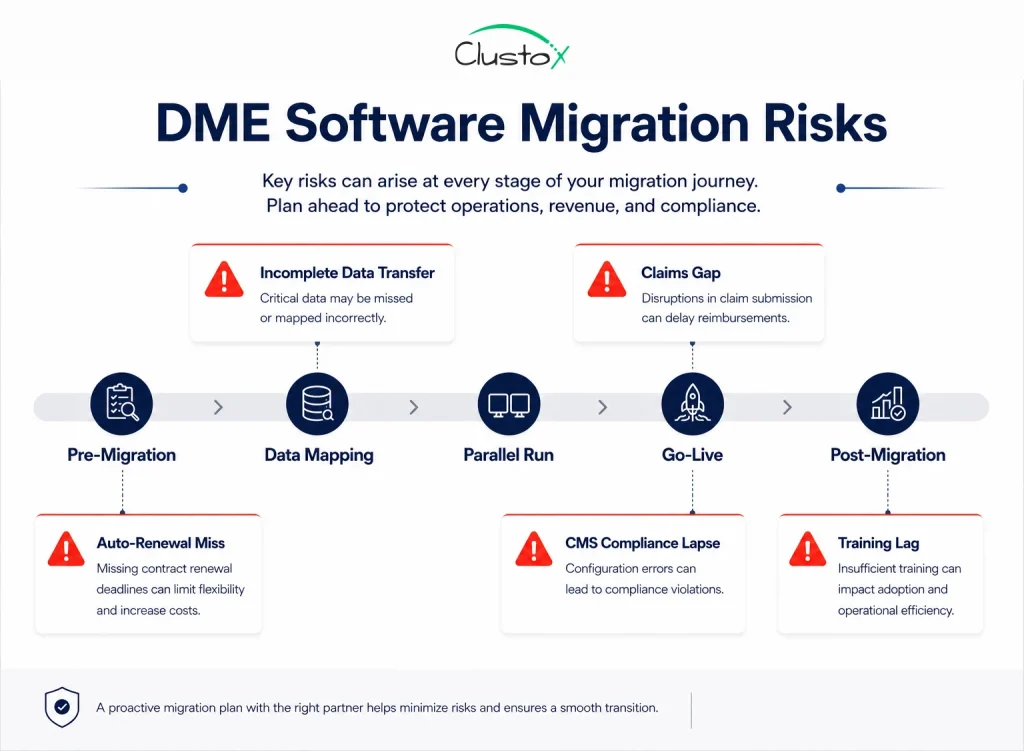
Switching DME platforms is one of the highest-risk operational decisions you will make. A poorly managed migration can disrupt billing cycles, create compliance gaps, and trigger payer claim submission errors that take months to clean up.
Most providers underestimate the complexity until they are already in it. The following are the areas where migrations most commonly go wrong.
Data completeness and patient record integrity
Your patient records contain open orders, active authorizations, rental billing cycles, and historical claim data. Not all of this migrates cleanly between platforms. Serialized equipment records, CMN documentation, and recurring supply schedules are particularly prone to gaps.
Before you sign a migration contract with any vendor, ask them to show you exactly how they handle these data types in migration. Request a sample data mapping document from a comparable prior migration. If a vendor cannot produce that, the migration plan is not mature.
Parallel run periods and claim submission continuity
A parallel run period, where both the old and new systems run simultaneously for a defined window, is the most reliable way to catch migration gaps before they affect revenue. Not all vendors include this in their standard implementation. Confirm it is in the contract before you sign.
Claim submission continuity is non-negotiable during a migration. Any gap in your ability to submit electronic claims to Medicare or Medicaid creates a direct revenue impact. Map out exactly which team is responsible for claims during each phase of the cutover.
CMS compliance during the transition
Your new platform must be fully CMS-compliant from day one of live operation. That includes correct HCPCS code handling, LMN documentation requirements, and HIPAA-compliant data handling. Verify that the vendor has obtained or maintained current CMS certification and that their compliance update process is automatic, not manual.
If you are switching platforms during a CMS rule change cycle, which happens regularly, build extra buffer time into your go-live date. Launching on a new platform the same week CMS releases a billing rule update is a risk you can avoid with planning.
Contract terms on the platform you are leaving
As covered earlier in this guide, Brightree’s auto-renewal clause requires 90 days of notice before the renewal date. If you miss that window, you are obligated to pay for another full contract year. Factor this into your migration timeline from day one.
The same contract scrutiny applies to any new platform you sign with. Read the cancellation terms, data portability rights, and auto-renewal clauses before you commit. Data portability, specifically your right to export your patient and billing data in a usable format, should be in writing.
Staff training and adoption time
A new platform is only as effective as the team using it. Underestimating training time is one of the most common migration mistakes. Build at least 30 days of parallel training time into your go-live plan, and designate a platform champion on your internal team who can support colleagues through the transition.
Vendors that offer dedicated implementation managers, not just a help desk ticket queue, consistently deliver faster time-to-full-adoption. Ask each vendor how they staff implementations and what the escalation path looks like if your team hits a blocking issue post-launch.
How Do You Choose the Right Brightree Alternative for Your Operation?
A feature comparison table is useful, but it does not make the decision for you. The right platform depends on where your operation sits today and where you plan to be in three years.
Start with your biggest operational pain point
If prior authorization is consuming your team’s time, prioritize platforms with the strongest automation in that specific workflow. If billing errors and denial rates are your core problem, Bonafide or NikoHealth deserve top attention. If you need multi-service-line billing across HME and infusion, Fastrack or Universal Software Solutions are the realistic options.
Calculate the total cost of ownership
Add-on fees, clearinghouse fees, implementation costs, training time, and data migration expenses all belong in your TCO calculation. Competitors to Brightree sometimes have a lower base price but comparable total costs once you account for the full stack.
Run a structured demo against your actual workflows
Do not let vendors demo their best-case scenarios. Give them your most complex order types, your denial rate scenarios, and your prior auth volume. See how the platform handles real conditions, not sales demos.
Evaluate the migration path before you commit
Data migration from Brightree is not trivial. Ask each vendor directly: how do you handle patient record migration, open orders, and historical billing data? Request references from customers who migrated from Brightree specifically.
Check CMS compliance update frequency
CMS updates billing rules, HCPCS codes, and documentation requirements regularly. Your software vendor needs to push those updates automatically or provide a clear timeline for compliance patching. This is non-negotiable in DME operations.
The Bottom Line: Which Brightree Alternative Should You Choose?
There is no single best Brightree alternative. The right platform is the one that fits your operation’s size, billing complexity, service mix, and growth trajectory.
Here is a quick summary of where each platform fits best.
- NikoHealth is the strongest mid-market option for operations coming off Brightree that want a modern, flat-rate cloud platform with a smooth migration path.
- TIMS Medical is a good fit for mid-size providers that want deployment flexibility and a vendor with a long track record in the HME industry.
- Bonafide ERP is the right choice for billing-focused operations where clean claims and denial prevention are the primary software priority.
- Fastrack Healthcare is best for providers running both HME and home infusion or home care lines that need multi-service-line billing in one system.
- Universal Software Solutions (HDMS) is well-suited for mid-to-large DME and infusion pharmacy operations that want deep distributor integration, robust patient outreach automation, and a platform actively building toward agentic AI workflows.
Before you sign a new contract, run structured demos against your real workflows. Calculate full TCO. Read the renewal and cancellation terms carefully. The contract terms that hurt Brightree users most were the ones they did not read closely enough before signing.
If your operation is also evaluating how AI automation fits into your workflow, the platform’s API architecture matters as much as its feature list. The right platform should support the tools you build on top of it, not just the tools it ships with.
Want to Upgrade Your DME Software?
Clustox builds custom Agentic AI workflows for DME providers. We help you evaluate, migrate, and automate your operations on the right platform.
Frequently Asked Questions (FAQs)
Is there a DME software option with published, transparent pricing?
TIMS Medical publishes a starting price of around $250 per month. NikoHealth uses a flat-rate model but requires direct contact for a quote. Most DME platforms in this comparison, including Brightree, Bonafide, Fastrack, and Universal Software Solutions, use custom pricing only.
How long does a migration from Brightree to another platform typically take?
Migration timelines vary based on your data volume, open orders, and the receiving vendor's implementation resources. Most structured migrations take 60 to 120 days for a mid-size operation. Request a detailed timeline and references from prior Brightree migrations before signing any agreement.
Do these Brightree alternatives support Medicare and Medicaid billing?
Yes. All five platforms in this guide support Medicare and Medicaid electronic claims submission and are built to CMS billing standards. Confirm each vendor's specific payer network and clearinghouse partnerships, as coverage can vary for state Medicaid programs and regional payers.
What is the risk of missing Brightree's auto-renewal window?
Multiple Capterra reviewers report that missing Brightree's 90-day cancellation notice window results in being locked into an additional full year of service fees, even after migrating to a new platform. Mark your contract renewal date and set a calendar reminder at the 90-day mark well in advance.
Can Agentic AI be added to any of these DME platforms?
Yes, if the platform exposes well-documented APIs. NikoHealth and Universal Software Solutions both support external integrations. Clustox builds custom Agentic AI agents for DME operations on top of existing platforms, covering prior auth monitoring, eligibility triage, denial response drafting, and resupply outreach. The platform's API quality is the primary technical dependency.
What contract terms should you review before signing with a new DME platform?
Focus on three areas: the auto-renewal clause and required cancellation notice period, your data portability rights upon termination, and implementation timelines with penalties for vendor delays. Confirm that patient and billing data export is available in a standard, usable format after contract end.
DISCLAIMER
This article is intended for DME providers, operations leaders, and technology decision-makers. It is not medical advice and does not constitute guidance on patient care, equipment selection, or clinical decisions. Regulatory references (CMS, HIPAA, accreditation standards) are accurate as of the review date. Regulations change frequently, and providers should consult primary sources or qualified counsel for current requirements.