

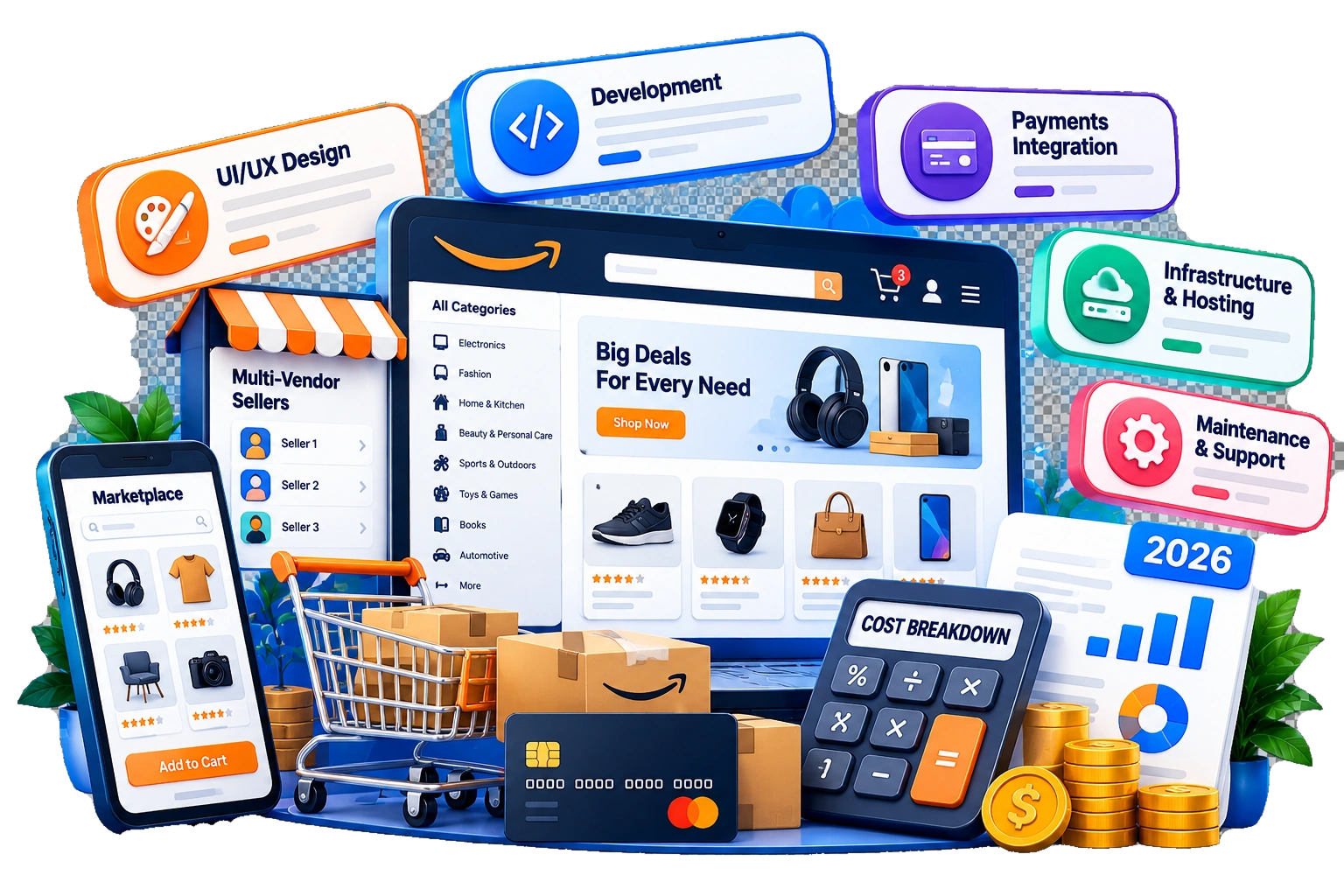
Amazon generated $717 billion revenue in the past year. Behind that number is a marketplace infrastructure that took years and hundreds of millions of dollars to build.
Which is exactly why more business leaders are asking a different question: what would it actually cost to build a marketplace like that?
The honest answer is it depends on what you are actually building. The cost to build a marketplace in 2026 ranges from $40,000 to $500,000+. That range is accurate. It is also nearly useless without understanding what sits inside it.
Scope, team structure, tech stack, and feature prioritization all move that number significantly. Each of those layers carries a cost, and most vendors won’t surface the details until you are already mid-project.
In this blog, we break down the real cost of building a marketplace in 2026, by stage, by feature, and by team type.
By the end, you will have everything you need to scope your build, plan your budget, and walk into your first vendor conversation knowing exactly what you are paying for.
What Are the Factors Affecting the Cost of Building a Marketplace Like Amazon?
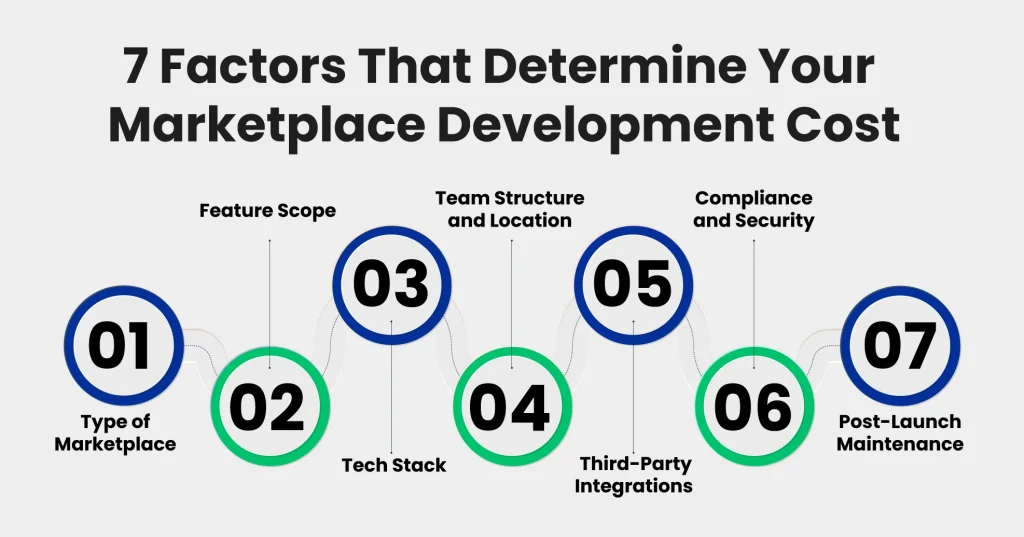
The cost of building a marketplace is not determined by a single decision. It is the sum of several interdependent variables, each one capable of moving your budget significantly in either direction.
Following are the core factors that determine your final development cost.
Table of Contents
1. Type of Marketplace
The model you choose defines your technical complexity from day one. A product marketplace like Amazon requires inventory management, multi-vendor logistics, and catalog infrastructure.
A service marketplace like Upwork needs booking systems, profile verification, and contract management. A rental marketplace like Airbnb adds availability calendars, deposit handling, and identity verification.
Each model carries a different development scope and a different price tag.
2. Feature Scope
Feature scope is the single biggest cost factor in marketplace development. Every feature you add requires design, development, testing, and integration work. The difference between a focused MVP and a full-scale platform is months of engineering time and hundreds of thousands of dollars.
Defining your core feature set before development begins is the most effective way to control your budget.
3. Tech Stack
Your technology choices directly affect both your build cost and your long-term scalability. A custom-built marketplace on React, Node.js, and PostgreSQL gives you full control and flexibility. A SaaS-based or open-source approach reduces upfront cost but limits what you can build over time.
The stack you choose in month one will still be running your platform in year three. That decision deserves serious attention before development starts.
4. Team Structure and Location
Who builds your marketplace matters as much as what they build.
- A US-based agency brings higher hourly rates, typically $120 to $200 per hour.
- An offshore or nearshore development partner can deliver the same scope at $25 to $80 per hour, depending on region and seniority.
Team composition, which is the ratio of frontend developers, backend engineers, QA specialists, and project managers, also affects your total cost and delivery timeline.
5. Third-Party Integrations
A marketplace cannot function in isolation. Payment processing through Stripe Connect, shipping APIs, AWS cloud infrastructure, Elasticsearch, and identity verification services add development costs.
Each integration requires scoping, development, testing, and long-term upkeep. The more integrations your platform requires on day one, the higher your initial cost.
6. Compliance and Security Requirements
Compliance requirements are not a late-stage consideration. If your marketplace handles payments, healthcare products, or cross-border sales, plan for GDPR, PCI-DSS, and KYC from the start.
Make them part of your early architecture decisions. Adding them after launch will almost always cost much more.
7. Post-Launch Maintenance
Development cost does not end at launch.
Plan for 15 to 20 percent of your initial build cost annually for maintenance, security patches, infrastructure scaling, and feature updates. For a $100,000 build, that is $15,000 to $20,000 per year, a number that belongs in your total cost of ownership calculation from the start.
How Much Does It Cost to Build a Marketplace in 2026?
The cost of building a marketplace in 2026 ranges from $40,000 for a focused MVP to over $500,000 for a full-scale enterprise platform. Where your build lands depends entirely on scope, features, team structure, and the technical decisions made before development begins.
There are three distinct build stages. Each one serves a different business objective and carries a different budget requirement.
MVP Marketplace: $40,000-$80,000
An MVP is not a half-built product. It is a focused, functional platform that validates your core buyer-seller model with the minimum feature set required to generate real transactions.
At this stage, you are answering one question: will people buy and sell on this platform?
What an MVP includes:
- User registration and authentication for buyers and sellers.
- Product or service listings with basic search and filters.
- Seller onboarding and profile management.
- Payment processing via Stripe Connect.
- Order management and basic transaction flow.
- Admin dashboard for platform oversight.
- Email notifications for key actions.
Timeline: 3 to 5 months
Best for: Founders validating a marketplace model before committing to a full-scale build. If nobody transacts on your MVP development, you have saved yourself $300,000.
Mid-Tier Marketplace: $80,000-$200,000
A mid-tier build moves beyond validation. At this stage, you are building a platform that can acquire and retain users at scale, with the features, performance, and reliability that a growing marketplace requires.
What a mid-tier build adds:
- Advanced search powered by Elasticsearch.
- Review and rating system for buyers and sellers.
- Multi-currency and multi-language support.
- Automated seller payouts and commission management.
- Dispute resolution workflows.
- CRM and analytics integration.
- Mobile-responsive design or native mobile app.
- Security and fraud detection.
Timeline: 5 to 9 months
Best for: Founders who have validated demand and are ready to scale. This is where most growth-stage marketplace builds land.
Full-Scale Marketplace: $200,000-$500,000+
A full-scale marketplace is a complete commercial platform, built for high transaction volumes, multiple seller tiers, and enterprise-grade reliability. This is the tier where architecture decisions around scalability, compliance, and infrastructure carry the most weight.
What a full-scale build includes:
- AI-powered search and personalized recommendations.
- Multi-vendor logistics and shipping integrations.
- Advanced seller analytics dashboard.
- Subscription and membership models.
- Full compliance infrastructure.
- Custom mobile applications for iOS and Android.
- Real-time inventory management.
- Enterprise-grade cloud infrastructure on AWS or Google Cloud.
Timeline: 9 to 18 months
Best for: Funded companies building a marketplace as a core business, not a side product. At this stage, you are building an infrastructure.
Cost Summary at a Glance
| Build Stage | Cost Range | Timeline | Best For |
|---|---|---|---|
| MVP | $40,000-$80,000 | 3-5 months | Validating the model |
| Mid-Tier | $80,000-$200,000 | 5-9 months | Scaling after validation |
| Full-Scale | $200,000-$500,000+ | 9-18 months | Building core infrastructure |
One principle applies across all three stages: the cost of building the wrong scope is always higher than the cost of scoping correctly from the start.
Founders who try to build full-scale before validating demand almost always rebuild. Founders who treat the MVP as a throwaway product almost always regret the technical debt.
The right stage is the one that matches where your business actually is, not where you hope it will be in two years.
Not Sure Where Your Build Falls on the Cost Spectrum?
Our team of marketplace engineers will break down your requirements into a clear, phased cost plan before any development begins.
Feature-Wise Cost Breakdown: Which Features Cost the Most, and Which Can You Defer?
Every marketplace has a core set of features that must work before anything else matters. They are the foundation your entire platform runs on. Getting them right from the start determines how much you spend fixing things later.
The following covers the eight features that define any functional marketplace, with honest cost estimates for each.
1. Product Listings and Search
Search is the primary way buyers discover products on any marketplace. Basic keyword search is straightforward. Filtered search with categories, price ranges, and location adds complexity.
Cost Budget:
$5,000 to $18,000 for listings and search, depending on how your discovery experience needs to be at launch.
2. Order and Transaction Management
Once a transaction happens, your platform needs to track it end-to-end: order confirmation, fulfillment status, delivery updates, returns, and dispute handling. This is the operational backbone of your marketplace.
Cost Budget:
A well-built order management system costs between $5,000 and $10,000 and is non-negotiable for any marketplace that processes real transactions.
3. Buyer and Seller Dashboards
A marketplace serves two distinct user types simultaneously. Buyers need order history, tracking, and account management. Sellers need inventory control, payout visibility, and performance data.
Cost Budget:
Building separate, role-based dashboards adds real complexity to your backend. It typically costs $8,000 to $20,000, based on the features needed at launch.
4. Seller Onboarding and Verification
Without sellers, your marketplace has nothing to sell. Seller onboarding covers everything from account creation and document submission to KYC verification and approval workflows.
Cost Budget:
Seller onboarding and verification usually costs $5,000 to $14,000. The cost depends on the identity checks and automation needed at launch.
5. Payment Gateway Integration
Payment infrastructure is one of the most technically complex features in any marketplace build. Every transaction involves split payments between buyers, sellers, and the platform. Refund handling, failed transaction recovery, and financial compliance all have to work correctly from day one.
Cost Budget:
Stripe Connect is the most widely used solution for multi-vendor marketplaces in 2026. Integration and configuration typically costs between $5,000 and $12,000.
6. Admin Panel
Every marketplace needs an internal control layer. The admin panel is where your team manages users, monitors transactions, resolves disputes, applies platform fees, and tracks performance metrics across the platform.
Cost Budget:
A functional admin panel with reporting and moderation tools costs between $6,000 and $12,000 and is one of the most underscoped features in early marketplace builds.
7. Notification and Communication System
Buyers and sellers need to stay informed at every stage, including order confirmations, payment updates, dispute alerts, and promotional messages. A notification system that covers email, in-app, and push channels keeps both sides of your marketplace engaged and reduces support volume significantly.
Cost Budget:
Budget between $3,000 and $7,000 for a well-structured notification and communication layer.
8. Review and Rating System
Trust is the currency of any marketplace. Buyers rely on ratings to make purchasing decisions. Sellers rely on reviews to build credibility. Without a structured review system, your platform has no trust layer, and trust is what drives repeat transactions.
Cost Budget:
A review and rating system typically costs between $4,000 and $8,000 to build and integrate correctly.
Features like AI-powered recommendations, native mobile apps, and multi-vendor logistics are real requirements at scale. But building them before you have validated demand is one of the fastest ways to exhaust a marketplace budget before your platform has its first 1,000 users.
What Are the Hidden Costs Most Founders Forget to Budget For?
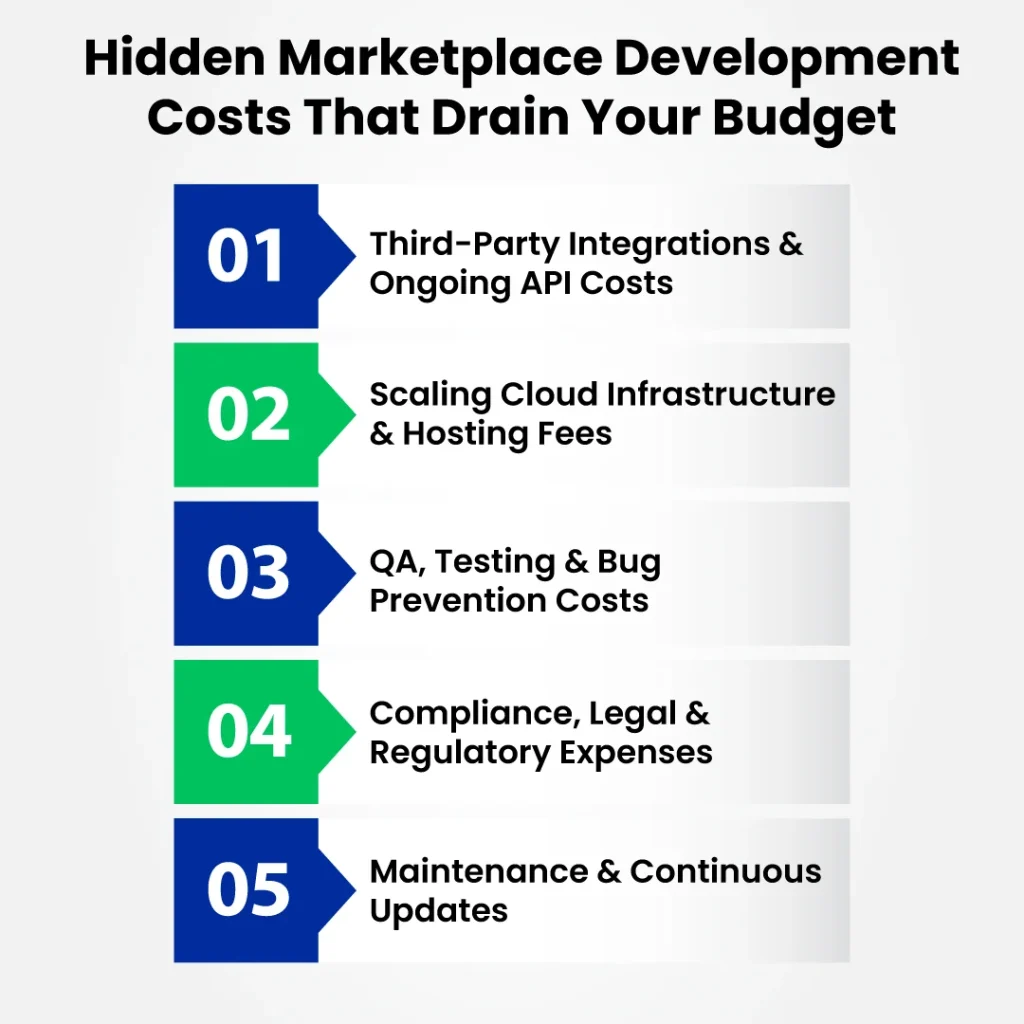
The features you scope are rarely what breaks a marketplace budget. It is the costs that never appear in the initial estimate that do the most damage. Most founders discover them mid-project when reversing course is expensive.
Below are the cost categories most founders discover too late.
Cloud Infrastructure and Hosting
A marketplace running on AWS or Google Cloud does not have a fixed monthly cost. It scales with traffic, storage, and usage. Early-stage platforms typically spend $50 to $300 per month on infrastructure. At the growth stage, that number moves to $2,000 to $15,000 per month depending on transaction volume and data storage requirements.
QA and Testing
On a platform processing real transactions, every undetected bug carries a cost far beyond the fix. A dedicated QA and testing process across every buyer flow, seller flow, and payment scenario is what keeps that trust intact after launch
Compliance and Legal
GDPR, PCI-DSS, and KYC are not optional for a marketplace operating at any meaningful scale. Legal fees, compliance audits, and development work to meet these standards are often planned after the build. By then, they cost much more.
Ongoing Maintenance
Plan for 15 to 20 percent of your initial build cost annually for security patches, bug fixes, infrastructure updates, and feature iterations. For a $100,000 build, that is $15,000 to $20,000 per year, every year.
Every Week of Mid-Project Surprises Costs More Than a Week of Upfront Planning.
Get a full cost breakdown that goes beyond features, covering every layer of your marketplace build before development starts.
How Long Does It Take to Build a Marketplace Like Amazon?
Timeline and cost move together. The longer your build takes, the more it costs in development hours, delayed revenue, and compounding scope changes. Getting your timeline right from the start is as important as getting your budget right.
| Build Stage | Timeline |
|---|---|
| MVP | 3 — 5 months |
| Mid-Tier | 5 — 9 months |
| Full-Scale | 9 — 18 months |
Three factors push timelines beyond these estimates more than anything else: unclear requirements before development starts, scope changes mid-build, and underestimating integration complexity.
Founders who lock scope before development begins and partner with the right custom software development team consistently deliver on time.
Frequently Asked Questions (FAQs)
2. How Long Does It Take to Build a Marketplace Like Amazon?
An MVP takes 3 to 5 months. A mid-tier platform takes 5 to 9 months. A full-scale marketplace takes 9 to 18 months. The biggest factor affecting the timeline is how clearly the scope is defined before development begins.
3. What Is the Difference Between an MVP and a Full-Scale Marketplace?
An MVP is built to validate your buyer-seller model with the minimum features required to generate real transactions. A full-scale marketplace is built for high transaction volumes, multiple seller tiers, and enterprise-grade reliability. The cost difference between the two ranges from $40,000 to $500,000+.
4. How Much Does It Cost to Build a Multi-Vendor Marketplace?
The cost ranges from $40,000 for a focused MVP to over $500,000 for a full-scale platform. A mid-tier multi-vendor marketplace with seller dashboards, automated payouts, and advanced search typically costs between $80,000 and $200,000. The final number depends on scope, team structure, and compliance requirements.
5. Can You Build a Marketplace With a $50,000 Budget?
Yes. A $50,000 budget covers a well-scoped MVP, user authentication, product listings, payment processing, order management, and an admin dashboard. Advanced features like AI-powered search, native mobile apps, and multi-currency support belong in a later phase once the core model is validated.
Wrapping Up: Making the Right Call Before You Build
Every cost figure in this breakdown points to the same conclusion: what you decide before development starts matters more than what you build during it.
Scope, team structure, architecture, and feature prioritization are decisions that either protect your budget or compound against it. Get them right early and the numbers become predictable. Get them wrong and no amount of funding recovers the cost once development is underway.
A focused MVP runs $40,000 to $80,000. A mid-tier build sits between $80,000 and $200,000. A full-scale platform goes beyond $200,000. Where your build lands depends entirely on the clarity you bring before the first sprint starts.
Founders who ship on budget define scope clearly, choose the right partner, and build with long-term requirements in mind from day one.
If that is where you are headed, Clustox can give you a realistic picture of what your marketplace would cost before you commit to anything.
Want To Build The Next Marketplace That Buyers and Sellers Trust?
It starts with a clear scope, the right architecture, and an expert team that has done this before.