

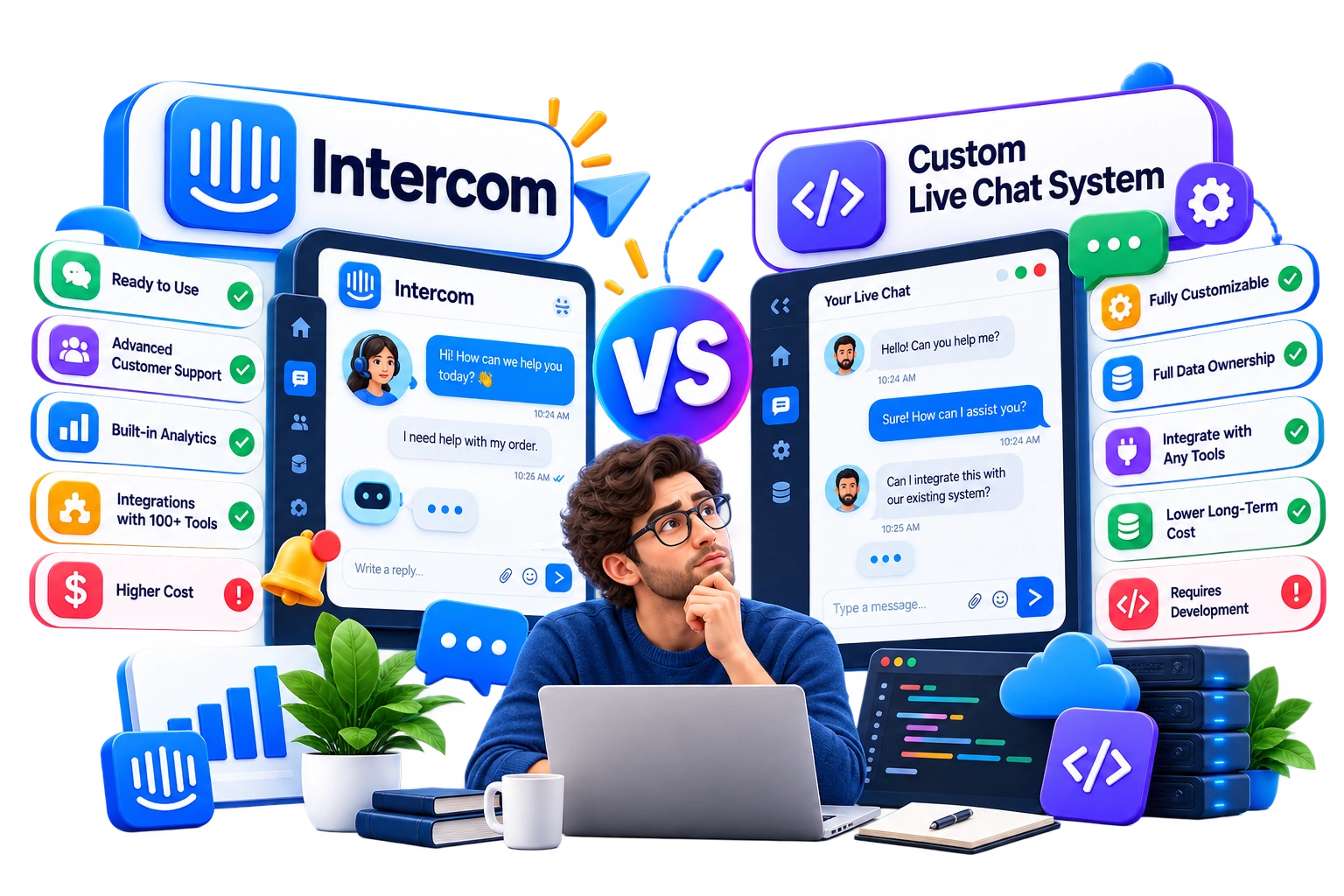
The decision between Intercom and a custom live chat system is a critical infrastructure choice for SaaS companies as they scale support and user engagement.
Intercom works well early on because it combines messaging, onboarding, and support in a single platform with minimal setup. But as products grow, teams often run into constraints and dependence on a vendor roadmap that doesn’t always match product needs.
Over time, what starts as a simple support layer can begin to influence how customer data is accessed, how conversations are structured, and how tightly chat integrates with the core product.
According to Gartner’s Tech Survey, 60% of software buyers regret at least one technology purchase within 12–18 months, usually due to mismatched capabilities, cost, or workflow fit. Live chat tools often fall into this category.
This is where the build vs. buy decision becomes important: continue scaling on Intercom or invest in a custom live chat system aligned with your architecture, data model, and long-term cost structure.
The right choice depends on scale, engineering bandwidth, integration depth, and ownership requirements.
To see where the limitations start to show up, we first need to understand what Intercom is actually built for.
What Is Intercom and How Does Its Live Chat Work?
Intercom is a customer messaging platform that combines live chat, in-app messaging software, AI-powered bots, and a full support ticketing system in one product. It sits between your application and your users, routing conversations to agents or automated flows while maintaining a complete user activity timeline.
Table of Contents
CTOs evaluating customer communication infrastructure should understand that scope before making any build-vs-buy live chat decision.
How Intercom’s Live Chat Actually Works
Intercom embeds a messenger widget into your web or mobile product. When a user opens it, they can start a conversation that routes to a support agent, triggers an automated bot flow, or both.
Behind the scenes, Intercom maintains a full history, user profile, and activity timeline. Your support team gets full context without needing to query your internal systems.
What It’s Built to Handle
Intercom is designed around three core workflows:
- customer support
- user onboarding
- proactive engagement
Support teams use it to manage inbound queries. Product teams use it to send targeted in-app messages based on user behavior. Growth teams use it to automate onboarding sequences. For companies running all three, having them in one platform reduces tool sprawl significantly.
Where It Goes Beyond Basic Live Chat
A basic live chat widget connects a user to an agent. Intercom goes further. It layers chatbot automation, user segmentation, and analytics on top of that connection. You can route conversations based on user attributes, trigger messages based on product events, and measure response times and satisfaction scores.
That depth is what justifies the price, at the right stage.
The benefits are real, but they come with tradeoffs that become harder to ignore as your product scales.
When Does Intercom Stop Being the Right Call?
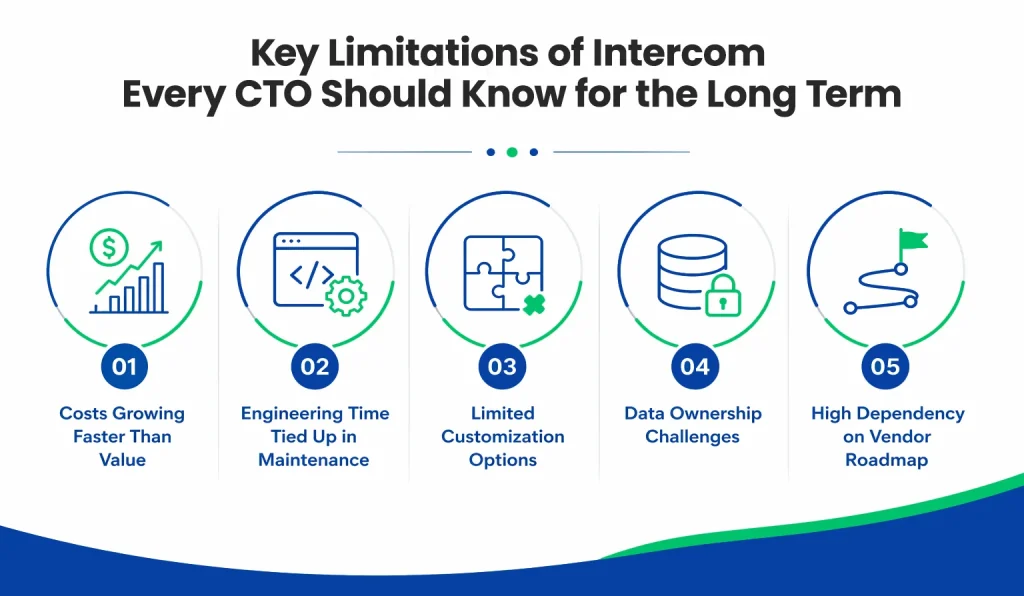
Intercom doesn’t fail overnight. It breaks down gradually. Workarounds start replacing core workflows. Integrations become harder to manage. Costs keep increasing with each renewal, until the platform no longer justifies what you’re paying.
These are the specific points where Intercom stops making sense.
When Cost Becomes Difficult to Justify
Intercom’s pricing scales with seats and feature tiers. At small team sizes, it’s manageable. As your support team grows and you start requiring advanced automation, custom bots, and SLA management, the cost compounds quickly. The issue is simple: cost grows faster than value.
When Your Chat Needs to Reflect Internal Data
Most product-led companies reach a point where chat needs to know things Intercom doesn’t. Current subscription status. Recent product activity. Open billing issues. Pulling that data into Intercom requires custom API work, and even then, it remains a workaround, not true integration. At that point, your engineers are maintaining glue code instead of building products.
When Customization Hits a Wall
Intercom gives you configuration options. You can adjust bot flows, tweak routing rules, and change the widget appearance. What you cannot do is change how the system fundamentally behaves. Custom conversation states, proprietary workflows, or chat experiences that need to mirror your product’s logic, none of that is possible within Intercom’s boundaries.
At this point, teams stop looking for Intercom workarounds and start evaluating what a real Intercom alternative would involve.
When Data Ownership Becomes a Business Requirement
As companies move upmarket, enterprise customers start asking challenging questions. Where does conversation data live? Who has access to it? How long is it retained? Intercom’s answers to those questions are fixed; you work within their data model, their retention policies, and their infrastructure. That becomes a deal blocker in regulated industries and enterprise sales cycles.
When Vendor Dependency Affects Your Roadmap
If Intercom’s roadmap doesn’t include a feature your product needs, you might have to wait. If their API changes, your integrations break. If their pricing model shifts, which it has, your budget forecast changes overnight. That level of dependency is acceptable early on. At scale, it becomes an operational risk.
These are the exact friction points CTOs report when they outgrow Intercom.
Still on Intercom but running into walls?
Partner with a team that has guided companies through this transition and can identify exactly where Intercom is holding you back.
The next step is seeing how the two options compare directly, across the dimensions that matter most.
Intercom vs. Custom Live Chat: Side-By-Side Comparison
At an early stage, Intercom’s advantages are obvious: quick setup, low upfront cost, and a support team that’s productive in days. What’s less obvious is how that equation shifts over time. A custom live chat system starts expensive and slow. But it compounds differently, with lower long-term costs, full data ownership, and no ceiling on what it can do.
The table below covers the dimensions that matter most at a growth or enterprise stage.
| Factor | Intercom | Custom Live Chat |
|---|---|---|
| Setup Time | Live in days with minimal engineering effort | 8–16 weeks depending on scope and team size |
| Upfront Cost | Low, subscriptions start at accessible tiers | High, design, development, and infrastructure investment upfront |
| Ongoing Cost | Scales with seats, features, and usage tiers | Primarily infrastructure and internal maintenance costs |
| Cost Predictability | Difficult to forecast at scale as pricing model can shift | Fully predictable, as you can control the cost structure |
| Customization | Limited to configuration within Intercom's boundaries | Full control, built entirely around your product logic |
| Data Ownership | Data lives on Intercom's infrastructure and retention policies | You own it entirely: your servers, your schema, your rules |
| Compliance Control | Fixed policies, limited flexibility for regulated industries | Full control: you define access, residency, and retention |
| Vendor Dependency | High, roadmap, pricing, and uptime tied to Intercom | None, as you have complete internal ownership |
| Maintenance Burden | Low, fully managed by Intercom | Requires dedicated engineering ownership and upkeep |
| Enterprise Readiness | Moderate, vendor policies create ceiling for enterprise deals | High, fully configurable to enterprise requirements |
The pattern is clear. Intercom wins on speed and simplicity. A custom system wins on control, ownership, and long-term cost structure. But before deciding which way to go, you need a realistic picture of what building actually costs.
What Does It Cost to Build a Custom Live Chat System?
The most common reason CTOs stay on Intercom longer than they should is a vague assumption that building is prohibitively expensive. It isn’t, but it does require a clear-eyed look at what you’re actually paying for and over what timeline.
A custom live chat system has three distinct cost layers: initial development, infrastructure, and ongoing maintenance.
Here’s what each looks like in practice.
Initial Development Cost
The build cost depends on scope. A production-grade live chat system , WebSocket connections, message persistence, an agent dashboard, and basic automation typically require 8–16 weeks of engineering time.
- Standard build: $20,000–$40,000
- Mid-complexity build (custom bot flows, automation): $40,000–$60,000
- High-complexity build (AI routing, multi-channel, enterprise-grade): $60,000–$100,000+
The variable that matters most here is not the technology. It’s how clearly the requirements are defined before development starts.
Infrastructure Cost
Once built, a custom live chat system runs on your own infrastructure. At a moderate scale, up to 10,000 concurrent users, monthly costs on AWS or GCP typically break down as follows:
- Compute and server costs: $100–$400/month
- Storage and message persistence: $50–$200/month
- Message delivery and WebSocket management: $50–$200/month
- Total monthly estimate: $200–$800/month
Compared to Intercom’s per-seat pricing at the same scale, the infrastructure cost is significantly lower. Keeping it there long-term, however, requires a clear cloud cost optimization strategy from day one.
Ongoing Maintenance Cost
This is the cost most teams underestimate. A custom system needs engineering ownership, bug fixes, security updates, feature additions, and infrastructure monitoring.
- Annual maintenance budget: 15–20% of initial build cost
- For a $40,000 build: $6,000–$8,000/year
- For a $60,000 build: $9,000–$12,000/year
That cost is manageable, but only if the system is architected correctly from day one.
When Does the Investment Pay Off?
A custom build costs more in year one. By year two or three, the math typically shifts. You’re no longer paying per seat, your infrastructure costs are stable, and you own the system outright. The break-even point for most teams at 50+ seats lands somewhere between 18 and 24 months.
Cost clarity is step one. Step two is knowing if a custom build is the right decision for where your product and team actually stand. These are the six signals that tell you.
6 Signals That Tell You Which Option Fits Your Stage
This is not a generic checklist. Each signal below reflects a real inflection point, the kind that shows up in engineering reviews, budget conversations, and product planning cycles. If three or more apply to your situation, the case for building is strong.
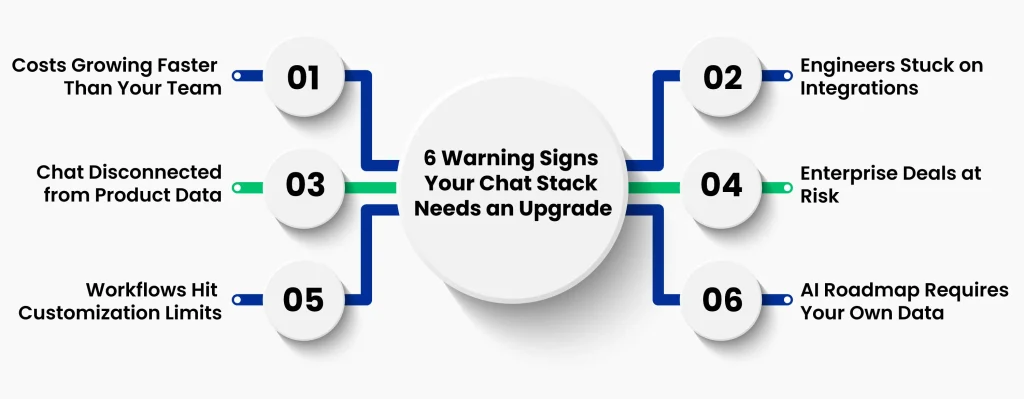
Signal 1: Your Intercom bill is growing faster than your team
Seat count is not the only cost driver anymore. Usage-based features, AI add-ons, and tier upgrades compound quickly. If your Intercom spend has increased significantly over the past two renewal cycles without a proportional increase in value, that’s a financial signal worth taking seriously.
Signal 2: Your engineers are maintaining Intercom integrations instead of building products.
Custom webhooks, API sync jobs, and workarounds to make Intercom talk to your internal systems, these are symptoms, not solutions. When integration maintenance becomes a recurring engineering cost, the tool is working against your team.
Signal 3: Chat needs to reflect real-time product data
If your support team constantly needs to cross-reference your internal systems during conversations, checking subscription status, usage history, and account data, your chat layer is disconnected from your product. A custom system eliminates that gap entirely.
Signal 4: You are losing enterprise deals over data ownership
Enterprise buyers ask challenging questions. Where does conversation data live? Who has access? What are the retention policies? If Intercom’s answers are blocking deals or extending sales cycles, data ownership has become a revenue problem.
Signal 5: Your chat workflows don’t map to Intercom’s logic
If your team is regularly working around Intercom’s bot builder, routing rules, or conversation states to approximate what you actually need, you’ve hit the customization ceiling. Configuration is not the same as control.
Signal 6: You are planning AI features built on your own data
If your product roadmap includes AI-powered chat routing, response suggestions, or conversation intelligence built on your user data and models, a third-party platform creates unnecessary friction. Owning the system means owning the data layer your AI agents and models run on.
Three or more signals hit home? That’s not a coincidence.
Tell us what you’re working with and we’ll give you a realistic picture of what a custom build would actually involve.
How to Choose the Right Development Partner for a Custom Live Chat Build?
A custom live chat system is only as effective as the team that builds it. The technology decisions made in the first two weeks, how messages are stored, how connections are managed, and how the system scales determine what you’re maintaining three years from now.
These are the qualities that separate the right partner from the wrong one.
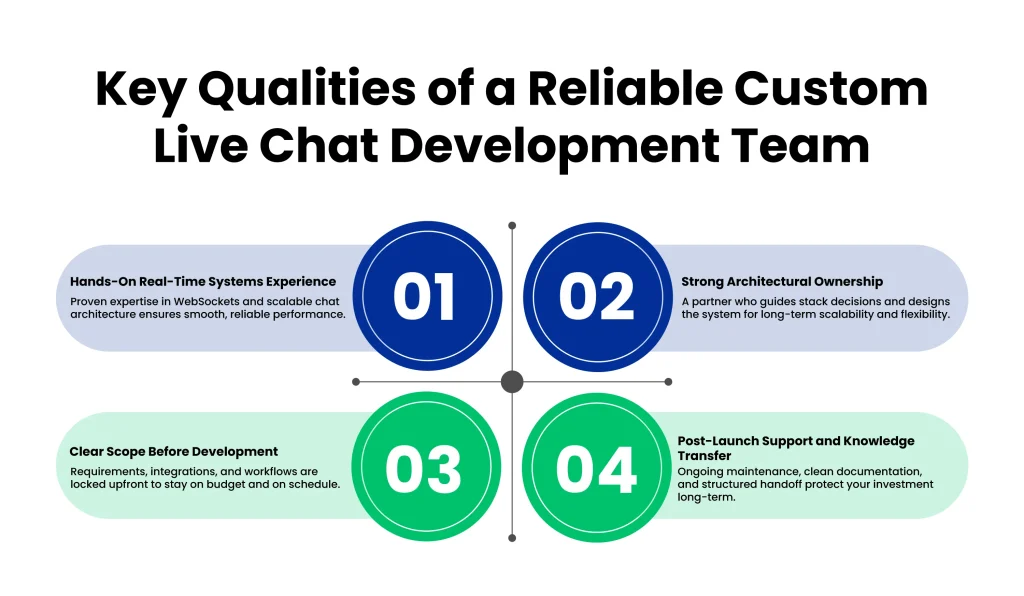
Real-Time Systems Experience
Live chat runs on WebSocket connections, not standard HTTP requests. A partner without hands-on experience in real-time systems will learn on your project. That learning has a cost in timeline, in rework, and in architectural decisions that are expensive to reverse.
Architectural Ownership
A partner who offers input before the first sprint is more valuable than one who waits to be told what to build. Which stack fits your scale? How to model conversation data. Where to build flexibility in and where to keep it simple. That judgment is what you’re paying for.
Defined Scope Before Development
Ambiguity is the most expensive part of any custom build. The right partner maps requirements, identifies integration touchpoints, and locks scope before writing a line of code. That upfront investment is what keeps the project on budget and on timeline.
Post-Launch Support Model
A custom system needs a clear owner after launch. The right partner builds with a handoff in mind, clean documentation, modular architecture, and knowledge transfer or offers a structured support engagement beyond delivery.
Clustox builds custom software for growth-stage and enterprise companies across fintech, healthtech, and SaaS. Our teams have direct experience in real-time communication infrastructure, and we treat architectural decisions as a core deliverable.
As a reliable software development partner, we bring the same judgment and ownership to every engagement. If you’re evaluating what a custom build would involve for your product, that’s a conversation worth having.
Build or Buy: Making the Call That Fits Your Stage
Intercom is not the wrong choice. It is the wrong choice for the wrong stage.
If your team is pre-scale, your workflows are standard, and engineering bandwidth is better spent elsewhere, Intercom is the right call. It is fast, reliable, and removes a real operational burden from your team.
But if your product has grown past those conditions, if costs are compounding, integrations are breaking, data ownership is blocking deals, or your chat layer is disconnected from your core product, the case for custom live chat development is clear. You get full control over what you build, how it scales, and what it costs over time.
The decision comes down to one honest question: is Intercom still working for your product, or is your team working around it?
If it’s the latter, that’s your answer.
Note: All cost figures in this blog are directional estimates. Actual numbers will vary based on your project scope, team structure, and infrastructure choices.
Frequently Asked Questions (FAQs)
2. How Long Does It Take to Build a Custom Live Chat System?
Typically 8–16 weeks depending on scope. A standard build sits at the lower end. AI routing, multi-channel support, and enterprise compliance push the timeline higher. Clear requirements before development starts is the single most important factor in keeping that timeline on track.
3. Can a Custom Live Chat System Integrate With Our Internal Tools?
Yes, and this is one of the primary reasons teams move away from Intercom. A custom system connects directly to your internal data model. That means real-time user data, subscription status, billing history, and product activity can surface inside every conversation. Intercom's native connectors cannot match that level of integration depth.
4. Does Building a Custom Live Chat System Require a Large Engineering Team?
No. A focused team of 2–3 engineers can deliver a production-grade system within the standard timeline. What matters more than team size is the right expertise, specifically, experience with real-time systems, WebSocket architecture, and scalable backend infrastructure.
5. What Tech Stack Is Used to Build a Custom Live Chat System?
The most common stack for production-grade custom live chat includes:
Real-time communication: WebSockets, Socket.io
Backend: Node.js, Python
Database: PostgreSQL, Redis for message queuing
Infrastructure: AWS or GCP
Frontend: React or Vue.js
The right stack depends on your existing infrastructure and scale requirements. These are the most widely used and well-supported options.
You’ve seen the trade-offs. Now your product deserves a chat system built around your logic and workflows.