

Early-stage startups often see migrating to microservices as the solution to all their problems (more often, it becomes a solution to a problem they discover later). …)
In pursuit of faster time-to-market, transitioning from a Rails monolith to microservices seems the right choice.
But what happens next is not alien.
Coordination between teams slows feature releases… deployment issues become frequent… operational overhead increases.
It’s nothing unique; many startups face the same dilemma. Especially teams building on Ruby, where rapid early web app development makes it easy to ship MVPs and iterate fast.
As a Ruby on Rails development company that has supported Fortune 500 companies and early-stage startups alike, we’ve seen this pattern repeat. And here’s our take:
The decision to move from a Rails monolith to microservices is often driven by release friction, team overlap, or concerns about scaling long before the monolith itself is the real bottleneck.
In this blog, we’ll help you decide if your startup is ready for the migration from a Rails monolith to microservices, when a monolith is still your fastest path to growth, and the strategies to transition safely when it’s the right time.
Table of Contents
Rails Monolith vs. Microservices in Ruby: Key Differences
The debate between a Rails monolith and microservices comes down to tradeoffs in speed, complexity, and team maturity. Both architectures can work in Ruby, but they solve very different problems at different stages of a startup’s journey.
For early-stage teams, the choice is rarely about scalability in theory. It’s about what helps you ship faster, debug easier, and grow without creating avoidable operational drag.
The table below highlights the real, practical differences between monolithic and microservice architectures in Ruby applications.
| Factor | Monolithic Architecture | Microservices Architecture |
|---|---|---|
| Application Structure | A single Ruby on Rails application with shared code, database, and deployments | Multiple independent services, often with separate databases and deployment pipelines |
| Development Speed | Faster early development due to shared context and fewer moving parts | Slower initial velocity due to service setup, contracts, and infrastructure |
| Team Size Fit | Works best for small teams and early-stage startups | Better suited for larger teams with clear ownership boundaries |
| Deployment Complexity | One deployment process, easier to manage and debug | Multiple deployments requiring orchestration and monitoring |
| Scalability Approach | Primarily vertical scaling with targeted optimizations | Horizontal scaling with independent service growth |
| Operational Overhead | Lower infrastructure and DevOps overhead | Higher overhead due to service communication, observability, and CI/CD |
| Failure Impact | Bugs can affect the whole app, but are easier to trace | Failures are isolated but harder to diagnose across services |
| Long-Term Maintainability | Easier to maintain early on with good Rails conventions | Requires strong discipline to avoid distributed complexity |
Why Is Rails Monolith the Best Choice for Early-Stage Startups?
Rails monolith not only provides speed and simplicity… It gives startups strategic advantages that matter most to CTOs and engineering leaders:
- Faster time to insight: Changes to one part of the system surface across the app immediately, making metrics, experiments, and optimizations visible in real time.
- Consistent business logic: Ensures all features adhere to the same rules, reducing hidden inconsistencies that hurt growth.
- Simpler scaling decisions: Performance barriers are easier to identify and target within a single architecture.
- Controlled technical debt: Centralized code ownership helps enforce patterns and maintain Rails code maintainability over time.
- Predictable release cadence: Teams can ship new functionality rapidly without coordinating multiple service dependencies.
Example
Monolithic architecture is far from outdated. Some of the world’s most successful companies scaled their businesses on it. One prime example is Basecamp…
One of the original Rails creators, Basecamp, has relied on a Rails monolith for over 20 years. Serving more than 100,000 paying customers, Basecamp runs Rails 7.x smoothly at scale, showing that even long-lived applications can maintain performance, reliability, and maintainable Rails code within a monolithic architecture.
9 Signs Your Rails Monolith Is Hitting Its Limits
As a CTO, you might notice your teams constantly coordinating around deployment conflicts or debugging cascading bugs in a single repository. These day-to-day friction points often trigger the thought:
“Maybe it’s time to rethink our architecture.”
Often, though, the issue is in the organizational processes, not the architecture.
Below are the red flags your monolithic Rails app may actually be holding you back:
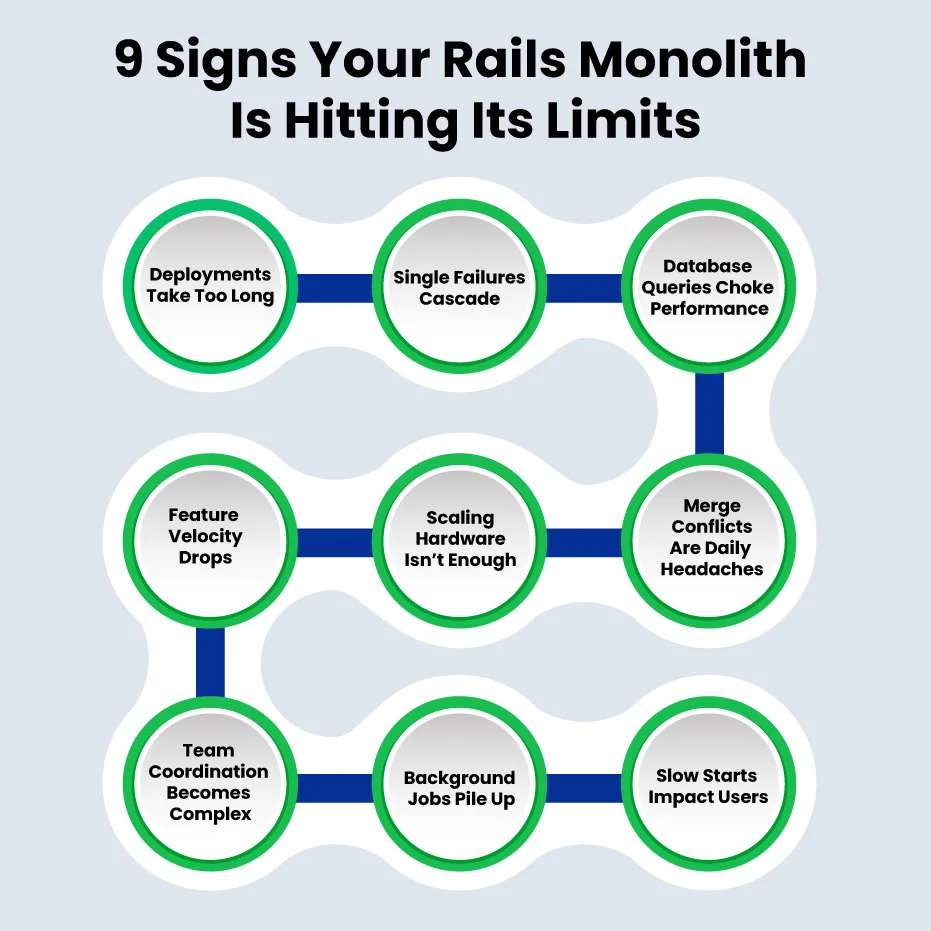
Sign #1: Deployments Take Too Long
Even small changes trigger full redeploys that stretch past 30 minutes. This slows feature delivery, creates obstacles in CI/CD pipelines, and frustrates teams waiting to release urgent fixes.
Sign #2: Single Failures Cascade
A bug in a single module can crash the entire application, resulting in downtime or broken functionality. This highlights the lack of isolation in monolithic Rails apps and increases the amount of firefighting developers have to do.
Sign #3: Database Queries Choke Performance
Repeated N+1 queries, heavy joins, or inefficient ActiveRecord calls slow critical workflows. Scaling servers vertically offers minimal relief, exposing the database as the primary source of contention.
Sign #4: Merge Conflicts Are Daily Headaches
Multiple developers working in the same codebase create constant conflicts. Resolving them consumes hours of engineering time, reducing the pace of new feature development.
Sign #5: Scaling Hardware Isn’t Enough
Adding more memory or CPU does little to solve performance issues. The monolith’s tightly coupled code can become a ceiling, limiting application responsiveness as user demand grows.
Sign #6: Feature Velocity Drops
As the codebase grows, shipping new features slows. Teams spend extra time coordinating changes across modules and writing workarounds, which can delay product iteration and time-to-market.
Sign #7: Team Coordination Becomes Complex
Once the development team grows beyond 10 engineers, managing tasks, testing, and deployments gets increasingly difficult. Without clear boundaries, communication overhead rises sharply.
Sign #8: Background Jobs Pile Up
Async jobs handled by Sidekiq or similar frameworks start queuing up. Delays in notifications, emails, or batch processing affect user experience and can mask deeper scaling issues.
Sign #9: Slow Starts Impact Users
Pages or API endpoints take 5+ seconds to respond. Users perceive the app as sluggish, even if the monolithic Rails backend is technically functional, highlighting performance limitations.
Why and When Should Startups Consider Moving from Rails Monolith to Microservices?
Some of the world’s biggest tech companies illustrate the extremes of this choice. Twitter, Uber, and Segment eventually moved back to monoliths after experimenting with microservices. Also, Netflix scaled fully into a microservices architecture to handle its global growth.
As startups expand into mobile app development, API-heavy workloads and concurrent user traffic often expose limits in tightly coupled Rails monoliths.
With the surge in continuous integration, AI-driven DevOps, and event-driven architectures, microservices adoption is booming. It’s projected to reach $15.97 billion by 2029 at a CAGR of 21%, according to Research and Markets.
Deciding about the migration from monolith to microservices architecture in Ruby on Rails isn’t a matter of hype (even though businesses often get into following trends):
The right move depends on:
- Team size
- Deployment complexity
- Product growth
- Performance demands
Below is a concise view of when a Rails monolith is still optimal versus when microservices start to make sense for a startup Rails architecture:
| Factors to Consider | Staying with Rails Monolith | Moving to Microservices |
|---|---|---|
| Feature Velocity | Quick iteration and a single codebase enable rapid MVP development. | Individual services can evolve independently once team size grows. |
| Operational Overhead | Simpler deployments, lower maintenance costs, and fewer integration points. | Adds complexity with service orchestration, CI/CD pipelines, and monitoring. |
| Team Coordination | Small teams (≤10 developers) avoid merge conflicts and overhead. | Larger, specialized teams benefit from isolated service ownership. |
| Scalability | Vertical scaling is sufficient for early-stage traffic and MVPs. | Horizontal scaling enables the independent growth of high-demand modules. |
| Fault Isolation | Bugs affect the entire app, but they are easier to debug in a single stack. | Services fail independently, reducing system-wide impact but increasing debugging complexity. |
| Tech Stack Flexibility | Limited to Ruby on Rails, but ensures consistent engineering practices. | Allows polyglot architecture (Go, Node, Python), useful for specialized performance needs. |
| Long-term Strategy | Ideal for startups testing product-market fit. | Makes sense when scaling to multi-team, enterprise-level growth. |
CTA
Stop Rails Bottlenecks From Slowing Your Launch
Pinpoint friction points in your monolithic Rails app that delay features and frustrate teams to optimize for speed, stability, and early-stage growth.
Get My Rails Health Audit
Questions Every Startup CTO Must Answer Before Making the Switch
Before committing to a migration, you need to ask the right questions. Luckily, we have curated the top 7 questions you can ask yourself before going all-in on microservices.
Question #1: Is the monolith actually the problem in our Rails app?
Question #2: Can we extract one bounded context profitably first?
Question #3: Does our team of 5–15 developers have the maturity to work on distributed systems?
Question #4: What are the realistic operational cost projections if we move?
Question #5: Can feature delivery afford to be 2x slower without impacting deadlines?
Question #6: Do clear service boundaries exist in our Rails codebase?
Question #7: What’s the 90-day rollback plan if the transition fails?
Strategies for Startups Considering a Transition from Rails Monolith to Microservices
When startups are evaluating a transition from a Rails monolith to microservices, the decision is rarely black-and-white.
The following strategies are designed to guide CTOs through the process, ensuring the move is necessary, deliberate, and aligned with both team capabilities and business outcomes.
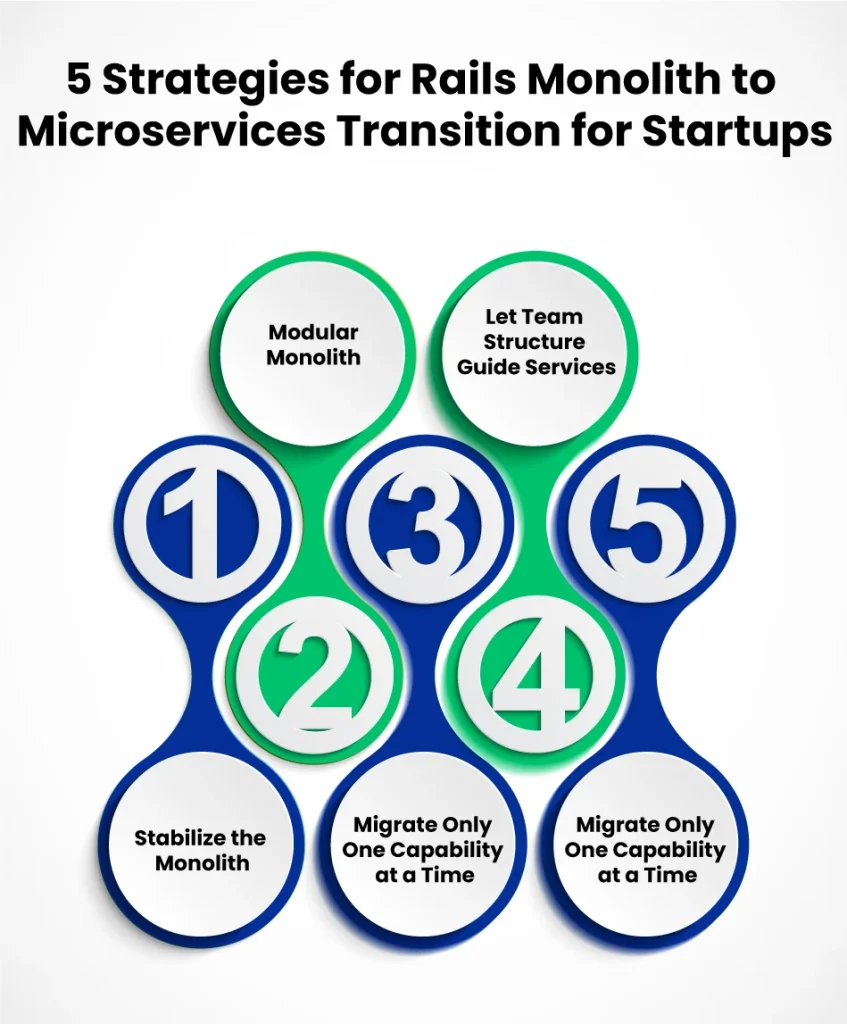
1. Stabilize the Monolith
Before considering a migration, ensure the existing Rails monolith isn’t the true bottleneck. Often, deployment issues, slow feature velocity, or scaling concerns can be solved by refactoring or optimizing the monolith rather than breaking it apart.
Example
GitHub still runs a monolithic Ruby on Rails web application at its core. Despite supporting over 100 million users, careful optimizations and modular code organization allow them to scale globally while maintaining high feature velocity.
2. Modular Monolith
Introduce clear boundaries within your monolithic architecture. A modular Rails monolith separates responsibilities into isolated modules without moving to distributed services. This helps identify which parts of the app truly require independence, reducing the risk of overengineering.
Example
Shopify’s massive Rails monolith with 2.8 million lines of Ruby remains modular. Components, such as payments, inventory, and checkout, are logically isolated. This enables teams to deploy features independently without splitting the entire application into microservices.
3. Migrate Only One Capability at a Time
If a service extraction is necessary, start with a single bounded context or feature. Extracting everything at once introduces operational overhead and slows feature delivery.
Example
A SaaS platform notices that its background job system for sending notifications was consistently queuing for hours. So, they decide to migrate only that job system to a dedicated microservice. This allows engineering teams to monitor real benefits such as reduced queue times and faster responses before committing to further extraction.
4. Let Team Structure Guide Services
Align microservices with your team’s operational reality. Small cross-functional teams can handle parts of the monolith effectively; splitting too aggressively can cause unnecessary coordination overhead.
Example
An early-stage Rails product reorganizes teams into product-aligned pods, each responsible for a core module. Only after teams are structured for autonomy can they extract the billing module into a microservice, minimizing communication friction and ensuring smooth deployments.
5. Move When Costs Are Measurable
Commit to microservices only when the benefits outweigh the operational and technical costs. Track metrics like deployment times, feature velocity, infrastructure costs, and overhead before migrating.
Example
A growing Rails platform observes that full redeploys for minor changes regularly exceeded 30 minutes, affecting feature delivery. By migrating only the heavy reporting engine to a microservice, they reduce deployment bottlenecks while keeping the rest of the Rails monolith intact.
How Clustox Helps Startups Move from Rails Monolith to Microservices (Without Wasting Time or Money)
When startups approach us, we often find the challenges are not always technical. Sometimes the strategy behind the transition is unclear, sometimes execution is rushed, and occasionally teams have already started a migration that creates more operational overhead than it solves. Understanding these nuances is critical before making the move from a Rails monolith to microservices.
With battle-tested expertise, our Ruby on Rails development services guide startups through the entire journey, from assessing your Rails app architecture to executing a precise Rails monolith migration strategy.
Here is how we help startups navigate this complex transition:
- Strategic Assessment: We analyze if moving from monolith to microservices in Rails is necessary or not. This includes reviewing Rails architecture decisions for growing startups, feature velocity, and operational costs to ensure any migration delivers real value.
- Modular Planning: Before breaking apart the codebase, we help structure a modular approach within the existing Ruby on Rails web app and technology stack. This allows teams to define clear boundaries and test changes without risking the full system.
- Incremental Migration: We focus on extracting one capability at a time. By isolating critical services, we reduce downtime, maintain Rails application performance, and ensure teams can continue delivering new features efficiently.
- Team Alignment: Our vetted experts align the Rails microservices architecture with the engineering team setup, using agile software development practices to align responsibilities, release cycles, and DevOps workflows with the new system.
- Performance and Maintainability: We monitor Rails code maintainability and Rails application optimization throughout the process. This ensures the new microservices structure scales reliably without introducing hidden technical debt.
- Scalable Growth Planning: We guide startups on horizontal scaling, integrating cloud-based Rails architecture, and optimizing DevOps pipelines. The goal is a system that can handle increased user volume and data while maintaining high engineering productivity.
Final Thoughts
Martin Fowler, widely regarded as the father of microservices himself, emphasizes that.
“You should build a new application as a monolith initially, even if you think it will benefit from a microservices architecture later on.”
He also warns that teams shouldn’t start with microservices unless they have reasonable experience building and managing distributed systems.
So your best option is to begin with a Rails monolith. But if you believe microservices are necessary for your startup’s growth, it’s wiser to work with a reliable software development company to plan and execute the transition safely.
Frequently Asked Questions (FAQs)
2. What Is The Difference Between Rails Monolith and Microservices?
A Rails monolith is a single codebase that integrates all features, enabling faster feature velocity and simpler scaling for early-stage startups. Microservices break the app into independent services, improving fault isolation and horizontal scalability but adding operational complexity. Choosing the right architecture depends on team size, growth, and performance demands.
3. When Should A Startup Consider Moving From a Rails Monolith To Microservices?
Startups should consider migration when feature velocity slows, deployment conflicts increase, or certain modules demand independent scaling. Signs include performance barriers, frequent merge conflicts, or growing operational costs. The move should align with the Rails app architecture for startups and the team's capabilities.
4. How Can Startups Optimize Their Rails Monolith Before Migrating?
Before moving to microservices, startups can implement a modular monolith, define clear service boundaries, and stabilize deployments. Incremental refactoring and performance improvements in the Rails application ensure the monolith scales efficiently while minimizing unnecessary migration risks.
Move from a Rails monolith to microservices strategically, keeping your code maintainable and your deployments reliable with expert Ruby app developers’ support.