

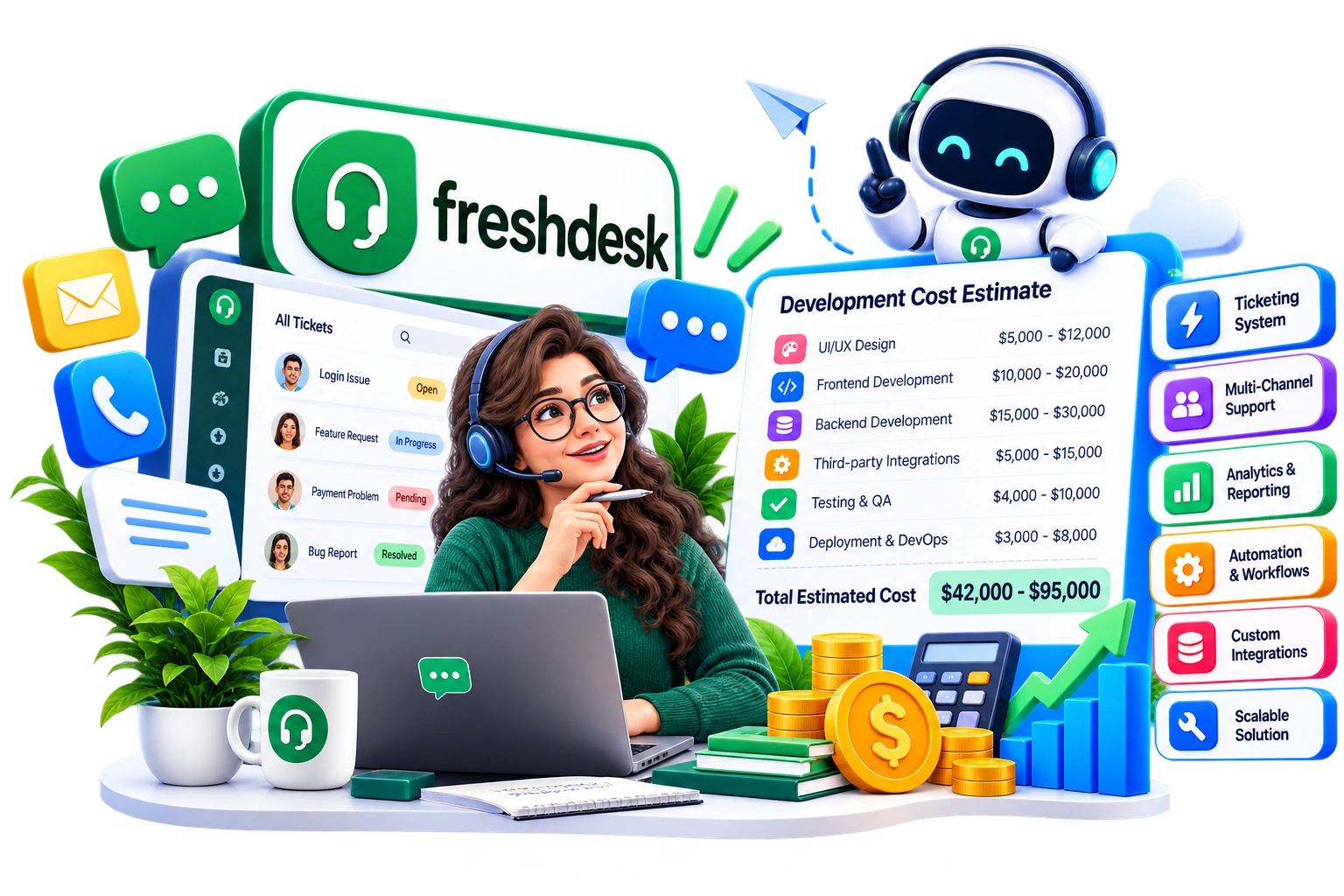
The invoice from the customer support platform that arrived last month, was it higher than the one before it?
For most growing companies, the answer is yes. And it’s not slowing down. In fact, 42% of organizations have already been forced to cut SaaS budgets, not out of preference, but because the costs outgrew the value.
That’s why founders and CTOs are now asking a question they wouldn’t have considered a couple of years ago: what if we built our own customer support platform?
Because the pattern is familiar. You start with a tool like Freshdesk; it’s quick to set up, affordable, and works well early on. But as your support team grows, so does the bill. Features you actually need sit behind higher tiers, AI comes as an added cost, and pricing no longer reflects what you signed up for.
At that point, the question shifts from “which plan should we choose?” to “should we be using this platform at all?”
Building a custom platform starts to look less like a stretch and more like a strategic move. You control the product, the roadmap, and the costs.
But it’s not a small decision. This blog breaks down what it really takes, costs, trade-offs, and how to decide if it’s the right move.
Why Are Companies Moving Away From Freshdesk?
Customer support platforms like Freshdesk have helped thousands of companies build and scale their support operations. They’re fast to deploy, easy to onboard, and solid for early-stage teams.
Table of Contents
But as companies grow, a pattern starts to emerge. The platform that felt like the right fit at 10 agents starts creating friction at 40. And that friction almost always shows up in the same places.
High Pricing
Most customer support platforms charge per agent per month. That model works at a small scale. But as your team grows, so does the bill, and not proportionally.
At 5 agents, that’s manageable. But for teams of 10 to 50 agents handling moderate complexity, real-world costs typically land between $100 and $150 per agent monthly once you factor in the features your team actually needs.
Advanced features, reporting tools, and integrations that your team genuinely needs are often gated behind higher tiers. What looked like an affordable monthly cost becomes a significant operational expense.
AI Features
AI has moved from a nice-to-have to a core requirement for most support teams. The challenge is that on most platforms, it comes at an additional cost per agent, with no option to buy selectively. If you have 35 agents and need AI capabilities for all of them, you’re looking at a meaningful jump in your monthly spend, regardless of how heavily each agent actually uses it.
Annual Renewals
This is where a lot of companies get caught off guard. Freshdesk, like most SaaS platforms, applies annual price increases at renewal. What you budgeted in year one looks different by year three. For finance and engineering leaders trying to forecast accurately, that kind of unpredictability makes long-term financial planning difficult.
Limited Flexibility
Off-the-shelf platforms are built for the average use case. If your support workflows are specific to your product, your industry, or your customer base, you will eventually run into a wall. You can configure around it, but every workaround adds complexity, and complexity adds cost.
When these four factors start stacking up at the same time, building a custom platform stops being a theoretical conversation and starts being a serious business decision.
For companies looking for a Freshdesk alternative that fits their exact workflows and scales without unpredictable costs, building custom is increasingly the answer. Which brings us to the first real question: what does a customer support platform actually need to do?
What Features Does a Customer Support Platform Actually Need?
Before you talk to a single developer or request a project estimate, you need to answer one question: what are you actually building?
Most cost overruns on custom software projects don’t happen because development is slow. They happen because the scope wasn’t defined clearly at the start. A customer support platform can mean a simple ticketing system, or it can mean a full omnichannel operation with AI routing, SLA enforcement, and CRM integration. The gap between those two things is significant, both in time and money.
Features fall into two tiers, and where you land determines everything about your cost and timeline.
Tier 1: Core Features (Your MVP)
These are the non-negotiables. Without them, you don’t have a support platform; you have an inbox.
| Feature | What It Does |
|---|---|
| Ticket Management | Creates, assigns, tracks, and resolves support requests from a central dashboard |
| Email Support Integration | Converts incoming emails into tickets automatically via SendGrid or similar |
| Knowledge Base | Self-service library of FAQs, guides, and articles that reduces inbound ticket volume |
| Basic Automation | Auto-assigns tickets by category, priority, or agent availability |
| Agent Dashboard | Single interface where agents manage all active tickets and customer history |
| Reporting & Analytics | Tracks response times, resolution rates, ticket volume, and agent performance |
This is your $40,000 to $80,000 build. It gets your team operational and your customers supported. The features are not fully complete, but it’s a real, functional platform.
Tier 2: Advanced Features (Full-Scale Platform)
These are the features that move you from functional to competitive. They’re also where the cost and complexity jump meaningfully.
| Feature | What It Does |
|---|---|
| Omnichannel Support | Unified inbox across email, live chat, social media, and phone |
| Live Chat Integration | Real-time customer conversations via WebSocket-based chat |
| Automated Ticket Routing | AI-driven assignment based on issue type, agent skill, and workload |
| SLA Management | Sets and enforces response and resolution time targets per ticket priority |
| CRM Integration | Connects support data with customer records via REST API |
| Custom Roles & Permissions | Controls what different agents and teams can see and do |
| Multi-language Support | Serves customers across regions without separate instances |
Adding these features moves your build into the $100,000 to $250,000+ range and extends your timeline from 3 months to 9 to 12.
The Decision that Matters Most
You don’t have to build everything at once. In fact, the companies that do almost always regret it.
The smarter approach is agile software development, launch with Tier 1, gather real usage data from your support team, and build Tier 2 features based on what actually creates friction. This keeps your initial investment controlled and your build focused on validated needs rather than assumptions.
The features you include will directly determine your cost. Which is exactly what we’ll break down next.
Not Sure What Belongs in Your MVP and What Can Wait?
If you want a structured scoping session with engineers who have built this before, we are ready to help.
The features you include will directly determine your cost. Which is exactly what we’ll break down next.
What Factors Determine the Cost of Building a Customer Support Platform?
Two companies can decide to build the same type of platform and end up with quotes that are $80,000 apart. The difference almost always comes down to scope.
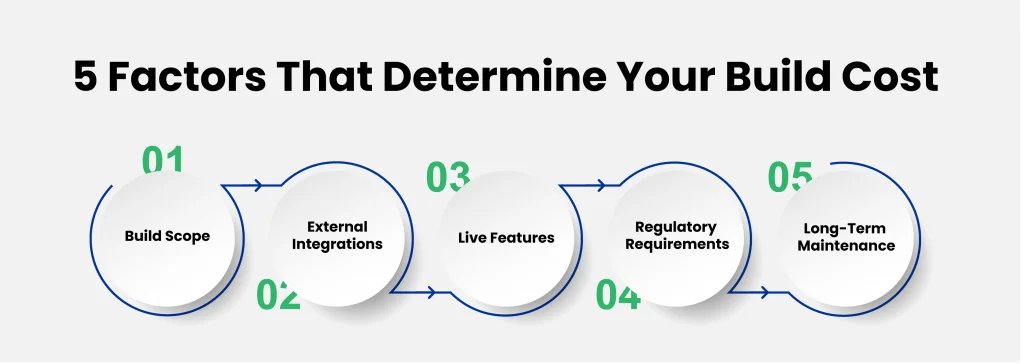
These are the factors that move the number most:
Feature Scope
This is the biggest cost driver by far. Every feature you add requires design, development, testing, and integration work. The wider your initial scope, the higher your cost and the longer your timeline.
Third-Party Integrations
Connecting your platform to external systems, CRM, billing, email delivery via SendGrid, and cloud infrastructure on AWS, GCP, or Azure adds development and QA time to your build. Each integration also carries maintenance costs after launch. And the cloud provider you choose will directly influence your infrastructure spend as you scale.
Real-Time Features
Live chat, instant notifications, and real-time ticket updates require WebSocket infrastructure and more complex backend architecture. If live chat is a day-one requirement, budget for it. If it can wait for version two, deferring it can meaningfully reduce your initial cost.
Compliance Requirements
If your platform handles sensitive customer data in regulated industries, HIPAA technical safeguards add a layer of development work: audit logging, data encryption, and access controls. Scope this accurately from the start. Adding compliance later always costs more.
Ongoing Maintenance
Plan for 15 to 20% of your initial build cost annually for maintenance, security patches, and updates. For a $100,000 platform, that’s $15,000 to $20,000 per year, a number that belongs in your total cost of ownership calculation from day one.
These factors are what separate a $50,000 build from a $200,000 one. With that context in place, here’s what the actual numbers look like.
How Much Does It Cost to Build a Customer Support Platform?
This is the section most people jump to first, and understandably so.
The honest answer is it depends on what you’re building. But “it depends” isn’t useful on its own. So here’s the actual breakdown, based on real development scope and current market rates.
Custom software development costs in 2026 typically range from $10,000 to $60,000 for simple MVPs, $30,000 to $100,000 for mid-range builds, and $80,000 to $250,000+ for enterprise-grade systems. A customer support platform sits across all three tiers depending on your feature scope.
Here’s how that maps to what you’re actually building:
MVP Build: $40,000 to $80,000
This gets you a functional platform your support team can use from day one. Ticketing system, email support, a basic knowledge base, agent dashboard, and simple automation rules.
- Timeline: 3 to 4 months
- Best for: Startups validating a custom build before committing to full-scale development
Mid-Scale Platform: $80,000 to $150,000
Adds live chat, SLA management, automated ticket routing, CRM integration via REST API, and expanded reporting. This is where most growth-stage companies land when replacing a SaaS tool they’ve outgrown.
- Timeline: 5 to 7 months
- Best for: Companies with 20 to 50 support agents who need a platform built around their specific workflows
Full-Scale Platform: $150,000 to $250,000+
This tier covers omnichannel support, advanced AI routing, and multi-language capabilities. It includes deep CRM integrations, custom UI/UX design for dashboards and agent interfaces, and full compliance with GDPR or HIPAA requirements.
- Timeline: 9 to 12 months
- Best for: Scaling companies building support as a core product capability and not just an operational function
At a Glance
For a clearer picture of where each build type lands, take a look at the breakdown below.
| Build Type | Cost Range | Timeline |
|---|---|---|
| MVP | $40,000 — $80,000 | 3 — 4 months |
| Mid-Scale | $80,000 — $150,000 | 5 — 7 months |
| Full-Scale | $150,000 — $250,000+ | 9 — 12 months |
At 30 agents, a mid-tier SaaS plan costs between $36,000 and $54,000 per year. A custom platform at that scale pays for itself in 2 to 3 years. Every year after that is money back in your budget.
That’s the business case in one paragraph.
What Does the Tech Stack Look Like?
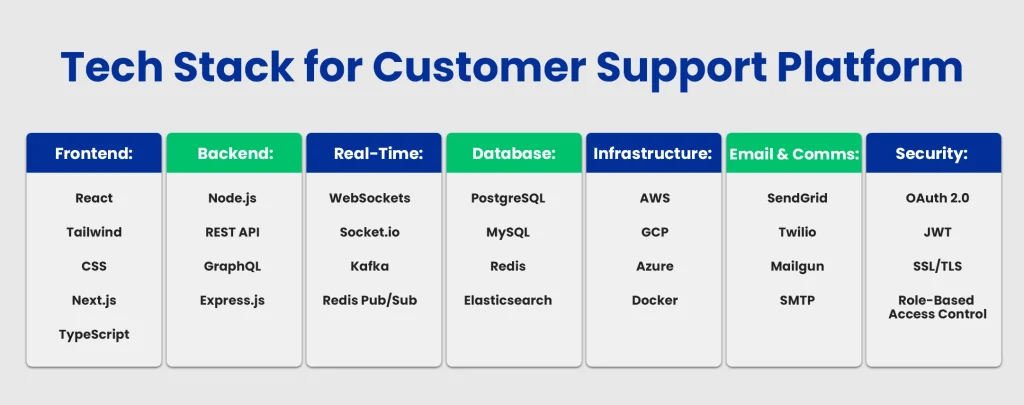
Every tool in your tech stack is a decision, and each one affects how your platform performs, scales, and integrates.
The stack below reflects what a customer support platform looks like when it’s built to handle real workloads, grow with your team, and stay maintainable over time.
If you are still weighing Node.js vs. React for your stack, that is a decision worth getting right before development begins.
Here’s how the full stack breaks down:
How Long Does It Take to Build a Customer Support Platform?
Timeline is where a lot of projects go wrong, not because development is slow, but because the scope wasn’t locked before the build started.
Based on the real development scope, from discovery through to deployment, each phase of the DevOps lifecycle plays a role in keeping your build on track:
| Build Type | Discovery | Development | Testing & QA | Total |
|---|---|---|---|---|
| MVP | 2 — 3 weeks | 6 — 8 weeks | 2 weeks | 3 — 4 months |
| Mid-Scale | 3 — 4 weeks | 12 — 16 weeks | 3 — 4 weeks | 5 — 7 months |
| Full-Scale | 4 — 6 weeks | 20 — 24 weeks | 6 — 8 weeks | 9 — 12 months |
Before committing to a build, you need three things in place: a clear feature scope, a realistic timeline, and a development partner with the right experience. When those three align, the numbers above stop being estimates and start being a plan.
Every Month of Unnecessary Delay Costs More Than Just Time.
Tell us what you are building and our team will give you a realistic timeline and cost estimate specific to your platform.
Build vs. Buy: When Does Custom Software Make Sense?
This is the question the entire guide has been building toward, and it deserves a straight answer.
Both options work. The difference is in where you are as a company and what you need from your customer support platform going forward.
When Buying Makes Sense
If you are early stage, your support volume is low, and your workflows are straightforward, a ready-made customer support platform is the right call. Tools like Freshdesk and Zendesk get you up and running fast, require no upfront development investment, and handle the basics well. For companies at this stage, building is overkill.
When Building Makes Sense
The case for building gets stronger as your company grows. If several of the following apply to your situation, a custom customer support platform deserves serious consideration:
- Your customer support platform costs are increasing every year, and the pricing is hard to predict.
- Your support workflows are specific enough that you are constantly working around the tool.
- You have 20 or more agents, and the per-seat cost is becoming a significant expense.
- You need integrations that your current customer support platform does not support cleanly.
- Support is central to your product experience, and you need full control over how it works.
What Does Building Actually Give You?
When you build, you own everything. The features, the data, the roadmap, and the cost structure. There are no annual price increases, no feature gates, and no dependency on a vendor’s product decisions.
The upfront cost is higher. But over time, a custom customer support platform built around your workflows will cost less, perform better, and scale with your business in a way that Freshdesk or Zendesk simply cannot match at scale.
Companies that choose to build customer service software from scratch almost always do so because the off-the-shelf option stopped scaling with them, and they needed something built around how their team actually works
Why Is Clustox the Right Partner to Build a Customer Support Platform?
Deciding to build is the first step. Who builds it determines everything else.
Clustox works with funded startups, growth-stage SaaS companies, and enterprises on custom software development, from early MVP development to full-scale platforms. We have done this before, and we know where projects go wrong before they do.
Here is what working with Clustox actually looks like:
- Discovery and Scoping
Before any development begins, we define exactly what you are building, what it will cost, and how long it will take.
- Full-Stack Development
Our frontend development team builds clean, responsive interfaces in React. Our backend development team handles architecture in Node.js, API integrations, and cloud infrastructure, every layer of the build, end-to-end.
- Testing and QA
Our QA and software testing process puts every feature through real use cases before it ships. We don’t hand over a platform and hope it works.
- Deployment and Integration
Clustox manages the full deployment process and makes sure your platform connects cleanly with the systems your team already uses.
- Post-Launch Support
Once your platform is live, we stay involved. Security updates, bug fixes, and new features are handled without you having to start the conversation from scratch each time.
With the right development partner, building a custom customer support platform becomes a clear, manageable process from the first scoping call to the day your team goes live.
The Bottom Line
When you step back and look at the full picture, the decision becomes clearer than it first appears.
The cost to build a customer support platform is real. So is the return.
A well-scoped MVP gets your team operational in 3 to 4 months. A full-scale platform built around your workflows pays for itself within 2 to 3 years. And every year after that, you are spending on infrastructure, not on someone else’s pricing model.
The companies that get this right are not the ones with the biggest budgets. They are the ones that defined their scope clearly, chose the right partner, and built with the long term in mind from day one.
If that is where you are headed, the next step is straightforward: understand exactly what your build would look like before you commit to anything. That starts with reliable custom software development services and a team that has done this before.
Frequently Asked Questions (FAQs)
2. Can You Build a Customer Support Platform With a Limited Budget?
Yes, and the smartest way to do it is to start with a focused MVP. Build only what your team genuinely needs on day one. A well-scoped MVP can cost as little as $40,000 and give you a fully functional platform to start with. From there, you add features one phase at a time based on what your team actually needs, not what you assumed they would need before launch.
3. Should You Build a Customer Support Platform In-House or Hire an External Development Partner?
An in-house team gives you full control but comes with hiring costs, onboarding time, and long-term salary commitments. An external development partner gives you an experienced team, faster delivery, and lower overhead. For most startups and growth-stage companies, an external partner is the more cost-efficient and lower-risk option.
4. Can I Integrate AI into a Custom Customer Support Platform?
Yes, and it is one of the strongest arguments for building custom. With a custom platform, you can integrate AI features specific to your product and customer base, automated ticket routing, AI-assisted responses, sentiment analysis, and predictive escalation. On most SaaS platforms, AI is an add-on you pay extra for. With a custom build, you design it into the platform from the start.
5. What Features Does a Customer Support Platform Need?
At a minimum, a customer support platform needs ticket management, email support integration, a knowledge base, basic automation, an agent dashboard, and reporting. Advanced features like omnichannel support, live chat, automated ticket routing, and SLA management are added in later phases as the platform scales.
The decision is clearer than it looks when you have the right people helping you think it through.
Our team at Clustox works with founders and CTOs to turn a complex build decision into a clear, actionable plan.