

AI agent development costs typically range from $15k to $500k+, depending on the agent’s complexity, scope, data pipelines, integration needs, and scale.
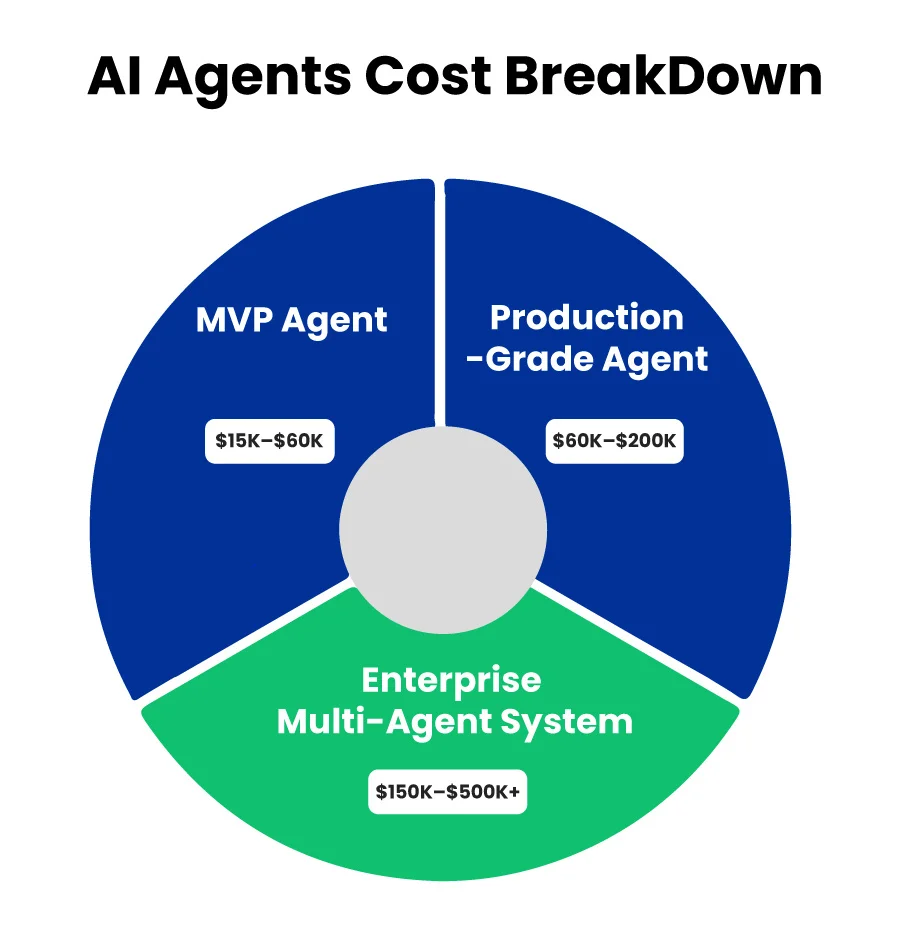
Simple MVPs with off-the-shelf LLMs, basic tools, and minimal custom work can start around $15k–$60k; production single-agent setups with orchestration, security, and observability cost $60k–$200k; and enterprise multi-agent setups with compliance, fine-tuning, and high-scale infrastructure cost $150k–$500k. On top of that, ongoing costs of $1k–$15k per month cover cloud infra, APIs, and monitoring.
After building custom AI agents for startups, SMEs, and enterprises, we have seen a pattern.
Most organizations underestimate the total cost of ownership (TCO). It is rarely the upfront development cost that surprises CTOs. It is the ongoing maintenance, operations, infrastructure, and hidden gotchas that catch them off guard.
Deloitte’s Emerging Technology Trends study confirms it. Only 11% of organizations have AI agents in production.
Where is the rest of the 89%? They often get tangled in costs they didn’t anticipate.
In this guide, we will look at:
- How much does custom AI agent development cost in 2026
- Core cost components of AI agent development
- How AI agent architecture affects total development cost
- Factors that drive up the cost of AI agents
- Deciding between Build vs. Buy AI agents
- Hidden costs CTOs frequently overlook
If you are a CTO trying to justify AI investment without underestimating long-term costs, this guide will help you make a grounded decision.
Table of Contents
What Is a Custom AI Agent?
A custom artificial intelligence (AI) agent is a generative AI-powered system designed for a specific purpose that can understand context, interact with internal systems, and autonomously execute multi-step operations to achieve defined business goals.
Take Netflix’s personalized recommendation system or Spotify’s customized playlists, for instance. These systems are built around a clear use case and trained on proprietary data to continuously improve performance.
How Is a Custom AI Agent Different from ChatGPT or SaaS AI Tools?
Most SaaS AI tools and chatbot platforms are designed for broad use. They respond to prompts, summarize documents, generate text, and even draft workflows. That’s helpful at the surface level, but they stop where execution begins.
A custom AI agent is built to operate inside your environment. It connects to your systems, follows your business logic, and executes actions instead of just suggesting them.
Here’s how both differ:
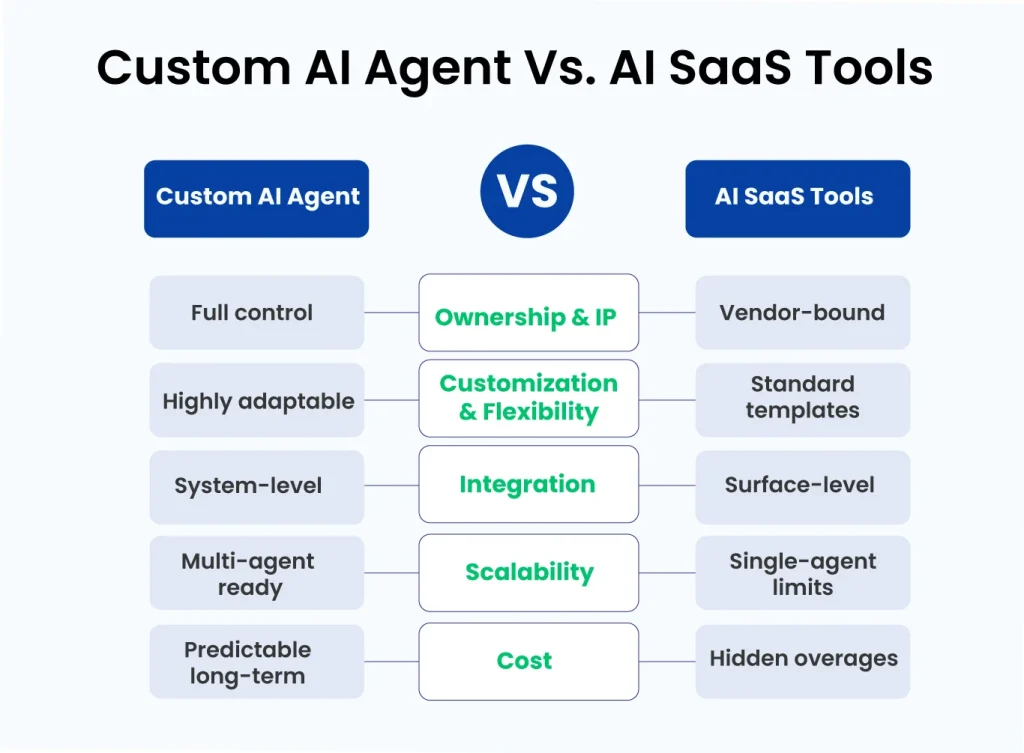
Ownership and Intellectual Property
When you build on a SaaS AI platform, a lot of your logic lives inside its framework. Your prompts, refinements, and orchestration flows are technically yours. But they are still bound by vendor constraints.
With a custom build, you control deployment, model updates, retraining cycles, and data residency decisions.
One pattern we’ve seen across enterprise deployments is hesitation around scaling when ownership is unclear. The moment teams regain control over decision pipelines, iteration speeds up.
Customization and Flexibility
Standardized platforms work well when workflows are standardized. Most enterprise workflows are not.
Exception handling, override hierarchies, internal approval paths, and compliance triggers are highly complex and rarely fit into prebuilt automation templates.
If your operations require dynamic reprioritization based on live signals from multiple systems, you need more than prompt tuning. You need logic that blends LLM reasoning, retrieval layers, and definitive rules that reflect how your business operates.
Integration with Internal Systems
When data sits across multiple services, partial automation often creates a different kind of friction. Instead of eliminating manual work, it shifts validation and exception handling back to your team.
A domain-aligned agent integrates at the system level. It pulls structured data, triggers actions, logs decisions, and feeds updates back into your stack.
Scalability for Large Operations
Scale introduces concurrency spikes, increased monitoring requirements, orchestration challenges, and failure recovery logic that were not visible during the proof-of-concept stage.
If multiple workflows depend on AI-driven decisions, single-agent setups can become problematic. Distributing responsibilities across coordinated agents, with proper observability and failover, becomes less of an optimization and more of a necessity.
Long-Term Cost Considerations
Subscription pricing looks predictable in the early stages. The shift happens once the system starts touching core workflows.
As integrations deepen and usage expands, retrieval layers grow, monitoring becomes mandatory, and retraining cycles require governance. See how what started as an isolated automation experiment slowly turns into infrastructure that needs scrutiny.
It doesn’t matter if you build AI agents internally, adopt an AI agent platform, or hire AI agent development experts; each path affects your long-term economics.
What Makes an AI Agent “Production-Ready” in 2026?
Not every AI agent that works in a sandbox is ready for real-world operations. Production-readiness is about resilience, observability, and alignment with your business realities.
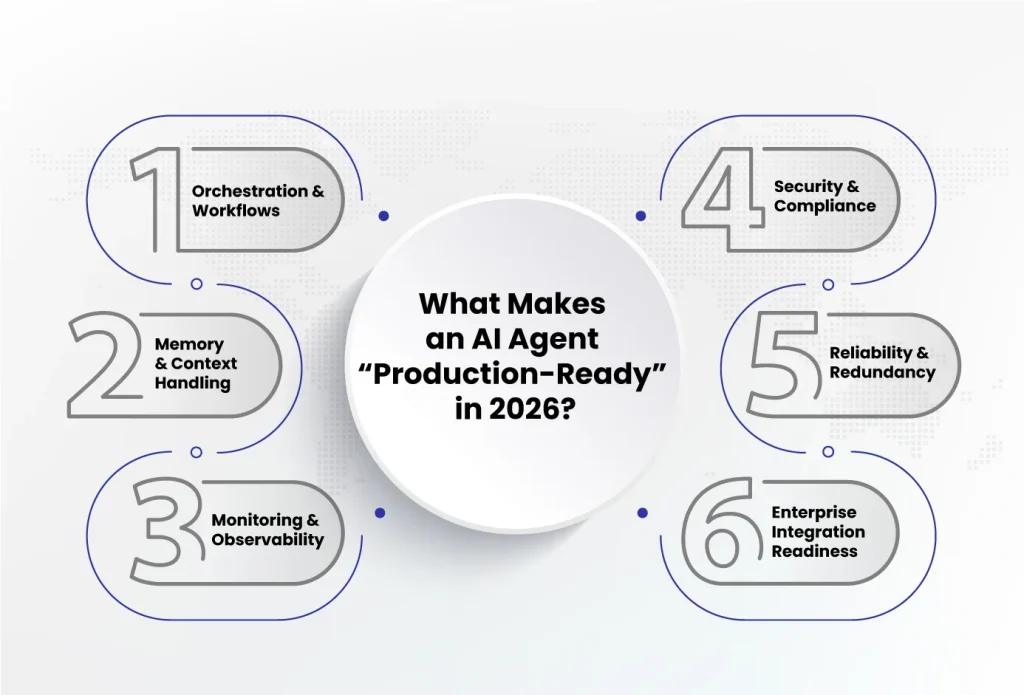
By “production-ready,” we mean an AI agent that reliably handles workflows, retains context across sessions, integrates readily with your systems, and meets operational and compliance standards. These are the attributes that influence your AI agent cost, deployment, and ultimately your ROI.
Orchestration and Workflows
A production-ready agent coordinates multiple tasks across tools. It doesn’t just respond to one prompt at a time; it follows complex workflows and ensures dependencies are respected.
Think of an insurance claims process. A reactive agent might flag missing forms, whereas a production-ready AI agent automatically pulls data from multiple internal systems, triggers notifications, updates the claim status, and ensures no step is skipped.
Memory and Context Handling
Imagine a customer service system tracking a multi-step onboarding. Without context, the agent repeats questions or misses critical steps. But with proper memory and context handling, the agent anticipates needs, reduces errors, and lowers human intervention.
You can see why context is critical. A simple AI assistant forgets everything once a session ends. A production-grade AI agent remembers previous interactions, stores relevant data in memory layers, and applies that context to future decisions.
Monitoring and Observability
A production system needs visibility. Without it, small errors can cascade into operational disruptions. Monitoring goes far beyond just uptime. It includes tracking model outputs, latency, and system dependencies.
That’s why we always recommend our clients integrate DevOps and monitoring into their pipelines from day one. Skipping this often results in higher AI agent maintenance costs and delayed issue resolution.
Security and Compliance
Industrial-level AI agents touch sensitive data, which means security and compliance should be baked in from the start. It’s not enough to rely on platform defaults. You need encryption, access controls, and audit trails aligned with internal policies and external regulations.
If you’re dealing in the finance sector, every transaction triggers regulatory reporting. Missing a compliance hook will be costly and catastrophic.
Pro Tip: Ensure regulatory alignment is built into the agent architecture to reduce AI agent hidden costs later.
Reliability and Redundancy
Failures happen. A production-ready agent anticipates them. It can retry tasks, switch to fallback processes, and maintain uptime without human intervention.
In eCommerce stores, a single-agent outage could delay refunds for thousands of customers. Multiple agents, backup processes, and automated error handling mitigate risk and protect your AI agent investment.
Enterprise Integration Readiness
Finally, a production-ready AI agent is built to connect. It will integrate across platforms readily, from ERP to CRM, internal databases to external APIs.
A SaaS AI tool may never access the workflows or databases critical for operational decisions. A production-ready agent becomes part of your infrastructure, driving real efficiency and measurable ROI.
Note: Misjudging the integration scope is one of the largest drivers of AI agent deployment delays and cost overruns. Mapping integration points early is highly advisable.
How Much Does It Cost to Build a Custom AI Agent in 2026?
When CTOs are estimating AI agent development costs, the first variables they usually look at are predictable:
- Team size and hourly rates
- Model choice, such as GPT-4 vs an open-source LLM
- Initial build scope and timeline
- Expected user volume
The above variables matter, but they don’t drive the outcome as much as you think.
After building agentic systems for startups, SMBs, and enterprises, we’ve seen that in 2026, the cost to build AI agents is typically determined by five variables:
- How deeply the agent integrates into operational systems
- How much architectural responsibility it carries in decision loops
- Size of your compliance surface area
- Expected concurrency and reliability under load
- Internal readiness to own monitoring, retraining, and governance
Notice what’s missing? Model selection is rarely the primary cost driver.
Let’s break this down across three practical types of AI agents.
1. MVP AI Agent Cost
An MVP agent is designed to test a specific business hypothesis with minimal architectural commitment. Most use production-ready foundation models such as GPT-4o or Claude, structured prompts, and light retrieval over internal knowledge.
You are validating impact, not redesigning infrastructure.
It Includes
- Reactive agents (simple reflex)
- Model-based agents (basic state tracking)
Who Is This For?
- CTOs evaluating build vs. buy decisions
- teams testing operational savings before committing capital
- organizations piloting contained automation without touching core systems
Who This Isn’t For
- High-concurrency systems
- Environments handling sensitive data like PHI
- Mission-critical operational pipelines with high error cost
Reason:
Because MVP AI agents are lightweight, often rely on pre-trained models with minimal customization, and lack hardened monitoring or failover mechanisms.
Note: In several early-stage builds, we’ve seen data normalization consume more effort than agent logic itself. The friction isn’t “AI complexity” but an inconsistent internal system.
Production-Grade AI Agent Cost
This agent type moves beyond validation. The agent becomes part of a live workflow that impacts revenue, compliance, or customer experience.
You’ll typically see deeper planning logic, tool orchestration, and structured execution embedded into core operations. At this stage, conversations shift from prompt tuning to reliability engineering.
It Includes
- Goal-based agents (planning/multi-step)
- Autonomous agents (tool calling + execution)
Who Is This For?
- Claims, underwriting, fulfillment, or billing workflows
- Teams replacing manual validation loops
- Organizations expecting measurable operational savings
Who This Isn’t For
- Full cross-department orchestration without clear ownership
- Fully autonomous decision-making touching multiple business units
- Extremely distributed operations requiring agent swarms from day one
Reason:
Because production-grade agents handle real workflows reliably and safely, but they’re scoped to specific functions. They can scale within defined boundaries but aren’t yet designed for enterprise-wide autonomy across loosely coupled systems.
Enterprise Multi-Agent System Cost
At enterprise scale, isolated agents create coordination risk. Departments depend on each other’s automation. That’s where structured multi-agent systems enter the picture. Now you’re not deploying a tool. You’re defining operating logic.
It Includes
- Learning agents (fine-tuning/adaptation)
- Cognitive agents (utility-based reasoning)
- Multi/hierarchical systems (agent swarms)
Who Is This For?
- Enterprises automating across departments
- Organizations under HIPAA, SOC 2, or similar mandates
- Leadership teams pursuing measurable ROI across functions
Who This Isn’t For
- Early-stage startups without internal AI governance
- Teams lacking operational maturity for multi-agent systems
- Organizations without structured data pipelines or compliance frameworks
Reason:
Because multi-agent systems demand coordination, governance, and operational readiness. The barrier isn’t cost alone but the complexity of ownership, regulatory exposure, and long-term management capacity.
AI Agents Cost Comparison Table
| Agent Type | Cost Range | Timeline | Monthly On-goings | Best Fit For | Core Deliverables |
|---|---|---|---|---|---|
| MVP Agent | $15K–$60K | 4–8 weeks | $1K–$3K | Validating a narrow workflow with controlled risk | Reactive or model-based logic with basic API integration |
| Production Agent | $60K–$200K | 8–16 weeks | $2K–$8K | Revenue-linked or compliance-aware workflows | Goal-based/autonomous execution with persistent memory and orchestration |
| Multi-Agent System | $150K–$500K+ | 16–32+ weeks | $8K–$25K+ | Enterprise-wide automation across systems | Learning/cognitive frameworks with multi-agent coordination and governance |
What Are the Core Cost Components of Custom AI Agent Development?
See, AI agent pricing is an aggregation of architectural decisions. Every technical decision you make, around orchestration, memory design, compliance standards, or infrastructure strategy, carries operational responsibility. That responsibility is what increases AI implementation cost.
Below are the eight primary cost drivers behind custom AI agent development.
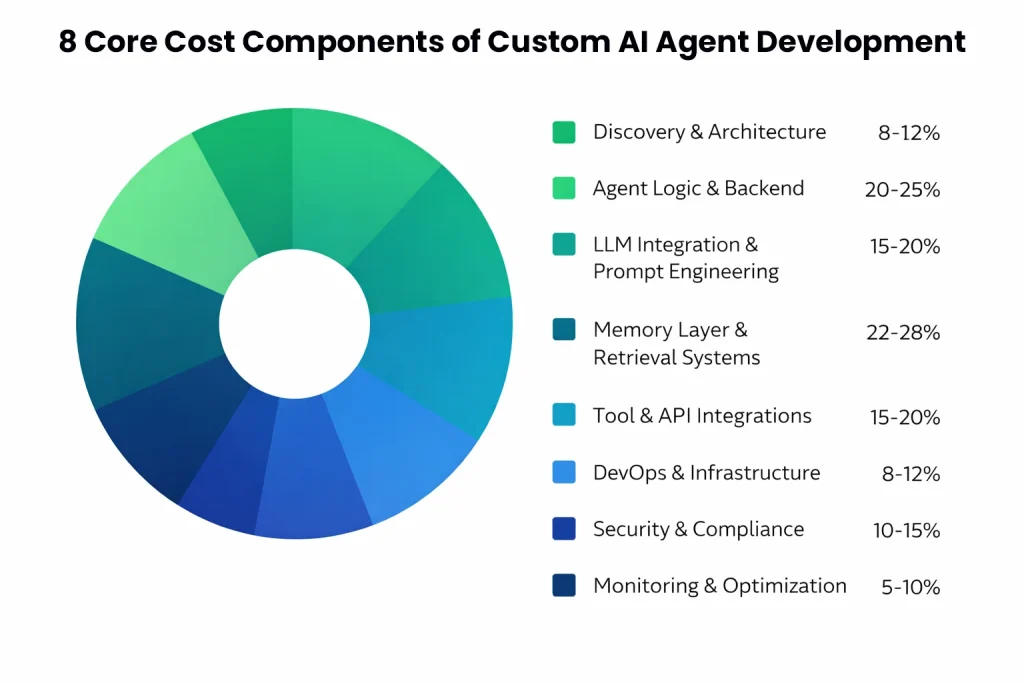
1. Discovery and Architecture
Discovery and architecture define the system blueprint. Together, they set use case boundaries, decision loops, workflow orchestration depth, and integration scope. When this foundation lacks clarity, rework later can inflate total AI adoption costs by up to 20-40%.
2. Agent Logic and Backend
At the core sits the reasoning engine, where business rules, domain-specific logic, and execution controls are encoded inside the AI agent. Greater autonomy and decision authority translate directly into more engineering hours and deeper validation cycles.
3. LLM Integration and Prompt Engineering
The intelligence interface determines how the LLM-powered AI agent interprets instructions and produces reliable outputs. Poor integration leads to token waste, unstable responses, and unpredictable AI infrastructure costs over time.
4. Memory Layer and Retrieval Systems
Persistent context and RAG-based retrieval live here, enabling model-based agent behavior beyond single prompts. Weak indexing or fragmented internal data often becomes a major hidden contributor to the cost of integrating AI agents.
5. Tool and API Integrations
Execution depends on stable connections to CRM, ERP, internal APIs, and workflow systems. In real-world environments, legacy architecture and inconsistent schemas are common causes of AI agent pricing overruns.
6. DevOps and Infrastructure
Deployment model, scalability thresholds, and concurrency tolerance are defined at this level. Misjudging infrastructure requirements usually results in escalating cloud spend as usage expands.
7. Security and Compliance
Access control, encryption, audit logging, and regulatory constraints shape how far the system can safely operate. In regulated sectors, this directly amplifies the cost of enterprise-level AI implementation.
8. Monitoring and Optimization
Observability, retraining cycles, drift detection, and continuous tuning sustain long-term performance. Without disciplined monitoring, AI ROI erodes quietly through downtime, degraded accuracy, and growing maintenance overhead.
What Are the Core Architecture Layers of a Custom AI Agent?
AI agent architecture is the operating structure behind the intelligence. It defines how the system reasons, takes action, stores context, and stays reliable under real-world pressure.
By understanding these layers, you can anticipate operational effort, scalability limits, and the real drivers behind long-term build cost and ownership complexity.
The table below outlines the core layers along with their impact on the development process of AI agents:
| Layer | What It Does | Why It Matters | Impact on AI Agent Development Cost |
|---|---|---|---|
| LLM Layer | Interprets instructions and generates responses | Drives reasoning quality and decision reliability | Model choice, fine-tuning, and usage volume affect infrastructure and iteration cost |
| Tool Integrations | Connects to APIs, databases, and internal systems | Enables real execution instead of surface-level responses | Complex or unstable integrations increase engineering time and maintenance overhead |
| Memory Layer / Vector DB | Stores context and retrieves relevant data | Supports multi-step reasoning and continuity | Poor retrieval design raises compute usage and ongoing optimization cost |
| Orchestrator | Coordinates workflows and task sequencing | Keeps automation stable under scale and concurrency | Inefficient design expands testing scope and scaling complexity |
| Infrastructure | Manages deployment, scalability, and failover | Controls reliability, latency, and uptime | Misjudged capacity planning leads to escalating cloud spend |
| Monitoring Layer | Tracks performance, errors, and system health | Prevents silent failures and model drift | Weak observability increases long-term maintenance and recovery costs |
Build vs. Buy: Is It Smarter to Build a Custom AI Agent or Use a SaaS Tool?
After understanding the costs of developing AI agents, the next logical question is: Should you keep paying for access to someone else’s AI stack or invest in building an asset your organization fully controls?
For CTOs leading agentic AI for enterprise, this build vs. buy decision directly affects cost predictability, integration flexibility, and long-term competitive leverage.
To evaluate this properly, you need to look beyond launch velocity and examine ownership, integration depth, and 12–24 month total cost exposure.
| Decision Area | SaaS AI Tool | Custom AI Agent |
|---|---|---|
| Initial Investment | Low subscription entry | Higher upfront AI agent development cost |
| 12–24 Month Total Cost | Recurring subscription plus growing API usage fees | Front-loaded investment with controlled infrastructure scaling |
| Integration Depth | API-level access within platform limits | Deep system-level integration aligned with internal architecture |
| Customization & Logic Control | Bound by vendor capabilities | Fully owned agent logic and orchestration |
| Vendor Lock-In Risk | High switching friction once embedded in workflows | Full deployment flexibility and portability |
| API Cost Volatility | Exposed to provider pricing changes and rate limits | Greater control over model selection and cost optimization |
| IP Ownership | Logic is tied to the external ecosystem | Proprietary AI asset owned internally |
Use SaaS AI Tools When
- You are validating a narrow use case
- AI supports non-core workflows
- Integration depth is limited
- Long-term differentiation is not a priority
Develop Custom AI Agents When
- AI powers revenue-linked or compliance-sensitive systems
- High-volume automation makes usage-based pricing unpredictable
- Agentic AI becomes part of your core product or operating model
- Data governance and audit control are critical
7 Hidden Costs Many Founders Miss in AI Agent Development
At the beginning, we touched on how hidden costs quietly augment your AI agent development costs. This is that moment. In 2026, Autonomous AI agents are one of the top AI trends CTOs are looking forward to. But once you move from pilot to production, the math changes.
If you want real control over the ROI of AI agent initiatives, these are the costs that deserve your attention:
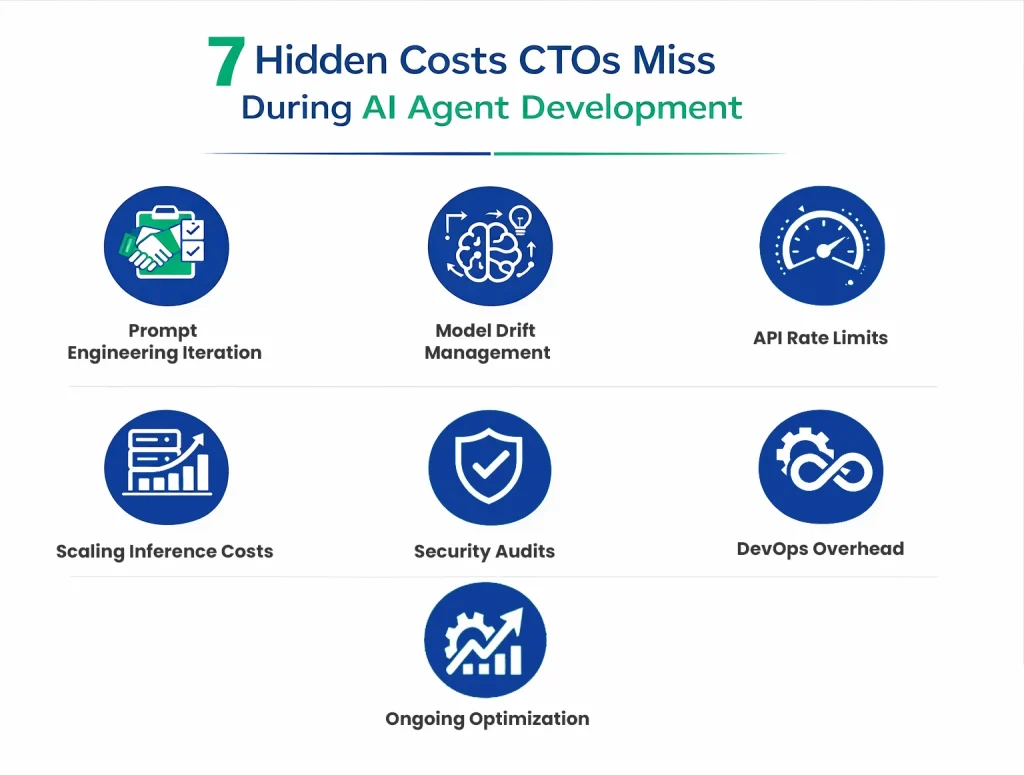
1. Prompt Engineering Iteration
Prompts don’t magically stabilize after v1. As edge cases stack up and tone, tools, and logic collide, teams keep tweaking, testing, and revalidating. That back-and-forth gradually stretches timelines and increases your real AI agent pricing.
How to Avoid It?
Lock the use case tightly and run structured prompt testing before expanding the scope.
2. Model Drift Management
Your agent performs well on launch data. Six months later, inputs shift, customer behavior changes, and accuracy dips. Especially with a domain-specific setup or a RAG knowledge agent, drift becomes a slow leak in performance and credibility.
How to Avoid It?
Schedule evaluation checkpoints and tie model retraining to measurable accuracy drops, not guesswork.
3. API Rate Limits
On paper, integrations look straightforward. In production, concurrency spikes hit rate caps, workflows stall, and automation queues build up. This is where API integrations and orchestration decisions start affecting delivery speed.
How to Avoid It?
Design throttling, batching, and fallback logic into your workflow orchestration from day one.
4. Scaling Inference Costs
Early usage feels cheap. Then adoption spreads across teams, and usage-based billing compounds. Inference volume, context length, and retries begin driving cloud costs faster than expected.
How to Avoid It?
Simulate 12-month usage growth before full rollout and stress test different model tiers.
5. Security Audits
Every new integration or dataset can trigger an internal review. For enterprise AI agent deployments, security & compliance checks are ongoing, not one-time. The time and documentation overhead add up quickly.
How to Avoid It?
Align architecture docs and access controls with internal governance standards before scaling access.
6. DevOps Overhead
An agent in production needs monitoring, logging, rollback plans, and uptime guarantees. Infrastructure (cloud/on-prem) decisions especially influence your ongoing maintenance more than most teams expect.
How to Avoid It?
Treat DevOps as part of core build planning, not a post-launch support task.
7. Ongoing Optimization
Accuracy, latency, retrieval quality, and integration depth… none of this stays fixed. Continuous improvement work directly affects your AI agent’s cost-benefit over time.
How to Avoid It?
Allocate a defined optimization budget instead of treating performance work as emergency fixes.
Final Thoughts
Business leaders are already making data-driven decisions using AI agents, yet many struggle when pilot projects turn into enterprise-scale deployments. The hidden costs of integration, memory management, workflow orchestration, and ongoing optimization often catch teams off guard, delaying impact and inflating budgets.
That’s where careful planning and the right support make a difference. Working with a partner with AI agent development expertise can help map your operational needs, align systems, and build agents that deliver value from day one. With guidance like this, you can move confidently from experimentation to scalable, controlled, and ROI-driven AI solutions.
Frequently Asked Questions (FAQs)
How Long Does It Take to Build a Custom AI Agent?
Timeline depends on integration complexity, orchestration needs, and regulatory requirements. But usually, this is the timeline based on the agent type:
MVP Agent: 4–8 weeks
Production-Grade Agent: 8–16 weeks
Enterprise Multi-Agent System: 16–32+ weeks
Can Startups Afford Custom AI?
Yes. Many startups are using AI agents to reduce operational costs. Starting with a focused MVP agent allows them to test impact, validate workflows, and scale gradually without over-investing upfront.
What Is the Ongoing Monthly Cost?
The ongoing monthly costs cover cloud infrastructure, APIs, monitoring, and optimization, depending on agent complexity.
MVP Agent: $15K–$60K
Production-Grade Agent: $60K–$200K
Enterprise Multi-Agent System: $150K–$500K+
Do AI Agents Require DevOps Teams?
Yes. DevOps is essential not only as a core cost component but also because DevOps overhead is a hidden cost in AI agent development. Experienced DevOps engineers ensure monitoring, logging, failover, and performance optimization, keeping your agents reliable under scale.
What Infrastructure Is Required?
Agents need scalable cloud or on-prem deployments depending on concurrency, compliance, and workload. Production-grade and multi-agent systems require persistent storage, orchestration layers, monitoring pipelines, and secure access controls to support complex workflows.
Evaluating the cost and architecture of building custom AI agents?
Our AI engineering team can provide a technical feasibility and cost assessment customized to your product.