


“Design is not just what it looks like and feels like. Design is how it works.” Steve Jobs
Have you ever clicked away from a website because it felt confusing?
Additionally, a good UX agency helps users find what they need quickly. Furthermore, it improves satisfaction and builds trust in your brand.
For instance, companies that invest in UX can see a return of up to 9,900 percent, meaning every dollar spent can bring significant value back. This makes selecting the right UX design services in NC a strategic decision, not just a design choice.
In this Blog, we’ll discuss what makes a UX design firm “good” in North Carolina and how you can identify the right fit for your business.
What Makes a UX Design Firm “Good” in North Carolina?
A good UX design firm in North Carolina goes beyond creating visually appealing interfaces. It understands the state’s diverse business environment and designs experiences that support both user needs and business objectives.
North Carolina is home to industries such as healthcare, fintech, SaaS, education, and manufacturing. A reliable UX firm understands how these sectors operate and designs solutions that align with industry workflows, user expectations, and regulatory considerations, including accessibility and data privacy requirements.
However, when UX strategy is closely connected with functionality and innovation, Product Design services help transform research insights into practical, scalable solutions.
Table of Contents
Research-driven design plays an important role. Instead of relying on assumptions, strong UX agencies study real user behavior, test designs with target audiences, and refine experiences based on insights. This approach helps create intuitive user journeys while supporting long-term product goals.
Additionally, the best UX design services focus on clear navigation, fast usability, and simple user journeys. Transparent communication throughout the project, including regular updates, clear explanations of design decisions, and active feedback loops help maintain alignment and ensure practical, measurable results.
What Should You Look for in a UX Design Firm in North Carolina?
Choosing the right UX design firm can make a big difference in your product’s success. Below are the most important qualities to consider to make a smart decision without wasting time or budget.
Let’s get into it.
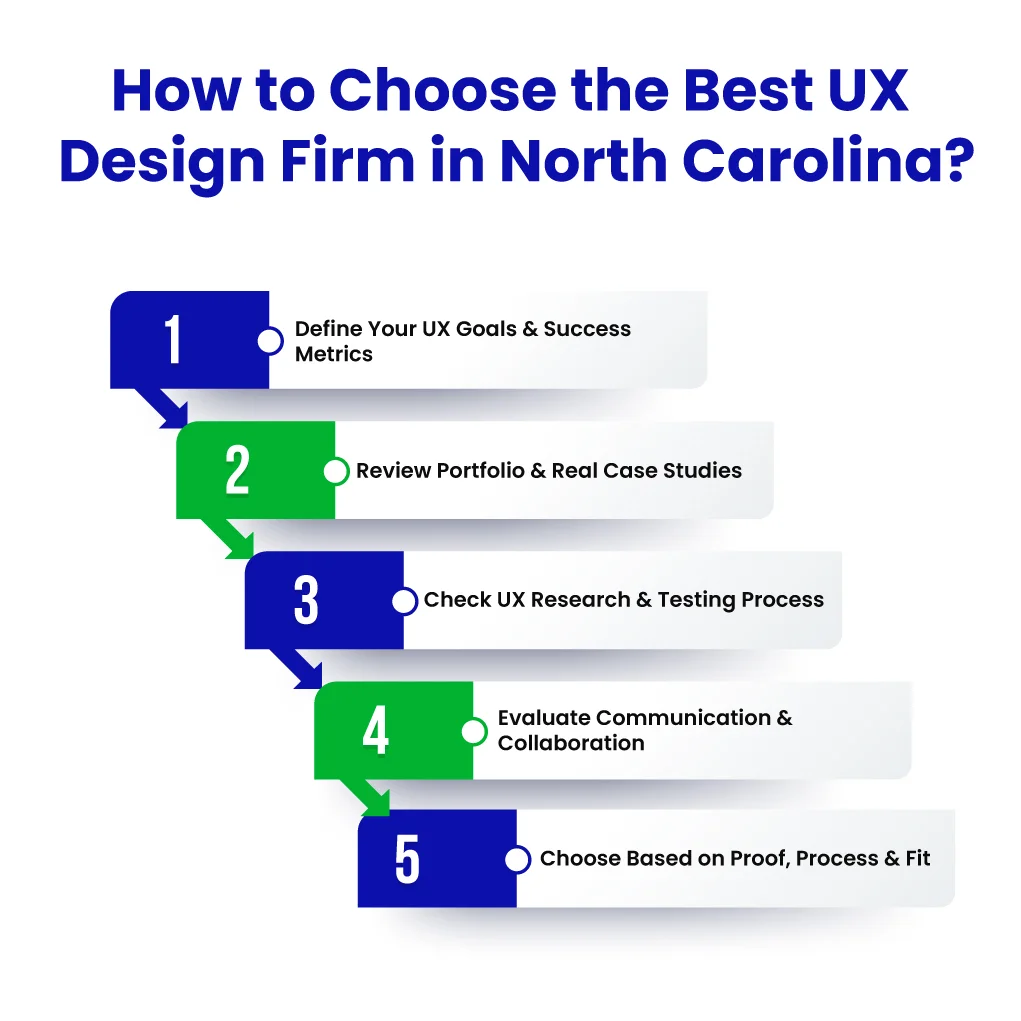
1. Define Your UX Goals and Expected Outcomes
Start with a clear goal. If you want better conversions, your UX goal should focus on simplifying the user journey. If you want higher retention, improve onboarding and the user experience.
Additionally, you should list the outcomes you expect. For example, you may want more sign-ups, fewer drop-offs, or faster task completion. Furthermore, setting measurable goals helps you track progress and results.
For instance, a strong UX strategy should aim to reduce confusion, improve usability, and increase trust. A poor user experience can push 88 percent of users away, so your goals should focus on real improvements.
2. Set Your Budget and Timeline
Before you contact a user experience design company in North Carolina, decide how much you can invest.
However, UX project costs vary based on several factors, including the depth of user research, the number of user groups involved, platform complexity, and any industry-specific compliance or accessibility requirements. Setting a clear budget early helps you compare firms more effectively.
As a rough estimate, a small website UX review may range from $3,000 to $7,000, while a full UX redesign for a digital product typically falls between $15,000 and $50,000. These figures are indicative ranges, not fixed pricing, and actual costs depend on project scope and deliverables.
If your product is growing or evolving rapidly, planning for ongoing UX work can help maintain consistency and long-term usability. In such cases, aligning your roadmap with modern UI/UX design for businesses in 2026 can support scalable design decisions.
Timeline planning is equally important. A simple website redesign may take 3 to 4 weeks, while a complete product UX overhaul can take 3 to 6 months, depending on research cycles, testing phases, and iteration rounds. Rushing the process often impacts design quality and user outcomes.
Finally, discuss delivery milestones and communication frequency with the UX firm. Regular progress updates and clearly defined checkpoints help you stay informed, manage expectations, and avoid delays.
Fix usability issues that may be impacting conversions with a professional UX audit and clear action plan.
3. Review Their Portfolio, Case Studies, and Client Reviews
A strong UX design firm in North Carolina will share real case studies, not just screenshots. Their portfolio should showcase the full UX process, including user research, wireframes, prototypes, UI design, and testing results.
This demonstrates that design decisions are validated through real user feedback, not visual preference alone.
When reviewing case studies, use a simple evaluation checklist to separate strong UX work from surface-level design:
- Problem: What user or business challenge was identified?
- Method: What UX research, testing, or design methods were used to address it?
- Result: What measurable outcome improved, such as conversions, task completion, or usability scores?
Case studies that clearly answer all three points show true UX maturity. If a project only shows final screens without explaining the problem or outcome, it reflects visual design rather than UX strategy.
Look for projects similar to your business or industry to ensure the firm understands your specific needs. If you prefer a local partner, UX design companies in Charlotte or a North Carolina–based UX agency may offer stronger regional insight.
Also, review client feedback on Google, Clutch, and LinkedIn. Prioritize comments about communication, delivery timelines, and project management. Consistent feedback in these areas supports the firm’s ability to execute UX work effectively and predictably.
To set expectations early, choose firms that clearly explain their UI/UX design services, deliverables, and engagement models.
4. Check Their UX Research Process and Workflow
A good UX design firm in North Carolina will start with research before design. They should gather real user feedback through surveys, interviews, and usability testing to understand what users really need. This helps identify user journeys, pain points, and behavior patterns, and shows that they make decisions based on real data.
A strong UX agency in North Carolina will follow a structured UX process that includes research & discovery, user interviews, wireframing, prototyping, usability testing, and final UI design. This ensures the design is validated at each stage and reduces the risk of costly changes later.
Also, check if they use prototypes and wireframes to test ideas early and if they provide a smooth handoff to development. A North Carolina UX design company that follows a research-based workflow will deliver better results, fewer revisions, and a design that truly improves user experience.
5. Check Their UX Testing and Validation Process
A strong UX design firm in North Carolina clearly explains how it will test and validate design decisions before and after implementation. Instead of relying on assumptions, the firm should demonstrate how real user behavior informs design improvements.
Look for agencies that use proven UX testing methods such as usability testing, user interviews, A/B testing, and heatmap analysis. These techniques help identify navigation issues, usability gaps, and friction points that may impact user engagement or conversions.
An effective UX testing service is iterative. A reliable firm will test early concepts, refine designs based on feedback, and validate final solutions against predefined success metrics. This ensures design changes are measurable and aligned with both user needs and business goals.
Collaboration is also important. A UX agency in North Carolina should involve your team during testing reviews, clearly explain findings, and recommend actionable improvements. This approach leads to validated design decisions and more predictable outcomes.
6. Assess Communication and Collaboration
Before hiring a UX design firm in North Carolina, confirm how often they will update you. Regular progress updates help you stay informed and ensure the project stays on track. Without consistent communication, projects can easily be delayed or go off course.
Also, ask which project management tools they use, such as Jira, Trello, or Asana. This shows how organized they are and how they will manage tasks, feedback, and deadlines. Using a proper tool also makes collaboration easier for your team.
Finally, check their availability and response time. You want a firm that can respond quickly when you need changes or have questions. Slow communication can lead to delays and affect the final outcome, so clear, timely collaboration is essential.
7. Review Their UX Deliverables and Documentation
Before hiring, confirm what deliverables you will receive from the UX design firm in North Carolina. This can include wireframes, prototypes, user flows, and design systems. Clear deliverables ensure you know what to expect and how the design will be implemented.
A professional UX design agency in North Carolina will provide documentation that explains user personas, journey maps, and usability findings. This helps your team understand the design decisions and supports future updates.
Also, check if they share design assets in tools like Figma or Adobe XD. Deliverables should be organized and ready for development. Proper documentation shows strong UX design services in NC and ensures smooth handoff.
8. Ask for Client References and Live Validation
Beyond portfolios and public reviews, ask UX design firms in North Carolina for direct client references. Speaking with past or current clients gives you firsthand insight into how the firm works in real projects, not just how they present themselves online.
Use these conversations to validate claims around communication quality, delivery timelines, budget management, and responsiveness to feedback. Ask whether the firm met expectations, handled challenges effectively, and delivered measurable UX improvements.
This step also helps confirm industry relevance. Clients can share whether the agency has experience with similar products, such as SaaS platforms, web applications, or mobile apps, and how well they adapted to specific business or user needs.
Direct client feedback acts as a final validation layer, helping you confirm whether the UX agency can deliver consistent value beyond documented case studies.
9. Ask for a Small Pilot Project
If you are not fully sure about the UX firm, start with a small test project. This helps you evaluate the firm before committing to a full redesign.
A pilot project can include tasks such as reviewing a few key pages, creating wireframes for a single user flow, and testing a small part of your app.
This will help you evaluate:
- Quality of work
- Communication
- Delivery speed
A small pilot project reduces risk and gives you confidence before you invest in a larger UX project.
Final Decision: Select a UX Agency with Proven Results and a Clear Process
After reviewing all the options, choose the UX firm that best aligns with your goals and delivers real value. The right firm should offer proven results, a clear process, and good communication throughout the project.
A clear process means the agency can explain how it will approach research, design, testing, and delivery. Proven results should be supported by measurable outcomes, such as improved usability, increased conversions, or stronger user engagement.
Their portfolio should include real case studies that show how they solved problems and improved user experience. Also, make sure the budget and timeline are realistic and aligned with your expectations.
Choose the firm that offers:
- Proven results
- Clear process
- Good communication
- Strong portfolio
- Realistic budget & timeline
When a firm meets all these criteria, you can confidently move forward with your UX project.
How Does Clustox Help You Choose the Right UX Partner?
Clustox helps North Carolina businesses make confident UX decisions through a structured, transparent evaluation process. We begin by understanding your business goals, user needs, and project scope. Then we guide you through research-driven UX strategies to help you define the right budget, timeline, and deliverables.
Our team focuses on measurable results, providing clear case studies, usability testing insights, and practical recommendations.
Throughout the process, Clustox maintains open communication and regular updates, so you stay informed at every stage. We assist you in selecting the best UX strategy and ensure your project delivers genuine value by combining local market knowledge with proven UX techniques.
Frequently Asked Questions (FAQs)
2. What Should be Included in a UX Design Contract?
A clear contract protects both sides and sets expectations from the start. Typically, a UX design agreement should include:
Project scope and deliverables
Timeline and milestones
Pricing structure and payment terms
Ownership of design assets
Communication and revision process
In addition, clarity around post-design support can prevent confusion later. For North Carolina projects, especially in regulated industries such as healthcare or finance, it’s also helpful to include a section on data handling, confidentiality, and compliance requirements (e.g., HIPAA or PCI standards).
3. Can a UX Design Firm Work With an Existing Development Team?
Yes. Most professional UX design firms are experienced in collaborating with in-house or third-party development teams. In practice, this usually means sharing design files, documentation, and annotations through tools like Figma. As a result, developers receive clear guidance, and implementation becomes smoother.
For North Carolina-based projects, ensure the UX team follows secure file-sharing practices and proper documentation so development teams can implement designs without introducing security or compliance risks.
4. Does UX Design Continue After the Project is Completed?
No, UX design should not stop at launch. In reality, user behavior evolves, and products grow. Ongoing UX support may include usability testing, design updates, and performance improvements informed by real user feedback. This continuous approach helps maintain usability and long-term value.
For North Carolina businesses, ongoing UX work also ensures continued compliance and security as product features expand or regulations change.
5. Do UX Design Firms in North Carolina Understand Local User Behavior and Market Needs?
Yes, a good UX firm in North Carolina understands the local market and user expectations. Whether you are targeting users in Charlotte, Raleigh, Durham, or other regions, local firms are familiar with common user patterns, accessibility expectations, and industry-specific needs.
They also understand North Carolina’s business landscape, including the tech hub in Research Triangle Park, healthcare systems, and financial industries in Charlotte. This local understanding helps them design products that match regional user behavior and business goals.
Conclusion: Make the Decision Based on Proof and Process
A UX design firm that demonstrates real results and follows a clear process can shape how users interact with your product in meaningful ways. Over time, strong research, structured testing, and consistent communication help reduce friction and create experiences that feel intuitive rather than confusing.
At the same time, the decision should remain grounded in evidence and clarity. Firms that explain their workflow, share measurable outcomes, and deliver well-documented designs help teams move forward with confidence. As a result, timelines stay realistic, collaboration improves, and costly revisions become less likely.
For businesses operating in NC, practical UX support often means working with a team that can translate user needs into usable, scalable solutions. A partner providing UX design services in NC can help address usability challenges while keeping business goals in focus throughout the project lifecycle.
Ultimately, decisions shaped by proof and process lead to user experiences that perform better, support long-term growth, and deliver value for both users and the business.
Stay ahead of competitors with a UX strategy that improves user retention, reduces support tickets, and strengthens your product experience.