

Running IT operations today can feel like managing a busy café during the morning rush. There are orders coming in non-stop, machines that might break, and a line of impatient customers waiting for everything to run smoothly.
Handling all of that manually can get chaotic fast, and it’s no wonder, with the DevOps market projected to reach $19.6 billion by 2026 as enterprises rush to automate delivery and operations.
In IT, DevOps is like the experienced barista who knows exactly how to keep the workflow moving, making sure every order (software release) goes out quickly and reliably.
AIOps acts as the smart assistant that spots patterns, predicts potential problems before they happen, and helps the team handle everything more efficiently.
Simply put, DevOps helps you build and deliver software faster, while AIOps adds intelligence and automation to handle complex IT operations at scale. Many modern enterprises use both to keep systems running smoothly and avoid surprises.
In this blog, we’ll take a step-by-step look at AIOps and DevOps, covering architecture, automation, operational intelligence, and real-world use cases so you can see which approach, or combination, makes the most sense.
What Is AIOps: Intelligence Behind Modern IT Systems
Managing IT systems with tons of traffic, events, or data can get messy fast. AIOps, short for Artificial Intelligence for IT Operations, helps you handle it smarter and faster using AI and machine learning.
The AIOps platform market was valued at roughly $10.5 billion in 2024 and is projected to exceed $66 billion by 2035, showing how automation and intelligent monitoring are becoming essential.
Table of Contents
Instead of letting alerts pile up, AIOps analyzes all your signals, events, and metrics to spot patterns and predict problems before they disrupt your workflow. Therefore, AI is becoming fundamental in DevOps for enterprises looking to reduce downtime and improve operational efficiency.
AIOps Architecture: How Does It Handle Data, Insights, and Automation?
AIOps is designed to manage massive amounts of operational data and help your team make smarter decisions without feeling buried.
Its architecture typically has three main layers:
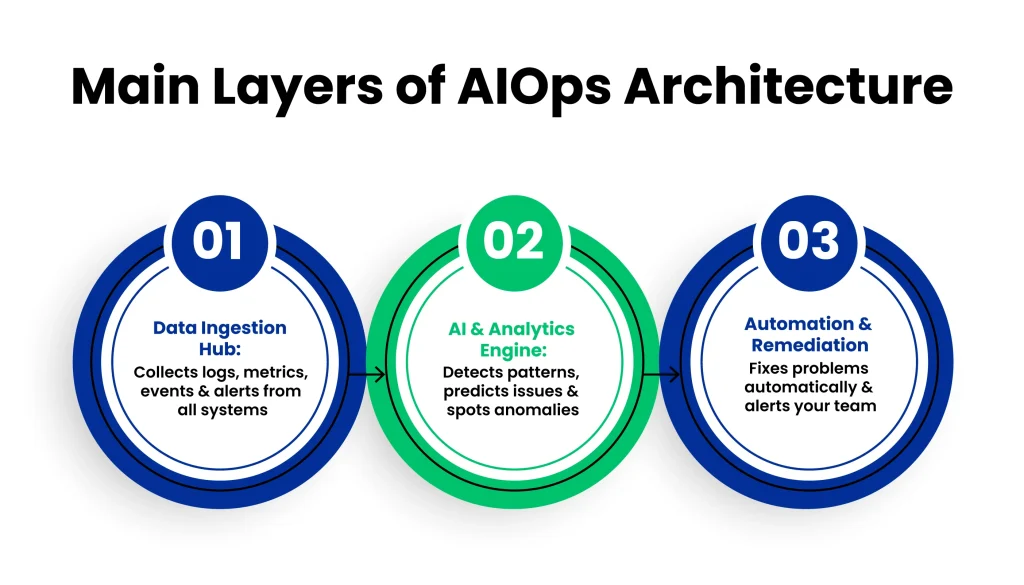
- Data Ingestion Layer
This is where all your data comes together: logs, metrics, events, and alerts from your applications, servers, and networks. It’s like a central hub where everything arrives, ready to be analyzed.
- Machine Learning and Analytics Engine
This layer is the brain of AIOps. It studies the incoming data, identifies patterns, detects anomalies, and predicts potential issues before they escalate. It’s like having a teammate who notices trends you might miss and gives you a heads-up.
- Automation and Remediation Layer
Once a problem is spotted, this layer can act automatically. It might trigger a fix, reroute traffic, or send actionable alerts to your team, so you spend less time chasing issues and more time focusing on important projects.
These layers together give you visibility, predictive insights, and automated responses, making your IT operations smoother and more strategic.
What Is DevOps: Building and Delivering Software Faster
How do some companies push out software updates almost daily without everything breaking?
That’s the challenge DevOps is designed to solve. Simply put, DevOps helps you build, test, and deliver software faster and more reliably by connecting development and operations teams.
DevOps is all about collaboration, continuous improvement, and automation. Teams work closely, share feedback quickly, and fix problems before they spiral out of control.
DevOps Architecture: How Does It Keep Software Delivery Smooth?
The architecture of DevOps is built to make software delivery predictable and repeatable. Main components include:
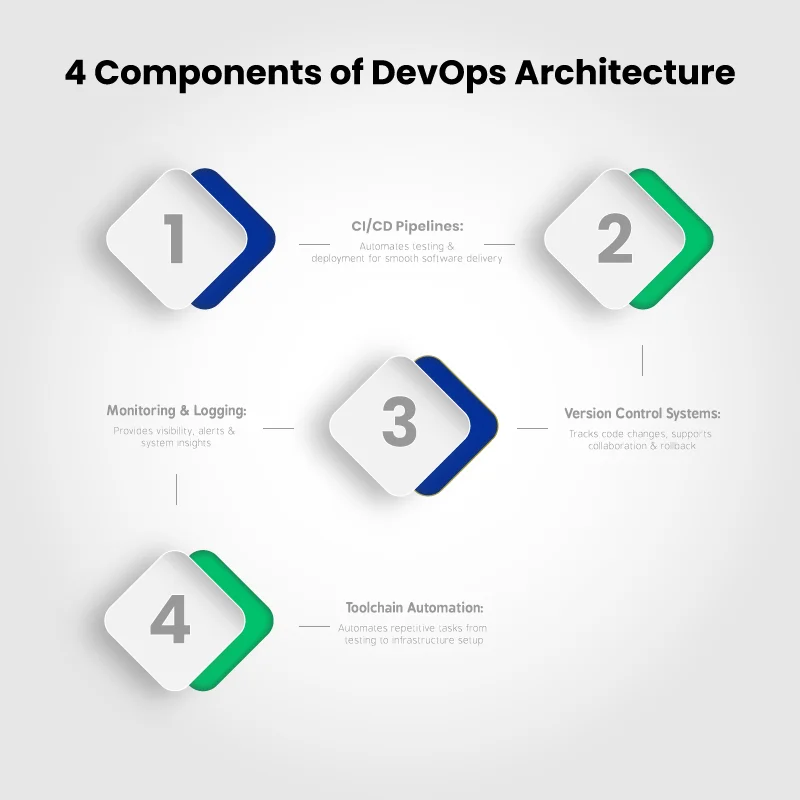
- CI/CD Pipelines
Continuous integration and continuous deployment keep your code moving smoothly from development to production. It’s like an automated conveyor belt that tests and ships updates without you having to micromanage every step.
- Version Control Systems
Tools like Git help your team track code changes, roll back mistakes, and collaborate efficiently.
- Monitoring and Logging
DevOps ensures you can see what’s happening in your systems at all times. Alerts and logs help your team catch issues before they affect users.
- Toolchain Automation
DevOps uses a mix of tools to automate repetitive tasks, from testing and deployment to infrastructure setup.
With this setup, you get faster releases, smoother workflows, and fewer surprises, making software delivery less stressful and more reliable.
AIOps Architecture vs. DevOps Architecture
Deciding between AIOps and DevOps, or figuring out how to use both, is a bit tricky. A good way to see the difference is by comparing their architectures. How each system is built affects how your team works, how fast issues get resolved, and how scalable your operations are, especially when following the DevOps lifecycle.
To make the differences easier to digest, here’s a quick comparison table:
| Feature | DevOps Architecture | AIOps Architecture |
|---|---|---|
| Primary Focus | Predictable and reliable software delivery | Intelligent and data-driven IT operations |
| Core Components | CI/CD pipelines, version control, monitoring, and toolchain automation | Data ingestion layer, ML & analytics engine, automation & remediation layer |
| Automation Type | Automates code integration, testing, and deployment | Automates issue detection, root cause analysis, and remediation |
| Scale | Best for team workflows and software delivery processes | Handles complex, large-scale IT environments with many systems |
| Data Usage | Mainly code, logs, and monitoring data for pipelines | Aggregates logs, metrics, events, and signals across systems for insights |
| Goal | Faster and more reliable software releases | Proactive problem-solving and predictive operational intelligence |
This table makes it clear: DevOps focuses on speed and reliability in software delivery, while AIOps brings intelligence, automation, and scale to IT operations.
Feeling Buried Under Alerts and Bottlenecks?
Our team designs automation that predicts problems before they impact your systems.
How Do AIOps and DevOps Handle Automation?
Automation is one of the biggest reasons teams turn to DevOps and AIOps, but they go about it in very different ways. The way each handles automation can change how your team works, how fast issues get resolved, and how much time you spend on repetitive tasks.
Automation in AIOps
AIOps takes automation a step further by adding intelligence and context. Instead of just following pre-set steps, it uses AI and machine learning to detect issues, predict problems, and even act automatically. Examples include:
- Automated Incident Response: Triggers alerts and actions automatically when it spots anomalies.
- Root Cause Analysis: Identifies the likely cause of issues without waiting for a human to investigate.
- Predictive Maintenance: Anticipates failures before they happen and takes preventive steps.
Here, the goal is smarter, context-aware automation, letting your team focus on strategy instead of firefighting.
Automation in DevOps
As DevOps is all about making software delivery smooth and predictable. Automation here is mostly focused on moving code from development to production efficiently.
Some examples include:
- CI/CD Pipelines: Automatically build, test, and deploy code so releases happen faster and with fewer errors.
- Infrastructure as Code (IaC): Scripts that set up servers, networks, and other infrastructure automatically.
- Scripted Workflows: Tasks like testing, configuration, and deployments run without manual intervention.
Many companies now adopt DevOps as a Service to manage these processes, outsourcing management of pipelines, monitoring, and toolchains to experts while still keeping control over their delivery workflows.
Here, the focus is speed, consistency, and reliable software delivery.
What are the Common Automation Tools in AIOps and DevOps?
As you’ve seen, both AIOps and DevOps rely heavily on automation, but they use it in very different ways. AIOps focuses on detecting issues, predicting problems, and responding automatically, while DevOps uses a mix of tools to automate repetitive tasks, from testing and deployment to infrastructure setup.
Here’s a practical look at some of the main tools each approach typically uses:
| Automation Area | AIOps Tools | DevOps Tools |
|---|---|---|
| Monitoring & Incident Response | Moogsoft, BigPanda, Splunk ITSI | Prometheus, Nagios, Grafana |
| CI/CD / Deployment | Some AIOps platforms integrate with pipelines | Jenkins, GitLab CI, CircleCI |
| Infrastructure Automation | Dynatrace, OpsRamp | Terraform, Ansible, Puppet |
| Testing Automation | Predictive alerts in AIOps platforms | Selenium, JUnit, TestNG |
AIOps vs. DevOps: How Do They Deliver Operational Intelligence?
Operational intelligence is about knowing what’s happening in your systems right now and what’s likely to happen next. Both AIOps and DevOps give you visibility, but the depth of insight is very different.
Here’s a clear, side-by-side breakdown:
| Area | AIOps | DevOps |
|---|---|---|
| Data Analysis | Analyzes logs, metrics, events, and traces together | Relies on metrics and logs viewed separately |
| Issue Detection | Detects anomalies automatically using machine learning | Issues detected through thresholds and alerts |
| Root Cause Identification | Identifies probable root causes automatically | Requires manual investigation by engineers |
| Predictive Insights | Predicts incidents before they impact users | Mostly reactive, issues found after they occur |
| Alert Noise Reduction | Correlates events to reduce alert fatigue | High alert volume, needs human filtering |
| Decision Support | Provides actionable insights and recommendations | Engineers interpret dashboards and alerts |
Takeaway: DevOps gives visibility, but AIOps turns raw data into early warnings and actionable insights, helping teams act strategically.
Which Works Better for Your Business: AIOps or DevOps?
Curious about how AIOps and DevOps fit into your business?
Each has its strengths, and the choice depends on your team, your systems, and the kind of challenges you face. When we look at typical business scenarios, it helps to see where each approach really shines.
To understand their strengths, let’s look at typical business use cases for AIOps and DevOps:
| Scenario | DevOps Strength | AIOps Strength |
|---|---|---|
| Software Delivery & CI/CD | Automates building, testing, and deploying code efficiently | Adds monitoring to predict pipeline failures before they happen |
| Cloud Infrastructure Management | Manages infrastructure as code, deployment consistency | Detects anomalies, predicts capacity issues, and triggers remediation |
| Incident Response | Alerts the right team for known failures | Correlates events, reduces alert noise, and often fixes issues automatically |
| High-Traffic Applications | Ensures releases are stable under heavy load | Predicts performance bottlenecks and potential downtime proactively |
| SaaS & eCommerce | Keeps new features rolling out smoothly | Detects system patterns that could affect customers and resolves issues before impact |
The takeaway:
- Use DevOps when you need fast, reliable, and repeatable software delivery.
- Use AIOps when you need intelligent monitoring, predictive insights, and automated operational response.
- In many modern enterprises, combining both gives you speed and intelligence, letting your team focus on strategy instead of constantly managing issues.
What are the Challenges of Implementing AIOps and DevOps?
All of this sounds great on paper, right?
Faster releases, smarter systems, fewer surprises. But once you move from reading about AIOps and DevOps to actually rolling them out, a few practical realities start to show up.
Every team, every system, and every organization comes with its own set of constraints, and ignoring them can slow things down quickly.
Before jumping in, it helps to pause and look at the most common challenges teams run into when adopting DevOps, AIOps, or both:
- Cultural Readiness: Teams need a collaborative mindset for DevOps and trust in AI-driven insights for AIOps.
- Integration Complexity: Existing tools and workflows must be connected seamlessly.
- Data Quality: AIOps relies on clean, high-quality data; bad inputs lead to poor predictions.
- Skill Requirements: DevOps needs engineering skills; AIOps requires data science and AI expertise.
- Cost & ROI: Both approaches involve investment; enterprises should weigh speed and intelligence against budget constraints.
Being aware of these factors upfront can save time, frustration, and cost during implementation.
The Bottom Line
By now, it’s clear that AIOps and DevOps are doing very different jobs, even though they often show up in the same conversations.
DevOps helps your teams move code from idea to production with fewer delays. AIOps steps in when systems start generating more data and signals than people can realistically track on their own.
If your priority is frequent, dependable releases, DevOps fits naturally. If your environment feels harder to read as it grows, AIOps helps connect the dots and highlight what matters most.
For most teams, this isn’t an either-or decision. DevOps keeps things moving. AIOps helps you understand the impact of that movement at scale. Used together, they reduce guesswork, cut down manual effort, and make day-to-day operations easier to manage as systems grow.
The real win is not picking the “better” approach but building a setup that supports how your teams work today and won’t slow them down tomorrow.
Frequently Asked Questions (FAQs)
2. Is AIOps Suitable For Highly Regulated Industries?
Yes! AIOps can help you stay compliant by automating monitoring, spotting issues before they become problems, and keeping operations consistent. It reduces human errors, so you don’t have to worry about missing critical checks. Using a reliable AI consulting service can make adoption smoother in complex, regulated environments.
3. How Does AIOps Handle Multi-Cloud Environments?
AIOps gives you visibility across all your cloud platforms, analyzing data in real time and flagging anomalies. That way, you can keep your systems running smoothly and make smarter decisions about resources across multiple clouds.
4. How Can Businesses Measure ROI From AIOps And DevOps Investments?
You can track ROI by looking at faster releases, fewer incidents, and reduced downtime. With DevOps, check how often your deployments succeed; with AIOps, see how much time you save by catching problems early.
5. How Do AIOps Platforms Integrate With Existing DevOps Pipelines?
AIOps works with the tools you’re already using. It can feed insights into CI/CD pipelines, trigger fixes automatically, and improve your monitoring dashboards, all without shaking up your current workflow.
Downtime, Alert Noise, and Slow Releases are Costing You Millions.
We architect and deploy the complete AIOps-DevOps synergy that turns your IT from a cost center into a growth engine.