


According to the Cloud Evolution: Mandate to Modernize report, 87% of organizations already use more than one cloud provider, with an average of 3 across their multi-cloud setup.
Seeing so many companies move toward multi-cloud adoption, it’s natural for businesses to ask if they should follow suit.
Legacy, on-prem systems weren’t designed for today’s environment. They often struggle to keep up with modern business demands, especially as companies integrate emerging AI technologies.
One reason firms move to multiple cloud platforms is that they support generative AI solutions, which we know can dramatically amp up business efficiency.
Still, adopting a multi-cloud approach isn’t a one-size-fits-all solution. Not every business needs to run workloads across multiple providers, and timing matters as much as strategy.
Is your business ready for a multi-cloud deployment?
This blog will give you insights into why multi-cloud is essential for businesses and when and how to implement it successfully to help make better decisions.
Let’s start by understanding the fundamentals of multi-cloud strategy.
What Is a Multi-Cloud Strategy?
A multi-cloud strategy is an approach to using multiple cloud providers to run your workloads, apps, and services. It’s about spreading your infrastructure across platforms like AWS, Azure, and GCP while maintaining control, security, and performance.
Table of Contents
Companies are living by this proverb, “Don’t put all your eggs in one basket,” and it makes total sense, right?
For businesses, it means having the flexibility to choose the right platform for each service while avoiding reliance on a single vendor that could cause downtime or limit growth.
Why Is Multi-Cloud Essential For Businesses In 2026?
The need for diversified cloud environments is growing fast. The global multi-cloud management market is valued at $12.43 billion in 2025 and is expected to reach $75.15 billion by 2032. It shows how quickly businesses are shifting toward more flexible setups.
Here’s why multi-cloud matters for companies today:
1. Operational Necessity
Outages are becoming more frequent, and relying on a single provider can put revenue and uptime at risk. A multi-cloud architecture allows businesses to spread workloads and maintain operations even when one platform has issues.
In practical terms, this helps teams:
- Distribute critical workloads across multiple clouds
- Reduce downtime impact on business operations
- Plan failovers and maintain continuity with multi-cloud management
2. AI-Driven Workloads
AI and machine learning tasks require significant computing power. That’s why businesses now select platforms based on which provider handles each task most efficiently.
This approach allows businesses to:
- Run heavy AI jobs on optimized platforms
- Gain flexibility and portability across clouds
- Automate & scale operations with multi-cloud DevOps practices
3. A More Mature Cloud Era
Businesses are moving beyond basic cloud migrations. The focus now is on control, compliance, and cost. Vendors offer better management tools, and more cloud services offer the flexibility and governance frameworks that modern IT teams need.
This shift makes it easier to:
- Strengthen compliance with multi-cloud security
- Expand adoption of hybrid and multi-cloud models
- Simplify daily operations with multi-cloud orchestration tools
When To Implement a Multi-Cloud Strategy?
You’ve realized your business could benefit from multi-cloud adoption. Deciding when to implement it is as crucial as knowing when to change lanes in heavy traffic. Doing it too early or too late can create unnecessary risk.
The following are a few common scenarios when businesses typically consider moving to multi-cloud:
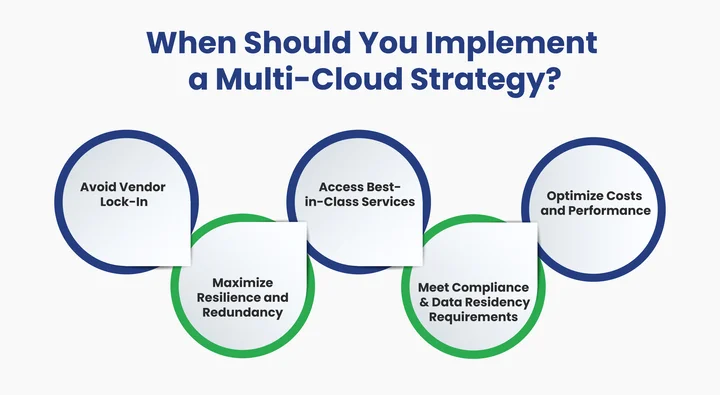
1. Avoid Vendor Lock-In
Relying on a single provider can leave your business stuck if pricing changes or services don’t scale. Vendor lock-in prevention with multi-cloud ensures flexibility.
Distribute workloads across multiple multi-cloud service providers to keep options open and maintain operational freedom.
2. Maximize Resilience and Redundancy
Downtime is expensive … and it can happen to anyone. Multi-cloud disaster recovery and governance allow you to keep systems running even if one platform fails by:
- Securing failover between providers
- Increasing operational reliability
- Minimizing business disruption
3. Access Best-of-Breed Services
Not every cloud excels at everything. Why settle, then?
Pick the platform that fits each workload best to ensure consistent operational performance.
For Instance:
- Google Cloud for AI/ML
- AWS for scalable storage
- Azure for enterprise integration
4. Optimize Costs and Performance
Yes, multi-cloud eases businesses in so many ways. But one can’t underestimate the common problem that almost every company is grappling with: cloud spend.
According to IDC’s Control Cloud Cost and Expand Transparency with FinOps guide, around 30% of public cloud spend is wasted.
Spend wisely. Smart allocation keeps costs down without sacrificing speed. Dynamically assign workloads to the most cost-effective cloud.
Bleeding Money On Cloud Bills Without Proof Of Where It’s Going? Get our 8-Point Cloud Cost Optimization Checklist and start spotting waste fast.
5. Meet Compliance and Data Residency Requirements
Sensitive data must be handled with utmost care. Data sovereignty in multi-cloud helps you comply with regulations like GDPR or HIPAA without slowing operations. Make sure to:
- Choose regions/providers that comply with local laws
- Integrate compliance checks into daily workflows
- Maintain control over data residency
How To Successfully Implement a Multi-Cloud Strategy?
Managing multiple cloud providers takes planning, governance, and the right tools to keep operations smooth and costs in check. Saying “we’ll go multi-cloud” and actually doing it is the difference between flying and just looking at the sky.
Here’s a practical approach to executing multi-cloud implementation effectively in 2026:
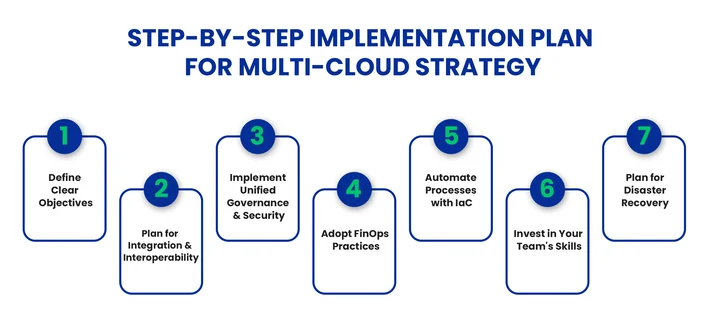
1. Define Clear Objectives
Are you aiming for higher resilience, better performance, or cost efficiency?
Start by identifying what you want to achieve. Clear goals guide every step of your enterprise multi-cloud strategy. For instance, determine critical workloads, match them to the cloud platform that best serves them, and track KPIs to measure success.
2. Plan for Integration and Interoperability
Your apps and services should move freely across providers. Using cloud-agnostic technologies, such as containers, in a multi-cloud strategy, along with orchestration platforms, ensures smooth workload portability. This also reduces downtime during migrations or resource scaling.
3. Implement Unified Governance and Security
A strong governance framework ensures all clouds adhere to consistent policies. Centralized tools combined with multi-cloud security best practices and Zero Trust principles help reduce risk.
- Monitor compliance across all clouds
- Use multi-cloud observability tools for real-time insights
- Embed security into DevOps and multi-cloud integration pipelines
4. Adopt FinOps Practices
Spending across clouds can get out of hand fast. As per the 2025 State of the Cloud Report, 84% of enterprises see managing cloud costs as their topmost challenge.
That’s why cloud cost optimization with FinOps has become essential for organizations wanting to keep efficiency high and expenses low. It lets you track costs, prevent waste, and allocate resources dynamically.
- Avoid cloud sprawl
- Optimize workloads for cost and performance
- Keep financial control without slowing operations
5. Automate Processes with Infrastructure as Code (IaC)
Automation reduces human error and speeds up deployment. Tools such as Terraform, Anthos, and Azure Arc enable consistent provisioning and policy enforcement across clouds. It’s invaluable when managing multiple providers and keeping workloads portable.
6. Invest in Your Team’s Skills
Even the best technology fails without skilled people. Upskilling teams in multi-cloud DevOps, Kubernetes, and automation is essential for managing complex environments. Certification programs and continuous training help bridge the skill gap.
7. Plan for Disaster Recovery
A solid disaster recovery plan ensures business continuity. Build failover mechanisms and data redundancy across multiple providers to mitigate downtime.
- Use multi-cloud disaster recovery frameworks.
- Test failover processes regularly.
- Maintain backups in diverse geographic regions.
The Bottom Line
Multi-cloud strategy has become the new normal. Companies are running workloads across multiple clouds, using enterprise multi-cloud solutions, and following best practices to stay agile, reduce risk, and prevent vendor lock-in.
It’s about maintaining control, security, and performance while staying ready for the future of business IT.
So, how is your business ready to leap?
Are you confident your current cloud setup can handle growth, compliance requirements, or AI-driven workloads?
The reality is that sticking to a single cloud could mean missed opportunities and hidden inefficiencies for most businesses.
Luckily, you don’t have to figure it out alone. Use the framework we shared to plan, execute, and govern your multi-cloud environment effectively.
Frequently Asked Questions (FAQs)
2. What Are The Main Challenges Of Moving To Multi-Cloud?
Managing multiple clouds introduces complexity. Common issues include integration gaps, inconsistent security, and difficulty monitoring workloads. Following transparent governance and best practices makes it easier to keep operations smooth and secure.
3. Can Smaller Businesses Benefit From Multi-Cloud?
Absolutely. Even smaller organizations can avoid vendor lock-in, use the best services for each workload, and scale efficiently. The key is planning carefully and keeping costs under control while utilizing the flexibility multi-cloud offers.
4. How Do I Keep Data Secure And Compliant Across Multiple Clouds?
Security and compliance are critical in a multi-cloud setup. Establish consistent policies, monitor activity across clouds, and ensure compliance with regulatory requirements such as GDPR and HIPAA. A proactive approach keeps data safe and operations reliable.
Optimize cloud costs post-migration with AWS, Azure, and GCP-certified engineers.