


“We’re at the beginning of something very, very exciting.” Can’t really disagree with Geoffrey Hinton, aka the Godfather of AI.
In 2022, when ChatGPT dropped, everyone was asking, “Can AI really write content?” Fast forward a few years, and the conversation has done a complete 360° shift.
As of 2025, 85% of marketers are already using AI tools in content creation (CoSchedule’s State of AI in Marketing Report). That’s a transformation in motion.
So, what does this mean for 2026?
It could very well be the year we all ask, “Is our brand getting recognized and cited by AI engines?” And why not? Your target audience is already searching on AI engines. Ignoring this is no longer an option.
The influence of Generative AI in content marketing is enormous. The way businesses run, create, distribute, and optimize content has changed like never before.
In this blog, we’ll cover:
- Generative AI trends turning heads in content marketing
- Challenges arising while dealing with AI in marketing
- Ways to cope with these AI-driven challenges
- How to prepare yourself ahead of time
Let’s dive in!
What Is Generative AI?
Generative AI is the type of AI that creates new content from the instructions you give it. You provide input, it processes what it learned from massive datasets, and then it generates something original. Think of it as the creative side of artificial intelligence.
Table of Contents
It runs on a few core technologies, such as:
- Machine learning: for learning audience behavior
- Transformer models: for handling long, complex content
- Deep learning: for understanding patterns and context in content
- Natural language processing (NLP): for producing human-like text
- RAG (retrieval-augmented generation): for generating accurate, data-backed content
Examples of Generative AI Tools for Content Marketing
Below are some of the widely used tools across different applications:
- ChatGPT (OpenAI): Generates text, blog drafts, and content ideas.
- Copy.ai: Produces short-form copy, headlines, and marketing text.
- Perplexity AI: Provides quick research and reliable insights.
- Synthesia: Turns written scripts into AI-generated videos.
- DALL·E 3 (OpenAI): Generates images and visual content.
- Gemini: Creates text, visuals, and personalized content.
- Jasper AI: Creates social posts, emails, and ad copy.
- Runway: Offers AI video editing and creative tools.
What Are The Latest Generative AI Trends Changing Content Marketing In 2026?
How generative AI is changing the content marketing world is fascinating. Putting the debate over generic, poor-quality content aside for a while, generative AI marketing is a perfect solution for marketers.
Scaling content output, reducing costs, increasing productivity, and saving time are just a few of the benefits of incorporating AI-driven content marketing.
Following trends will show how generative AI adoption in marketing is shaping everything, from content ideation and creation workflows to predictive analytics and AI personalization.
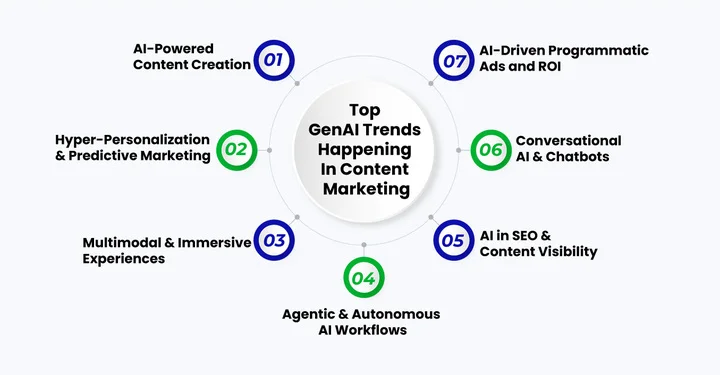
Trend #1: AI-Powered Content Creation
AI-driven content generation is the most common use case of AI. Marketers are using tools like ChatGPT, Jasper, Copy.ai, and Perplexity to research and create different types of content, including social media posts, blogs, product descriptions, and press releases.
Over 70% of marketing teams are now scaling AI use for content creation, according to the 2025 State of Marketing AI Report. These tools help marketers conduct research and generate content quickly, consistently, and accurately.
Marketers are utilizing essential tips to create marketing copy faster with AI. But Generative AI is not like a magic wand that you just say “swish and flick”… and poof, here comes your perfect marketing copy.
The marketers who succeed co-create with AI. AI might be more creative than you, but it doesn’t understand the most important thing you know: the strategy…
Below you can find 6 essential tips for AI-assisted content creation:
- Do The Research First
Before asking AI to generate anything, understanding your audience, competitors, and what works in your niche gives AI the context to produce meaningful, relevant content. - Start With Clear Inputs
Feed AI your drafts, examples, or structured instructions. Simply saying “write this for me” leads to generic outputs and wasted time. - Co-Create With AI
Don’t leave AI to do all the thinking. Blend AI’s speed with your human insight to maintain your brand voice. This is true AI-human content co-creation. - Focus On Personalization
It’s tempting to mass-produce content, but the real value comes from aligning output with audience segments. Use AI for hyper-personalized marketing and real-time engagement. - Integrate With Workflows
AI works best when connected to your content calendar, CRM, or social platforms. Without integration, outputs get scattered and inconsistent. - Measure And Refine
Track performance, review AI-generated content, and adjust your approach. Predictive analytics can help, but only if you act on the data.
Content creation is only the tip of the iceberg. Let’s see what else generative artificial intelligence can do for content marketing in 2026.
Worried your AI content might erode trust?
Clustox helps marketing leaders build AI content systems that maintain brand consistency, ensure quality, and uphold credibility across every channel.
Trend #2: Hyper-Personalization & Predictive Marketing
Hyper-personalization with AI is the practice of delivering content, recommendations, and experiences to each individual in real time. It uses predictive analytics to understand audience behavior and anticipate what each user wants, creating marketing that feels personal and relevant.
As per McKinsey, 71% of consumers now want personalized interactions, and companies that excel at providing them generate 40% more revenue.
Hyper-Personalization Use Cases:
- Personalized emails, push notifications, and content suggestions
- Product recommendations on websites and apps
- Dynamic homepage layouts and user experiences
- Social media content aligned with individual interests
- Automated engagement powered by AI-driven CRM insights
Real-World Example: Netflix
You open Netflix, and your next show is already queued up based on your watch history and preferred genres. You didn’t scroll, you didn’t search… that’s hyper-personalization in action, predicting what you want to watch next.
Trend #3: Multimodal & Immersive Experiences
Capturing attention is more challenging than ever. Brands are responding by creating multimodal generative AI solutions.
Multimodal AI refers to AI systems that can process and generate multiple types of content simultaneously, rather than being limited to text. In the marketing context, it usually includes:
- Text: Blog posts, social media copy, emails, product descriptions
- Images: Graphics, banners, illustrations, product visuals
- Video: Short clips, ads, explainer videos, AI-generated video content
- Audio: Voiceovers, podcasts, sound effects, music for ads
- AR/VR experiences: Virtual showrooms, interactive environments, immersive storytelling
The key idea is that all these formats can be generated, coordinated, and personalized together to give users a unified, consistent experience across channels.
Real-World Example: Airbnb
Airbnb lets travelers explore properties through AI-powered virtual tours that feel almost lifelike. Every interaction informs the system, making the experience more personal and immersive while keeping users engaged longer.
Trend #4: Agentic & Autonomous AI Workflows
Agentic AI was the center of attention in 2025, with a CAGR in market growth of 43.84% from 2025 to 2032. These autonomous systems don’t wait for instructions… they plan, decide, and move on their own. Implementing AI services can help your team adopt these workflows faster and more safely.
By 2026, they’ll become the engine behind fully automated AI content workflows, turning big marketing goals into actionable campaigns without constant oversight.
Accenture’s CMO Jill Kramer says it best:
“Agentic AI systems dramatically streamline workflows, speed up execution, and cut through content clutter.”
There are a lot of ways AI agents are supporting smarter decisions. But what’s fueling them behind the scenes?
The Real Power Behind Agentic AI
There’s a framework used in agentic AI called RAMP. It stands for Research, Analysis, Messaging, and Publishing. These steps work together quietly while LLMs predict what content will perform and adjust campaigns in real time. It’s like having a marketing team that never sleeps. It includes:
- Research & Analysis: Digs into audience insights, trends, and competitor data so campaigns stay informed
- Content Drafting: Creates blogs, social posts, emails, or ad copy aligned with your generative AI content strategy and brand voice
- Optimization & Distribution: Fine-tunes messages for each platform and schedules them across social media, email, apps, and web
- Performance Tracking: Monitors results and updates future campaigns automatically
What Most Businesses Get Wrong About Generative AI in Content Marketing
Autonomous AI can feel like a dream. It produces content fast, scales without constant oversight, and can make your marketing team look unstoppable. But here’s the truth—treating AI like just another tool won’t get you the results you want.
Many teams fall into the same traps:
- Filling channels with content that doesn’t connect with your audience
- Losing your brand voice because AI runs without guidance
- Creating risk when there is no oversight
That’s where Clustox comes in. We help marketing leaders like you:
- Build AI content systems that actually deliver on your goals
- Maintain control and consistency across every campaign
- Combine human insight with AI speed so your brand stands out
The difference between companies that use AI and those that truly win comes down to strategy, oversight, and guidance. With the right approach, AI becomes a tool that actually drives results instead of just adding more noise.
Trend #5: AI in SEO & Content Visibility
Back then, the race was simple: just rank on Google. Today, brands are competing for attention not only on search engines but also on AI-powered overviews and AI-first engines. Standing out means being visible to AI, which evaluates content relevance in real time across summaries, snippets, and conversational answers.
To make sense of it, we’ll break AI SEO into two main areas: GEO, which focuses on how generative engines interpret and surface your content, and AEO, which ensures your content is chosen and delivered in AI-powered answers.
1. GEO (Generative Engine Optimization)
GEO focuses on optimizing content so generative engines can understand, evaluate, and surface it accurately. It’s about making your content contextually relevant, authoritative, and ready to serve audiences at scale.
Under GEO, we look at the main ways brands can structure and scale content for regions, languages, micro-intents, and generative engines themselves.
i. LLM Optimization for Search
LLMs now “read” content as human editors do. Utilizing the top open-source LLMs ensures your content can be confidently surfaced, summarized, or cited by generative engines.
Here’s how you can make your content LLM-optimized:
- Use clear headings and concise explanations
- Provide structured, factual, and contextually relevant content
- Build pillar pages, FAQs, and authoritative resources that AI can rely on
ii. AI-Powered Content Optimization
It is about making your content actually worthy of being surfaced by AI. It’s not just about being readable by a model like LLM optimization does. Working with a Generative AI development company can help ensure your content strategy stays aligned with how AI evaluates relevance and accuracy. It looks at things like tone, structure, links, and context across your site.
Optimize your content for AI searches using the following tips:
- Check facts and maintain consistency across pages
- Structure content clearly with headings and subheadings
- Use internal links and authoritative references to boost credibility
- Keep content updated to reflect current trends and audience needs
iii. Geo-Targeted & Local Search Personalization
Location matters more than ever. AI now combines search history, device data, and CRM insights to deliver results that feel personal. Local content can be scaled without losing your brand voice.
The tips below will help personalize content for local searches:
- Keep business profiles, hours, and services accurate
- Include neighborhood-specific content and local examples
- Adapt content by micro-intent, language, and region based on audience behavior
2. AEO (Answer Engine Optimization)
AEO ensures your content gets selected by AI as the source for answers. It focuses on being the trusted, authoritative response that AI surfaces in real-time results.
Next, we’ll explore the primary tactics brands use to optimize for answer engines, including zero-click SERPs, citations, and structured answer blocks.
i. Zero-Click SERPs & AI-First Results
Zero-click means users get answers without ever clicking a link. Your content needs to be structured so AI can extract it effectively.
Follow these tips to rank on AI-first results:
- Create concise definitions and step-by-step explanations
- Clearly label sections to match user intent
- Build reusable answer blocks for AI summaries or chat interfaces
ii. AI Citations & Content Authority
Authority is about trust. AI engines favor sources with credibility and consistent accuracy, and content that’s cited or summarized gains visibility.
Ensure your content is authoritative with the below tips:
- Keep facts consistent and reference authoritative sources
- Maintain structured data and backlinks to strengthen trust
- Monitor which content AI frequently uses to guide future topics
iii. Structured Answer Blocks
Structured answer formats such as FAQs, precise definitions, and step-by-step explanations make it easy for AI to surface your content. These are the building blocks that help your brand become the go-to source in AEO.
Here’s how you can become a recommended source in AEO:
- Organize content into clear, question-and-answer sections.
- Use concise, scannable language that maps directly to user queries
- Update FAQs and answer blocks regularly to reflect evolving audience needs
What AI in SEO Looks Like in Theory:
In theory, brands think they just need to optimize content for search engines once and they’ll appear everywhere. GEO and AEO frameworks promise AI will automatically surface your content to the right audience, delivering visibility, authority, and engagement with minimal effort.
What Actually Happens Inside Most Companies:
The reality is messier. Teams often create content without clear structure, skip consistent updates, or fail to align with AI evaluation criteria. As a result, content may exist but never gets surfaced by AI engines, local searches are inconsistent, and zero-click opportunities are lost. AI visibility remains a gap, even if content volume is high.
How Clustox Fixes This Gap:
- Structure content for AI visibility: Design GEO and AEO-ready content that AI engines can interpret, surface, and trust.
- Embed governance at every level: Ensure accuracy, consistency, and compliance across all pages, FAQs, and answer blocks.
- Combine strategy with execution: Align AI outputs with your brand voice and marketing objectives.
- Turn visibility into impact: Make sure content is not just created but actually found, cited, and trusted by AI engines.
Trend #6: Conversational AI & Chatbots
According to the Rep AI research, AI conversations drive 4x more conversions. Walmart’s 2025 Retail Rewired report adds that 54% of shoppers say digital assistants save them time in-store.
The message is obvious: static content and basic support aren’t enough anymore. AI chatbots and voice assistants are reshaping customer engagement, making interactions instant, personalized, and surprisingly human.
Here are the benefits of chatbots:
- Fewer repetitive tasks for support teams
- Consistent messaging across every channel
- Instant responses that keep customers engaged
- Personalized suggestions shaped by real-time data
- Easy to scale conversations as your audience grows
Real-World Example: Sephora
Sephora rolled out an AI-driven chatbot trained on beauty-specific data and plugged it into Messenger, the website, the app, and even select in-store screens. It handled more than 75% of daily inquiries without any human backup. And the time it took customers to get answers dropped from minutes to under ten seconds.
Turn every customer interaction into instant engagement and measurable conversions.
Trend #7: AI-Driven Programmatic Ads and ROI
AI tracks how people move, what they search for, and where they linger. Marketers are now using AI to power programmatic advertising, adjusting in real time to serve the right message at the right moment. This precision cuts wasted spending and makes campaigns far more efficient.
Advertisers poured over $650bn into programmatic placements in 2024. This momentum continues to grow because AI is predicting, optimizing, and scaling campaigns better than ever.
Real-World Example: Burger King
In February 2024, Burger King invited customers to design their dream Whopper for a $1M prize. The campaign combined generative AI content creation with Burger King’s “Have It Your Way” promise. Every submission became a personalized, shareable experience, producing over 3 million unique Whoppers and 1.3 million AI-generated video ads.
How Did GenAI Shape Burger King’s Campaign?
- Customer Experience: Users picked up to eight ingredients for their dream Whopper via the BK app.
- AI-Generated Visuals: Each submission instantly became a photorealistic burger image using fine-tuned generative models.
- Personalized Video Ads: AI-created full video ads with custom jingles and thematic backgrounds for social sharing.
Top Gen AI Risks You Should Watch In 2026
2025 brought a wave of powerful AI tools into marketing and content creation. But it also came with its share of mess-ups… xAI’s Grok leaked hundreds of thousands of private chats. ChatGPT caught heat for biased responses and hallucinations. MidJourney faced copyright and AI-art controversies. These cases proved one thing: when AI isn’t handled carefully, it can turn into a brand risk overnight.
So, here are the AI risks you need to keep an eye on before they catch you off guard:
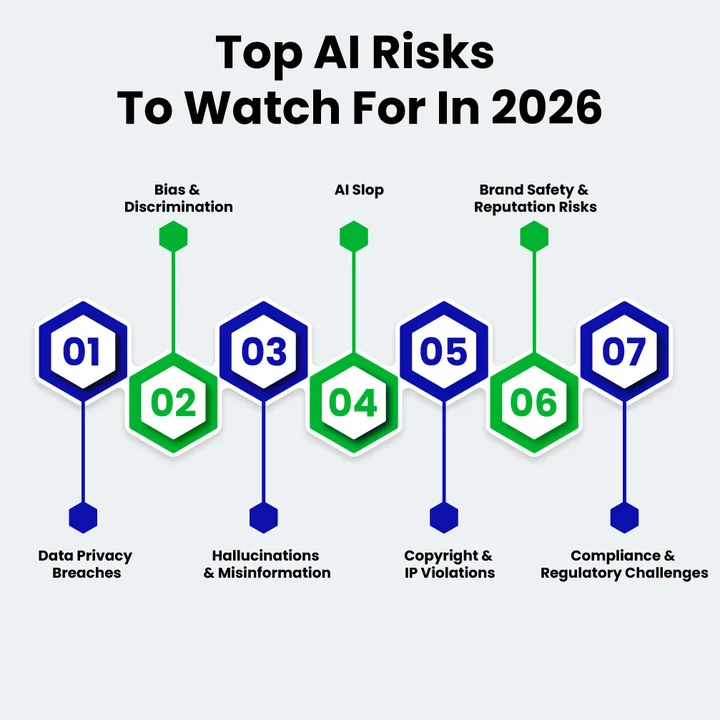
Risk #1: Data Privacy Breaches
When AI systems pull from the wrong data or store inputs poorly, sensitive information can slip through cracks you didn’t even know existed. One privacy leak is enough to shake audience trust for good.
Ways to Reduce It:
- Limit what data your AI tools can access
- Avoid feeding private or customer-identifiable info into models
Risk #2: Bias & Discrimination
AI doesn’t invent bias. It absorbs it from the data it’s trained on, which means it can unintentionally stereotype, exclude, or misrepresent parts of your audience.
How To Mitigate It:
- Review outputs for tone, representation, and fairness
Risk #3: Hallucinations & Misinformation
AI can sound confident even when it’s completely wrong. If you publish something without verifying it, you risk spreading misinformation under your brand name.
Strategies to Prevent It:
- Fact-check every AI-generated claim
- Keep a human editorial layer before publishing
Risk #4: AI Slop
When teams rely too heavily on AI, content starts feeling generic, repetitive, and bland. This kind of “AI slop” (low-quality or off-brand content) makes brands sound identical and drains all personality from your message.
How to Address It:
- Provide strong inputs, examples, and context
- Edit ruthlessly to keep content sharp and human
Risk #5: Copyright & IP Violations
Some AI outputs are too closely aligned with the training data. In visuals, writing, or music, this can accidentally mirror copyrighted work and put your brand at risk.
Strategies to Handle It:
- Use tools that provide commercial-use rights
- Scan visuals and text for potential overlaps
Risk #6: Brand Safety & Reputation Risks
If AI generates something off-tone, inappropriate, or insensitive, your audience won’t blame the algorithm. They will blame you.
How To Mitigate It:
- Set clear brand voice guidelines for AI
- Review sensitive or public-facing outputs manually
Risk #7: Compliance & Regulatory Challenges
AI rules are shifting fast. What’s allowed today might violate a policy tomorrow, especially in regions with strict data and content laws.
How To Avoid It:
- Stay updated on global AI regulations
- Document how your team uses AI tools
In A Nutshell
Generative AI has shifted how content is planned, created, discovered, and delivered. Marketing workflows are faster, smarter, and far more dynamic, from hyper-personalization to answer engines to chatbot-powered experiences.
2026 is a make-or-break year for content marketers. The brands that hesitate will fall behind. Every day spent treating AI as a side tool adds to the disadvantage. Your audience is already searching on AI engines, and competitors are scaling output, testing autonomous workflows, and optimizing AI-driven content strategies.
The next competitive advantage is not just producing more content. It is AI visibility. Being recognized, cited, and trusted by AI engines will separate leaders from laggards.
Success comes from systems, strategy, and governance that turn AI into a true partner, not just another tool. Standing still is not an option. The time to act is now.
Next steps are clear. Review your workflows, spot gaps, and make intentional improvements. Partnering with an AI consulting services company can help you build content AI trusts while mitigating risks.
HubSpot’s CMO Kipp Bodnar summed it up perfectly:
“The future of AI isn’t human vs. AI. It’s human with AI.”
Frequently Asked Questions (FAQs)
2. How Much Of Your Content Strategy Should Rely on AI?
AI is ideal for research, drafts, personalization, and optimization, but humans must guide strategy, storytelling, and brand voice. The most effective teams use AI for 40–60% of execution while maintaining human oversight, ensuring content stays distinctive and resonates with real audiences.
3. How Can You Measure ROI From Generative AI in Marketing?
Look beyond output volume. Measure efficiency gains, improved AI-engine visibility, engagement from hyper-personalized campaigns, reduced ad spend through predictive optimization, and faster testing cycles. Real ROI shows up in smarter decisions, stronger audience connections, and more predictable performance.
Optimize your content marketing with AI-driven systems that maintain brand trust and strategic control.