

Generative AI has moved beyond experimental chatbots and isolated content tools. Businesses are now using it to summarize complex information, assist customer support teams, generate software code, create marketing assets, search internal knowledge, and automate document-heavy workflows.
The value, however, does not come from adopting AI simply because it is available. It comes from selecting a defined business problem, connecting the technology with reliable data and existing systems, and measuring whether it improves speed, quality, cost, or customer experience. Without these foundations, generative AI can introduce inaccurate outputs, privacy concerns, security risks, and unnecessary operational costs.
For business leaders, the real question is not whether generative AI can produce content. It is where the technology can create measurable value while remaining accurate, secure, and appropriately governed. This requires balancing automation with human review and choosing use cases that align with the organization’s workflows, data readiness, and risk tolerance.
This guide explores the main benefits of generative AI for businesses, practical applications across industries, measurable outcomes, implementation steps, and the risks organizations should address before moving from experimentation to production.
What Is Generative AI for Business, and How Is It Used?
Generative AI is a category of artificial intelligence designed to produce new content, text, images, code, audio, or video from prompts or existing data. Organizations use generative AI in business to accelerate content creation, automate design tasks, enhance customer support, and generate new product concepts.
What sets generative AI for business in 2026 apart is the maturity of its models, the scale and diversity of available data, and the efficiency of current computing infrastructure. Advanced architectures enable real-time text generation, multilingual outputs, and context-aware responses that improve customer and employee experiences.
indispensable for businesses in 2026
Generative AI tools offer several capabilities:
Table of Contents
- Content creation for marketing campaigns, social media, newsletters, and product descriptions.
- Creative design, including image, video, or multimedia generation, tailored to brand requirements.
- Automated code generation and document summarization to streamline internal workflows.
- Idea and prototype generation to help teams test and refine concepts faster.
But how are companies actually applying generative AI to their operations in 2026?
Many are embedding it into customer service chatbots capable of natural, human-like conversations. Others use it to draft reports, create proposals, or surface insights from massive data sets. Leading enterprises are weaving these capabilities into their core business strategies to stay competitive.
What about the risks?
Issues such as data privacy, biased outputs, and model hallucinations remain significant. To use generative AI responsibly, organizations need strong governance, ethical guidelines, and ongoing monitoring alongside their deployments.
Struggling with time-consuming workflows? Cut content creation, reporting, and customer support time in half with generative AI.
What Are the Main Benefits of Generative AI for Businesses?
The value of generative AI depends on the business problem it addresses, the quality of the supporting data and systems, and the controls applied to its outputs. The following table summarizes common benefits, practical applications, possible performance metrics, and the risks businesses should consider.
| Benefit | Business application | Possible metric | Main risk |
|---|---|---|---|
| Faster content production | Marketing materials, reports, product descriptions, and internal documentation | Time per approved asset | Inaccurate, duplicated, or off-brand output |
| Employee productivity | Document summaries, enterprise search, and knowledge assistance | Time saved per task | Overreliance on generated answers |
| Customer-support efficiency | Agent-assistance tools, response drafts, and case summaries | Resolution time and response acceptance rate | Incorrect or inappropriate advice |
| Faster software delivery | Code suggestions, documentation, and test-case generation | Review time and development cycle time | Vulnerable or unreliable code |
| Personalized communication | Customer offers, messages, and content variations | Engagement and conversion rates | Privacy concerns and inappropriate targeting |
| Product innovation | Concept exploration, rapid prototyping, and research synthesis | Validation time and number of tested concepts | Investing in unvalidated AI-generated ideas |
These benefits are not automatic. Each use case should have a defined objective, measurable success criteria, appropriate human review, and controls for data privacy, security, accuracy, and compliance.
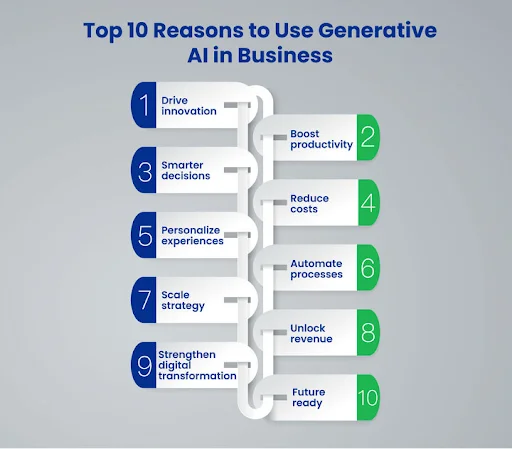
What Are the 10 Main Reasons to Use Generative AI for Business?
Generative AI can create meaningful business value when it is applied to the right processes with reliable data, clear objectives, and appropriate human oversight. From improving employee productivity to supporting innovation and customer experiences, here are ten practical reasons businesses are integrating generative AI into their operations.
With these opportunities and considerations in mind, let’s explore the top 10 reasons why generative AI is becoming indispensable for businesses.
Reason 1: Driving AI-Driven Innovation Across Operations
Generative AI empowers organizations to push innovation deeper into their operations by automating routine work, generating fresh ideas, and revealing new opportunities for improvement. Businesses can make confident, data-driven decisions and explore innovative solutions more quickly by integrating generative AI into routine processes.
Some practical ways generative AI drives innovation include:
- Rapid ideation and prototyping that let teams test new products or services in days instead of weeks.
- Spotting bottlenecks and suggesting smarter workflows to save time and resources across departments.
This approach not only accelerates day-to-day operations but also frees employees to focus on high-impact strategic initiatives, turning innovation from a one-off event into a continuous, scalable process.
Reason 2: Improving Productivity and Efficiency with Generative AI Tools
Generative AI is fundamentally reshaping how organizations work by boosting productivity and simplifying workflows. Instead of spending hours on repetitive, time-consuming tasks, such as drafting marketing content, analyzing large data sets, or preparing reports, teams can now redirect their focus toward high-value activities that drive growth.
Specifically, there are three main ways in which generative AI improves efficiency:
- First, it enables automated content creation for marketing campaigns, newsletters, and product descriptions.
- Next, it supports advanced data analysis, allowing teams to extract insights faster and make more informed decisions.
- Finally, it drives workflow optimization, reducing manual errors and saving hours of employee time across departments.
As a result, organizations adopting generative AI at scale achieve notable productivity gains and bring new offerings to market faster than competitors who still rely on manual processes. Ultimately, by embedding generative AI tools into everyday operations, businesses can boost productivity, reduce costs, and free their teams to concentrate on strategic innovation.
Reason 3: Enabling Smarter Decision-Making Through AI-Powered Solutions
The third reason is that generative AI solutions empower businesses to make smarter, faster decisions. In today’s environment of ever-growing and complex data, these tools help analyze information quickly and deliver actionable insights. As a result, teams can rely on data-driven choices rather than intuition alone.
More specifically, generative AI brings several key benefits:
- Real-time insights: Organizations can access up-to-date information instantly, which speeds up decision-making.
- Predictive analytics: Generative AI can forecast trends, customer behavior, and operational challenges before they unfold.
- Better risk management: Early detection of potential issues helps minimize costly mistakes.
- Optimized strategy: Data-backed insights enable leaders to align operations and improve overall outcomes.
Consequently, organizations that leverage generative AI for decision-making can act proactively, remain agile, and gain a sustained competitive advantage in a fast-changing market.
Reason 4: Reducing Business Costs Using Generative AI Applications
Generative AI applications help businesses significantly lower costs by automating repetitive and time-consuming tasks. For example, AI-driven virtual assistants and chatbots in customer service can handle routine inquiries around the clock, freeing human agents to focus on more complex issues while reducing staffing expenses.
Moreover, cost savings also come from optimizing resources and workflows. Retailers now use generative AI to forecast inventory demand more accurately, preventing overstock and minimizing waste. In manufacturing, generative AI–powered predictive maintenance identifies potential equipment failures before they occur, avoiding expensive downtime and improving asset utilization.
In addition, generative AI helps reduce costly errors across operations. For instance, AI-enabled accounting tools can detect anomalies in transactions, lowering the risk of mistakes and fraud. Businesses can boost overall profitability, cut costs, and improve operational efficiency by implementing generative AI in these ways, freeing up teams to work on higher-value projects.
Reason 5: Personalizing Customer Experiences with AI Business Applications
How can businesses deliver truly personalized experiences to every customer? Generative AI applications make this possible by analyzing customer behavior, preferences, and purchase history to create real-time, tailored interactions that feel unique to each individual.
For example, eCommerce platforms powered by generative AI recommend products based on past purchases, browsing patterns, and even seasonal trends. Similarly, streaming services use these models to suggest content that matches a user’s viewing habits, keeping engagement high and satisfaction levels rising.
In addition, generative AI enables highly targeted marketing campaigns. Businesses can send personalized offers, emails, or notifications that resonate with each customer segment, which increases conversion rates while strengthening loyalty. By utilizing generative AI for personalization, businesses can create enduring customer experiences that increase retention, spur growth, and set their brand apart in a crowded market.
Reason 6: Supporting Business Process Automation and Workflow Simplification
Generative AI applications are redefining how businesses manage repetitive and time-consuming tasks. For example, companies that use generative AI for HR processes such as employee onboarding and payroll management report up to 30% faster processing times while significantly reducing manual errors.
In finance, generative AI–powered tools handle invoice processing and expense tracking more efficiently than traditional systems. Beyond individual departments, generative AI also simplifies complex workflows across the entire organization.
These improvements not only save time but also enhance scalability, enabling businesses to handle higher workloads without increasing headcount or compromising quality. Key benefits of generative AI–powered process automation include:
- Time savings: Automates routine tasks and accelerates workflows.
- Error reduction: Minimizes mistakes in payroll, invoicing, and data entry.
- Operational efficiency: Streamlines cross-department processes for smoother operations.
- Scalability: Supports growing workloads without adding extra staff.
Organizations can increase productivity, cut expenses, and free up staff members for more strategic projects by integrating generative AI into business operations.
Reason 7: Expanding AI Business Strategy for Small and Large Enterprises
Small and medium-sized enterprises (SMEs) are increasingly turning to generative AI to compete on a global scale. For example, small eCommerce businesses now use generative AI–powered recommendation engines to boost sales and deliver personalized customer experiences, achieving conversion rate increases of up to 25%.
Meanwhile, large enterprises are implementing generative AI across multiple departments, from supply chain optimization to predictive maintenance. Industry leaders like Amazon and Siemens leverage generative AI to analyze massive datasets, improve operational efficiency, and make strategic decisions faster, resulting in significant cost savings and higher ROI.
Ultimately, adopting generative AI allows businesses of all sizes to scale smarter and faster. Integrating it into the overall business strategy ensures a stronger competitive advantage, higher efficiency, and sustained long-term growth.
Reason 8: Opening New Revenue Streams Through Generative AI Use Cases
Generative AI is helping businesses create entirely new products and services, thereby opening up additional revenue streams. For instance, media companies now use generative AI to produce personalized content such as news summaries, marketing materials, and social media posts, cutting content creation time by up to 50% while reaching wider audiences.
In addition, retailers and eCommerce platforms apply generative AI to design custom products or recommend unique bundles tailored to individual customers. Similarly, financial institutions employ generative AI–driven insights to deliver personalized investment strategies, generating additional advisory fees and increasing customer engagement.
By integrating generative AI into their operations, businesses can innovate faster, diversify their offerings, and open fresh revenue channels. Generative AI not only increases revenue potential but also strengthens market positioning and customer loyalty.
Reason 9: Strengthening Digital Transformation with Enterprise AI Solutions
Generative AI solutions are expediting digital transformation services by embedding intelligence across every area of business operations. Instead of treating AI as an add-on, companies are now integrating generative AI to improve processes, enhance decision-making, and modernize workflows at scale.
Moreover, generative AI boosts both customer engagement and operational efficiency. For example, banks use it to detect fraud in real time and deliver personalized services, while manufacturing firms rely on it to optimize production lines and monitor equipment performance proactively.
Key benefits of generative AI–driven digital transformation include:
- Automating repetitive tasks and streamlining procedures.
- Improving decision-making through deeper, AI-powered insights.
- Increasing customer interaction by personalizing experiences at scale.
- Reducing inefficiencies and simplifying complex operations.
- Supporting overall digital transformation initiatives with data-driven intelligence.
Businesses can stay ahead in a market that is becoming more and more competitive by implementing generative AI solutions to modernize operations, increase agility, and find new growth prospects.
Reason 10: Preparing Businesses for the Future of AI in Business
As we look ahead, integrating generative AI into business strategies is essential. Companies that proactively adopt these technologies are positioning themselves for long-term success. In fact, a recent report by AlphaSense shows that over 80% of organizations increased their use of generative AI in 2025, signaling a major shift toward AI-driven business models.
Looking forward, the future of generative AI in business will involve deeper integration across all functions, from customer service to supply chain management. Companies that fail to evolve risk falling behind as generative AI becomes a fundamental driver of competitiveness and innovation.
Important considerations for preparing for the future of generative AI include:
- Investing in AI literacy and training to upskill employees.
- Building scalable AI infrastructure and systems to handle growing workloads.
- Exploring innovative use cases for generative AI beyond initial pilots.
- Continuously monitoring AI trends and market shifts to stay ahead.
- Integrating generative AI into long-term strategic planning for sustainable growth.
Businesses can stay competitive in a market that is changing quickly and be ready to implement generative AI successfully throughout their operations by concentrating on these areas.
How Are Businesses Using Generative AI Across Industries?
The benefits of generative AI become clearer when examined through practical industry applications. Although the underlying technology may be similar, every industry uses it differently based on its workflows, customers, data, and regulatory requirements.
1. Healthcare and HealthTech
Healthcare organizations can use generative AI to summarize clinical documents, prepare administrative communication, simplify medical information, and help professionals search extensive knowledge resources.
Because healthcare involves sensitive information and high-impact decisions, generated outputs must comply with privacy requirements and remain subject to professional review. AI should assist qualified healthcare professionals rather than make independent clinical decisions.
2. Banking and Financial Services
Banks and financial institutions can use generative AI to summarize financial documents, assist customer-service representatives, prepare internal reports, review large volumes of information, and support compliance teams.
These applications require strict access controls, audit trails, data protection, and output validation, particularly when AI-generated information could affect financial or regulatory decisions.
3. Retail and eCommerce
Retail businesses can use generative AI to create product descriptions, develop campaign variations, summarize customer feedback, support customer-service agents, and personalize marketing communication.
AI-generated product information should remain connected to verified systems so that prices, product features, stock availability, and delivery details remain accurate.
4. Manufacturing
Manufacturers can apply generative AI to technical-documentation summaries, maintenance instructions, employee training materials, supplier communication, and internal knowledge retrieval.
Generated instructions should be reviewed against approved engineering documents and workplace safety procedures before being used in operational environments.
5. Software and SaaS
Software teams can use generative AI to suggest code, prepare technical documentation, generate test cases, summarize development issues, and support debugging.
However, AI-generated code may contain security vulnerabilities, performance problems, or incorrect dependencies. It must undergo peer review, testing, and security scanning before deployment.
Businesses requiring tailored systems can work with an experienced AI and machine learning development company to develop production-ready solutions.
6. Marketing and Media
Marketing teams can use generative AI to prepare campaign concepts, content outlines, video scripts, social media variations, research summaries, and localized messaging.
Human review remains necessary to protect factual accuracy, brand consistency, intellectual property, and responsible audience targeting.
7. Logistics and Supply Chain
Logistics companies can use generative AI to summarize shipment information, prepare operational reports, assist support teams, interpret supply-chain data, and improve access to internal procedures.
Generative AI can explain information and recommend possible actions, but operational decisions should rely on verified logistics, inventory, and transportation data.
The strongest industry applications do not use generative AI as an isolated content tool. They integrate it with reliable data, established workflows, employee expertise, and measurable business objectives.
What Risks Should Businesses Consider When Using Generative AI?
Generative AI can improve productivity and support innovation, but it also introduces operational, legal, security, and reputational risks. Businesses should evaluate these risks before implementation and establish clear controls for how AI systems access data, generate outputs, and influence decisions.
1. Inaccurate or Fabricated Outputs
Generative AI can produce responses that appear convincing but contain incorrect or fabricated information. This is commonly described as an AI hallucination.
Businesses should connect AI applications to approved information sources, test outputs systematically, display relevant source references where possible, and require human review for high-impact decisions.
2. Data Privacy and Confidentiality
Employees may unintentionally enter customer records, business strategies, source code, financial information, or other confidential data into unauthorized AI tools.
Organizations should establish clear AI usage policies, classify sensitive data, restrict access, and confirm how technology providers store and process submitted information.
3. Security Vulnerabilities
Generative AI applications can be exposed to prompt injection, unauthorized data access, insecure integrations, and manipulated inputs. AI-generated code may also introduce vulnerabilities into software products.
Security testing, restricted system permissions, input validation, access controls, monitoring, and secure integration practices should be part of the implementation process. The OWASP guidance for LLM and generative AI security provides further information about common technical risks.
4. Bias and Unfair Outcomes
AI-generated results may reflect bias present in training data, organizational information, or system design. Biased outputs can affect hiring, customer service, financial services, and other sensitive processes.
Teams should test systems using representative scenarios, involve relevant subject-matter experts, monitor outcomes, and establish escalation procedures for potentially harmful outputs.
5. Copyright and Intellectual Property
AI-generated text, images, code, and other materials may create questions about ownership, licensing, originality, and attribution.
Businesses should define how generated content may be used, review vendor terms, verify important outputs, and seek specialist legal guidance for commercially sensitive applications.
6. Regulatory and Compliance Requirements
AI regulations vary across industries and regions. Businesses may need to meet requirements related to privacy, transparency, recordkeeping, risk classification, or human oversight.
Legal, security, compliance, and business teams should be involved before deploying AI in regulated or high-impact workflows.
7. Overreliance on AI
Employees may accept AI-generated answers without checking their accuracy, particularly when responses are written confidently.
Organizations should train employees on the capabilities and limitations of generative AI, clearly identify which outputs require validation, and ensure accountability remains with appropriate human decision-makers.
8. Lack of Clear Ownership
Problems can become difficult to address when no one is responsible for the model, data, security, output quality, or business results.
Every generative AI initiative should have defined business, technical, data, and risk owners. Teams should also document how incidents are reported and who can pause or modify the system.
9. Unexpected Implementation Costs
The total cost of generative AI may include model usage, cloud infrastructure, integrations, data preparation, security, monitoring, employee training, and ongoing maintenance.
Businesses should calculate the total cost of ownership and compare it with measurable improvements in speed, cost, quality, or customer experience.
10. Model and Performance Changes
AI performance can change as models, data sources, user behavior, and business processes evolve. A solution that performs well during a pilot may not maintain the same quality after broader deployment.
Continuous evaluation, usage monitoring, quality checks, and periodic risk reviews are therefore necessary after launch.
Generative AI risk cannot be eliminated completely, but it can be managed. The objective is to balance innovation with appropriate governance, security, human oversight, and measurable accountability.
Frequently Asked Questions (FAQs)
2. How Do Companies Use Generative AI?
Companies use generative AI to draft content, summarize documents, assist with coding, search internal knowledge, create visual concepts, and support customer-service teams. It can also extract information and automate selected steps within existing business workflows.
3. Is Generative AI Suitable for Small Businesses?
Yes. Small businesses can use generative AI for marketing drafts, customer communication, meeting summaries, research, and administrative support. They should begin with a focused use case, protect confidential information, and review AI-generated outputs before using them.
4. Can Generative AI Reduce Business Costs?
Generative AI may reduce the time and manual effort required for selected tasks. However, businesses should consider software, model usage, integrations, security, employee training, and maintenance when calculating the total cost and expected return on investment.
5. What Are the Main Risks of Generative AI for Businesses?
The main risks include inaccurate outputs, data leakage, bias, security vulnerabilities, copyright concerns, and overreliance on AI. Businesses can manage these risks through access controls, systematic testing, employee training, clear governance policies, and human oversight.
6. How Can Businesses Measure the ROI of Generative AI?
Businesses can measure generative AI ROI by comparing implementation and operating costs with improvements in task-completion time, process costs, output quality, customer-resolution time, employee adoption, or revenue. Quality and risk indicators should be measured alongside financial outcomes.
Final Takeaway: Why Should Your Business Use Generative AI?
Generative AI can help businesses improve productivity, simplify knowledge-intensive processes, enhance customer experiences, and explore new growth opportunities. However, adopting an AI tool alone does not guarantee meaningful results.
Successful implementation begins with a clearly defined business problem, reliable data, measurable objectives, and appropriate human oversight. Businesses should begin with a focused use case, evaluate its performance and risks, and scale the solution only when it demonstrates measurable value.
Clustox helps organizations develop a practical adoption roadmap through its AI strategy consulting services, which automate complex workflows with AI agent development, and turn validated ideas into secure, integrated solutions through AI app development services.
Ultimately, the businesses that gain the most value from generative AI will not simply be the earliest adopters. They will be the ones that connect AI with meaningful business problems, responsible governance, and measurable outcomes.
Too many repetitive tasks are slowing your team down? Shift the burden to generative AI and let your employees focus on strategic growth.