

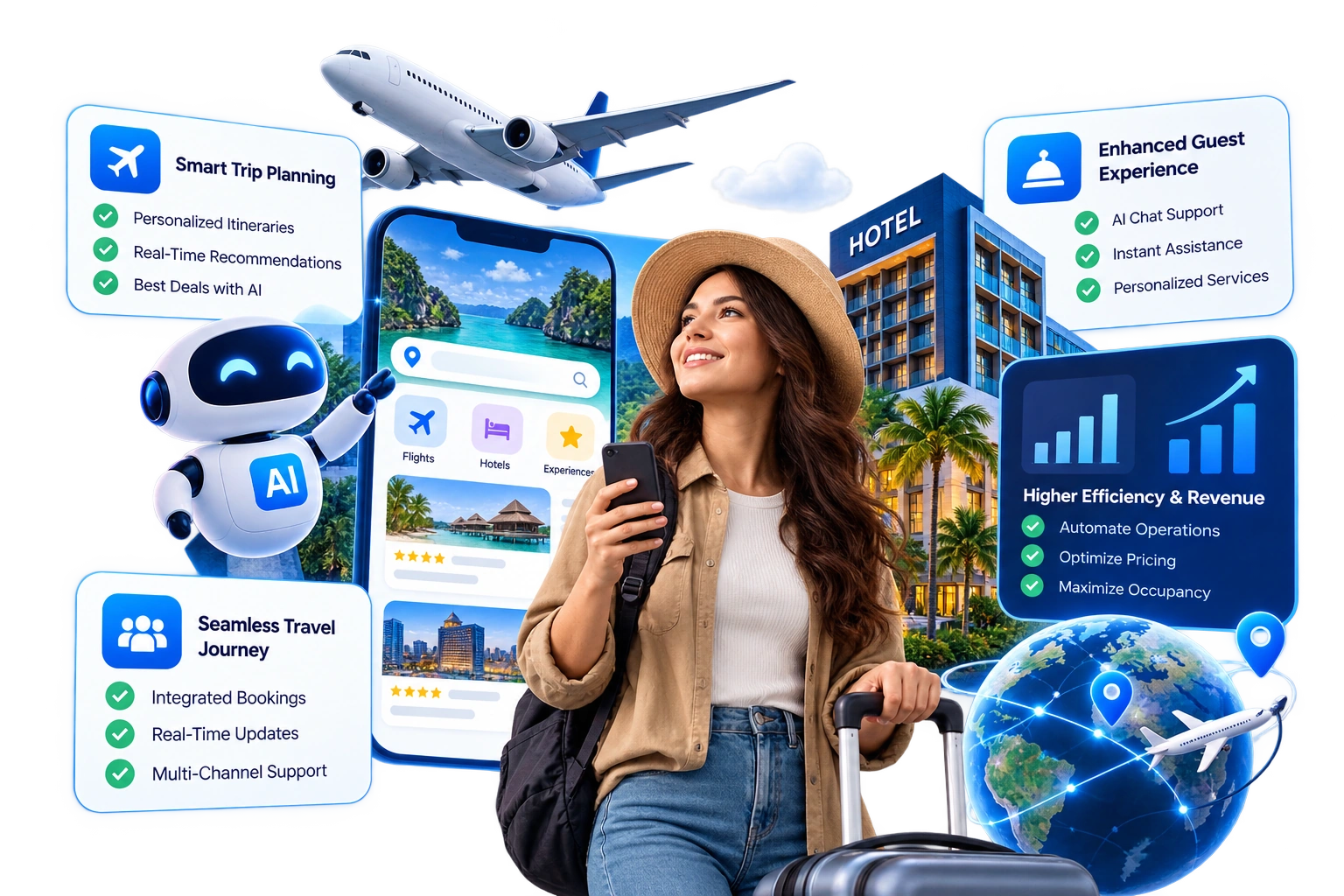
Travel and hospitality companies often struggle to keep guests happy while managing bookings, pricing, and daily operations.
Have you ever wondered why some hotels thrive while others fall behind?
In fact, recent numbers show that 75% of hotels using AI report higher guest satisfaction, and 52% say it significantly reduces operational costs, boosting overall performance and service quality.
The problem is clear: relying on traditional processes often leads to long wait times, manual pricing errors, and slow guest response, frustrations that can quickly harm revenue and reputation.
Meanwhile, competitors adopting AI-powered solutions gain a clear advantage by automating tasks and analyzing data in real time.
In this guide, we’ll talk about:
- Why AI is now essential in travel and hospitality
- How automation can simplify operations and reduce errors
- Ways personalized experiences improve guest loyalty
- How intelligent pricing strategies boost revenue
Let’s get started and see how these solutions can help your business stay ahead.
What are the Challenges Facing Modern Travel and Hospitality Businesses?
Guest expectations are higher than ever: 86% of travelers are willing to pay more for a better customer experience, while 70% prefer personalized service when booking holidays, indicating that expectations have skyrocketed beyond traditional service models.
Table of Contents
Travel and hospitality companies face multiple challenges as guest demands evolve and competition intensifies. Traditional manual systems and outdated processes struggle to meet the needs of modern travelers, often leading to frustrated guests, operational bottlenecks, and lost revenue.
The Main Obstacles Include:
- Rising Guest Expectations: Modern travelers want instant confirmations, personalized recommendations, and seamless interactions at every touchpoint.
- Operational Inefficiencies: Manual booking processes, pricing mistakes, and staff scheduling issues increase errors, slow service, and raise operational costs.
- Underutilized Data: Companies collect large amounts of guest and booking data, but without AI, much of this information remains unused and fails to drive better decision-making.
- Technology Gaps: Travelers increasingly prefer digital communication channels and contactless service, yet many businesses lack the tools to effectively support these preferences.
- Competitive Pressure: Businesses adopting AI and digital solutions can respond faster and deliver smoother guest experiences, leaving traditional operators struggling to keep up.
These challenges make it clear why relying solely on traditional, manual workflows is no longer enough for travel and hospitality businesses aiming to meet guest expectations and stay competitive in a fast‑evolving industry.
Why Should Travel and Hospitality Businesses Adopt AI Solutions Today?
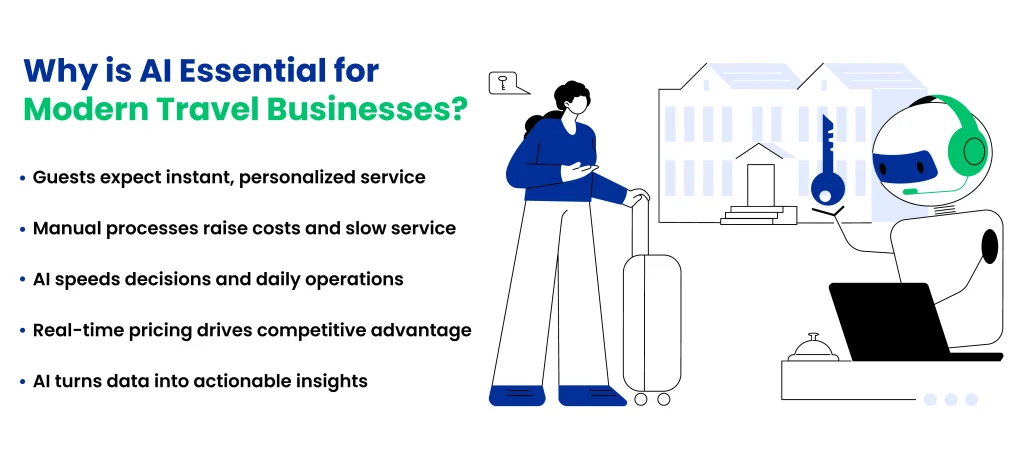
Travel and hospitality businesses face growing pressure to meet rising guest expectations, manage complex operations, and stay ahead of competitors. Guests now expect instant responses, personalized experiences, and consistent service at every touchpoint.
At the same time, relying solely on manual workflows can lead to long wait times, pricing errors, scheduling conflicts, and frustrated staff, all of which impact revenue and guest satisfaction.
Adopting AI solutions helps businesses tackle these challenges while delivering measurable benefits.
1. Automation to Simplify Operations
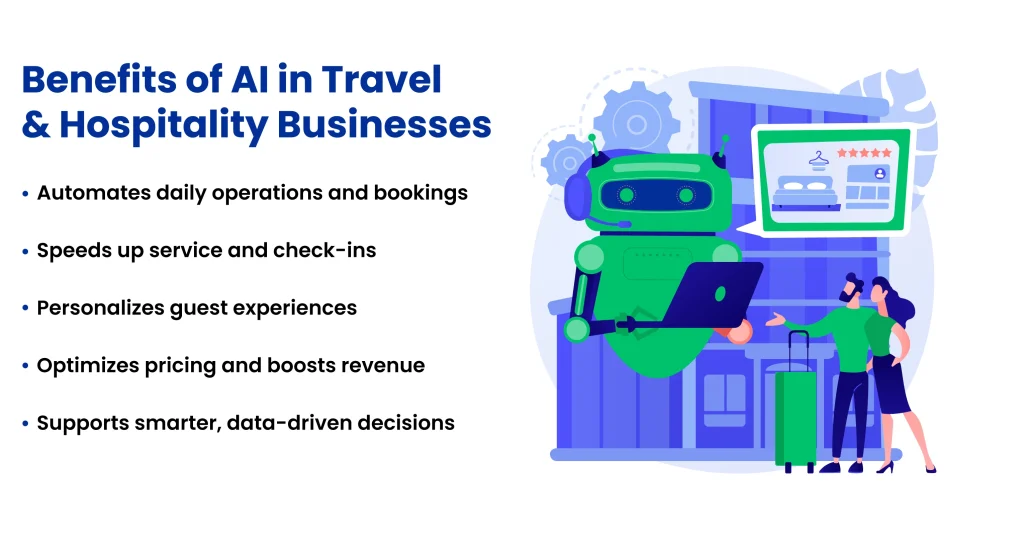
Manual processes slow down daily operations and increase errors. AI can automate bookings, cancellations, staff scheduling, and housekeeping assignments.
- How it works: AI predicts housekeeping schedules, assigns rooms based on guest preferences, and automates repetitive tasks.
- Business impact example: Hotels using AI have reduced check-in delays by up to 30%, allowing staff to focus on guest care.
- Risk of not using AI: Without automation, operational inefficiencies persist, leading to slower service and lower guest satisfaction.
2. Personalized Guest Experiences
Guests remember when their preferences are valued. AI personalization enables tailored offers, room suggestions, and curated recommendations. Tools like AI chatbot development can provide instant communication with guests at every touchpoint.
- How it works: AI analyzes guest behavior, past bookings, and preferences to anticipate needs.
- Business impact example: 68% of travelers remain loyal to hotels that offer personalized experiences, leading to higher repeat bookings and positive reviews.
3. Optimized Pricing and Revenue Growth
Pricing decisions without real-time insights can be costly. AI-powered pricing tools adjust rates based on demand, competition, and seasonal trends.
- How it works: AI continuously monitors market conditions and suggests optimal pricing strategies.
- Business impact example: One hotel chain boosted weekend bookings by 15% after implementing AI pricing optimization.
- Risk of not using AI: Businesses may underprice rooms, lose revenue opportunities, or confuse guests with inconsistent rates.
4. Data-Driven Decision Making
Hotels generate large volumes of data, but without AI, much of it remains underutilized. AI transforms this data into actionable insights.
- How it works: AI analyzes occupancy trends, guest behavior, and operational performance to inform decisions.
- Business impact example: Resorts can allocate staff more efficiently, adjust amenities, and improve overall guest satisfaction.
Addressing Common Hesitations
Many businesses hesitate to adopt AI due to budget, integration, or training concerns:
- Budget: Start with high-impact areas and expand gradually.
- Integration: Modern AI works seamlessly with booking, CRM, and operations software.
- Training: Intuitive interfaces and guided support ensure employees adopt tools effectively.
AI adoption is no longer optional. Businesses that implement AI strategically can enhance guest satisfaction, streamline operations, increase revenue, and maintain a competitive edge.
For companies ready to implement these solutions, travel and hospitality software development services offer customized systems that improve operations, enhance guest experiences, and boost revenue.
75% of hotels using AI are achieving higher guest satisfaction, faster check-ins, and smoother operations.
When will your business start seeing the same results?
What are the Risks and Considerations When Adopting AI in Travel and Hospitality?
While AI can transform travel and hospitality businesses, implementing it requires careful planning. Without the right strategy, tools, and preparation, companies may face challenges that limit the effectiveness of their technology.
Significant risks and considerations include:
- Implementation Costs and Time: Deploying AI solutions involves investment in software, hardware, and staff training. Businesses need to budget carefully to ensure the return on investment is worth the effort.
- Staff Training and Adaptation: Employees must learn how to use AI tools effectively. Without proper guidance, even powerful AI systems may fail to deliver the expected benefits.
- Data Privacy and Security: Handling sensitive guest data requires robust security measures and compliance with regulations such as GDPR. Neglecting data privacy can harm reputation and result in legal consequences.
- Choosing the Right AI Tools: Not every AI solution fits every business. Selecting the wrong tools can waste time, money, and resources, delaying improvements in operations and guest experiences.
- Integration Challenges: AI systems need to integrate seamlessly with existing booking, CRM, and operational software. Poor integration can disrupt workflows rather than improve efficiency.
Travel and hospitality companies can successfully implement AI by carefully considering these factors. It opens the door to increased productivity, improved visitor experiences, and higher profits.
How to Decide Which AI Solutions Fit Your Travel Business?
AI adoption in travel and hospitality requires the right strategy, tools, and implementation approach. Businesses looking to modernize operations and improve guest experiences benefit most when AI solutions are designed around their specific needs.
Adopting AI isn’t one-size-fits-all. Each hotel or travel service has unique operations, guest expectations, and growth goals, so choosing the right solution requires careful consideration.
Notable factors to evaluate before adopting AI:
- Business Goals: Identify what you want AI to achieve, whether it’s faster check-ins, personalized guest experiences, optimized pricing, or better data insights. Prioritizing goals helps you select the right tools.
- Integration with Existing Systems: Check how well the AI platform integrates with your current booking systems, CRM, and operations software. Simple integration reduces disruptions and ensures a smoother rollout.
- Scalability: Ensure the solution can grow with your business, handling more guests, additional properties, or more complex operations without requiring a complete overhaul.
- Staff Training and Adoption: Consider your team’s learning curve. Solutions with intuitive interfaces or training support reduce adoption friction and maximize ROI.
- Cost vs. Expected ROI: Balance upfront investment with the potential benefits—reduced operational costs, higher revenue, improved guest satisfaction, and loyalty.
By evaluating goals, integration, scalability, training, and ROI, hotels and travel services can choose AI solutions that deliver real business value and are practical to implement.
How Can Clustox Help Travel and Hospitality Businesses?
AI works best when it solves real business problems, not just automates tasks. That’s exactly what Clustox does for travel and hospitality companies: we partner with businesses long-term to implement AI solutions that are tailored to their unique operations, guest experiences, and growth goals.
What sets Clustox apart:
- Customized AI Solutions: Unlike one-size-fits-all tools, Clustox designs AI systems based on your business model, guest profiles, and operational workflows.
- Ongoing Support and Optimization: We don’t just deploy AI and leave; you get continuous monitoring, updates, and insights to ensure the solution evolves with your business.
How Clustox delivers results:
- Automating Daily Tasks: Clustox automates bookings, cancellations, and staff scheduling, reducing errors and freeing teams to focus on guest care. This ensures smoother operations and faster service delivery.
- Personalizing Guest Experiences: Our AI solutions services remember guest preferences, suggest activities, and deliver customized offers. This enhances the stay experience, encourages repeat visits, and builds long-term loyalty.
- Optimizing Pricing and Revenue: Clustox uses AI to adjust room rates dynamically based on demand, competition, and seasonal trends. This increases occupancy and revenue without confusing guests.
- Turning Data into Actionable Insights: By analyzing guest behavior and operational metrics in real time, Clustox helps managers make smarter decisions, allocate resources efficiently, and plan strategically for the future.
The Clustox Advantage:
With Clustox, travel and hospitality businesses gain a trusted long-term AI partner, not just a vendor. We help you adapt, scale, and continuously improve your AI-powered operations, delivering tangible results in guest satisfaction, efficiency, and revenue growth.
Frequently Asked Questions (FAQs)
2. Can Smaller Hotels and Travel Businesses Benefit from AI?
Absolutely. Even smaller operations can use AI to save time, reduce errors, and improve guest experiences without adding staff. AI insights also help make smarter growth and marketing decisions.
3. How Long Does It Take to Implement AI in Travel and Hospitality?
Implementation time depends on the size of the business, the complexity of operations, and the type of AI solution being deployed. A basic AI tool for bookings or pricing optimization can be implemented within a few weeks, while more comprehensive solutions, covering personalization, analytics, and automation, might take 2–4 months.
4. What Are the Costs of Adopting AI Solutions?
Costs vary depending on the level of customization, system integration, and scale of operations. While there is an upfront investment, AI adoption can significantly reduce operational expenses over time by reducing staffing errors, optimizing pricing, and automating tasks. Many businesses see a strong ROI within the first year by increasing occupancy, boosting revenue, and improving guest satisfaction.
5. How Difficult is Integration With Existing Systems?
Modern AI platforms, like those developed by Clustox, are designed to integrate seamlessly with booking, CRM, and operational software. Proper planning and configuration ensure minimal disruption during adoption.
6. What Should a Hotel or Travel Business Do First When Adopting AI?
Start with one AI use case that solves an immediate operational or guest experience problem.
A focused rollout helps reduce risk and deliver faster results:
- Identify a clear issue, such as slow check-ins or pricing errors
- Select an AI tool that fits your current systems
- Test on a small scale before expanding
- Train staff alongside implementation
This approach helps businesses move from experimentation to confident, results-driven AI adoption.
Conclusion
To sum up, AI‑powered travel and hospitality solutions are transforming the way modern businesses operate. From automating daily operations and optimizing pricing to delivering personalized guest experiences and turning data into actionable insights, AI helps businesses operate smarter, faster, and more efficiently.
Looking ahead to travel and hospitality AI trends, the AI market in travel and hospitality is projected to grow substantially from USD 15.69 billion in 2024 to over USD 58 billion by 2029, at a strong annual growth rate of around 30 percent, indicating that adoption will only accelerate in the coming years.
The Takeaway?
Hotels and travel services that embrace AI can reduce costs, enhance guest satisfaction, and make data-driven decisions that drive long-term growth.
For businesses ready to modernize and elevate their operations, exploring AI solutions, like those offered by Clustox, is the next step toward staying ahead in a rapidly evolving industry.
Do you want to transform your travel business with industry-leading AI?