


The global Electronic Medical Records market is expected to reach $34.50 billion in 2025. By 2030, the size will go up to a straight $44.26 billion. That’s massive growth.
Still, choosing between cloud-based and on-premises EMRs can feel a lot like deciding between owning a car and relying on a ride-sharing service.
The former gives you complete control, but every breakdown and maintenance issue falls on you. On the other hand, the latter option feels lighter and more flexible. But there’s a caveat: you have to trust it won’t let you down.
For many healthcare administrators, this choice impacts not just daily operations but also patient safety, cost planning, and long-term growth.
Should we risk the EHR data security in the cloud? Can our staff handle an on-premise EMR system?
And what about the long-term EMR implementation cost… Could it quietly blow our budget?
This blog will answer all of your questions. We’ll go over the differences between cloud and on-prem EMR solutions, weigh their pros and cons, and help you figure out which model best fits your facility.
What Is EMR And Why Should Your Facility Care?
Electronic medical records (EMRs) are digital versions of a patient’s medical history. They keep all critical information in one place, including diagnoses, lab results, medications, and treatment plans.
Table of Contents
A well-managed EMR system can simplify daily workflows, reduce errors, and improve communication between healthcare providers. A 2025 study found that EMRs can save healthcare providers an average of 75 minutes per patient.
Now, you might wonder how EMRs differ from EHRs.
While EMRs manage patient data within a single facility, Electronic Health Records (EHRs) allow information to be shared across clinics, hospitals, and specialists.
With the latest AI technologies shaping healthtech, EMRs are also evolving. They help providers analyze data faster, spot trends, and deliver better patient care.
But now, let’s get into the different types of EMR systems and what sets them apart.
What Is Cloud-Based EMR and Why Is It Becoming Popular?
A cloud-based EMR is hosted on the provider’s servers and accessed through the internet. It eliminates the need for local servers and reduces in-house IT management. The system is maintained by the vendor, who ensures updates, backups, and regulatory compliance.
Cloud EMRs are gaining popularity, particularly as telemedicine and remote access become standard in patient care. They also enable interoperability, which is one of the top features every healthcare SaaS should have in 2026.
What Are The Pros And Cons Of Cloud-Based EMR?
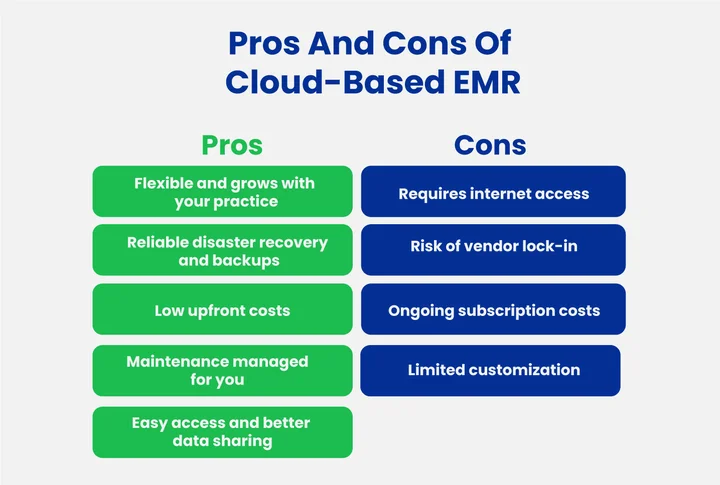
Cloud-based EMRs offer a mix of strengths and weaknesses that impact cost, flexibility, and daily operations. Knowing both the upsides and downsides helps you choose the right solution for your facility.
The table below breaks down the advantages and disadvantages of cloud-native EMRs to understand which fits your practice best:
What Is On-Premise EMR And Who Should Consider It?
An on-premise EMR system is installed locally on a healthcare facility’s servers and managed internally. Hospitals or clinics maintain complete control over data and infrastructure. This approach can feel more secure to organizations that handle highly sensitive patient information.
On-premise EMRs are often preferred by larger institutions with in-house IT teams, legacy systems, and regulatory requirements.
What Are The Pros And Cons Of On-Premise EMR?
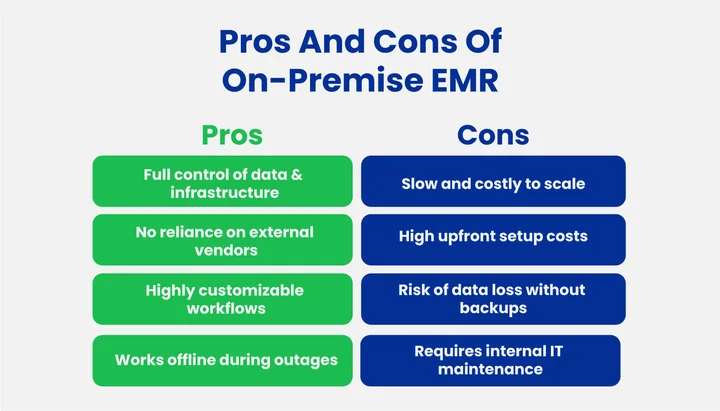
On-premise EMRs come with trade-offs that affect control, cost, and operational complexity. Weighing the advantages against the disadvantages helps facilities decide if managing everything internally makes sense.
Here’s a closer look at the specific pros and cons to understand what an on-premise system really offers in the form of a table:
Stop Losing Hours on Scattered Patient Records & Start Accessing Info Instantly
Comparison Between Cloud-Based vs. On-Premise EMR
We’ve now got a basic understanding of both EMR solutions.
Why not do a side-by-side comparison that shows how cloud EMR software and on-prem EMR systems differ across key parameters?
This comparison will make it easier to see which system fits your facility’s needs and long-term strategy.
| Feature | Cloud EMR | On-Premise EMR |
|---|---|---|
| Model Type | Subscription-based SaaS | Perpetual license |
| Cost | Lower upfront, ongoing fees | High upfront, lower long-term |
| Scalability | High, flexible | Moderate, slower |
| Security | Managed by the provider, shared responsibility | Full control, IT-dependent |
| Implementation Time | Weeks to months | Months to a year |
| Remote Access | Easy, from anywhere | Limited, local network |
| Customization | Moderate | High |
What Factors To Consider When Choosing Between Cloud and On-Prem EMR?
Even with all the information we have shared with you so far, it can get pretty tough to figure out which one to go with (choosing a partner wouldn’t have been that hard, would it?).
To make it easier for you, we’ve listed some essential factors you should keep an eye on when evaluating SaaS EMR vs. on-premises EMR.
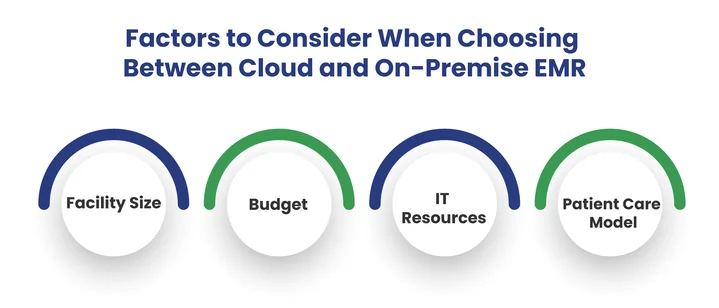
1. Facility Size
The size of your healthcare facility impacts how scalable and flexible your EMR system needs to be. Smaller clinics may not need complex infrastructure, while larger hospitals often require a system that can handle high volumes of patient data.
2. Budget
Your budget determines if a low upfront cost or a long-term investment makes more sense. Cloud EMRs typically have smaller initial costs but involve ongoing subscription fees.
On-premise systems, on the other hand, require high upfront investment but may reduce recurring expenses over time.
3. IT Resources
The availability of in-house IT expertise affects which system can be managed efficiently.
Cloud EMRs reduce the burden of server maintenance, backups, and cloud security. On the other hand, on-premise systems demand dedicated IT staff.
Your patient care approach can influence the right EMR choice. Maybe it’s heavily telemedicine-focused or primarily in-person.
Cloud EMRs are exceptional in supporting telemedicine and enabling remote access to EHR. At the same time, on-premises systems may be better suited to traditional, location-based care.
The Bottom Line
What is it, then? Cloud or On-premise?
In either case, no system is inherently flawed. It all depends on your facility’s priorities, resources, and long-term vision. Healthcare IT is evolving constantly, and making the right choice today can set your facility up for growth, reliable data protection, and consistent sharing of patient records across systems.
Once you’ve narrowed down your preference, having experts guide the implementation can make all the difference.
A trusted healthcare software provider ensures a smooth setup, regulatory alignment, and ongoing support, enabling hospitals and clinics to adopt systems that balance flexibility, security, and compliance.
Which trade-off feels more real for your facility: flexibility or complete control?
Frequently Asked Questions (FAQs)
2. What Are the Key Considerations When Migrating On-Premise EMRs to the Cloud?
Migrating safely requires planning to protect sensitive records and maintain workflow continuity. Tools and strategies for migrating on-premises EMR to the cloud safely focus on secure data transfer, backup validation, and testing EMR disaster recovery capabilities in the cloud.
3. How Does Cloud-Based EMR Improve Telehealth and Interoperability?
Cloud-based EMR software supports telemedicine by allowing providers to access patient records remotely and EMR interoperability by sharing data across multiple locations. This enables faster decision-making, better care coordination, and seamless integration with digital medical records and other clinical systems.
4. Is a Cloud-Based EMR Cheaper Than an On-Premise EMR?
It depends on your facility’s size, IT resources, and growth plans. While cloud EMR software usually has lower upfront costs and predictable subscription fees, on-prem EMR vendor solutions can be more cost-effective for large hospitals due to lower recurring expenses and complete control over infrastructure. Conducting an EMR cost comparison helps determine which option offers the best return on investment.
Struggling to Pick the Right EMR for Your Facility?