

Have you wondered how AI can understand and generate human-like language?
LLM artificial intelligence, referring to large language models, is reshaping how businesses process text, assist users, and automate tasks. These models use advanced neural networks to interpret and produce content that often feels conversational and useful.
LLM AI technology is now more common than many realize. According to the Gartner report, over 80% of enterprises will have used generative AI models or deployed generative AI-enabled applications in production by 2026, up from under 5% in 2023, indicating rapid adoption across industries.
This blog looks into how LLM AI technology works, significant use cases, architecture essentials, and how companies are applying this powerful technology to real business challenges.
Let’s get into it!
What is LLM Artificial Intelligence, and How Does it Work?
LLM artificial intelligence is transforming how machines understand and generate human-like language. Using the right open-source LLM can help organizations implement these AI capabilities more effectively and reduce development complexity.
These models can answer questions, summarize content, and even create original text, making them essential for modern AI applications.
These models can answer questions, summarize content, and even create original text, making them essential for modern AI applications.
Table of Contents
Now we discuss the following thing: how LLM AI technology actually works, including the core mechanisms that enable these generative AI models to function effectively.
How Does Large Language Models’ AI Technology Work?
Large language models use advanced techniques to understand, interpret, and generate human-like text. These models are the foundation of LLM AI technology and enable generative AI models to deliver meaningful results across industries. Understanding the key components helps explain why these models are so powerful.
The main elements that make large language models work include:
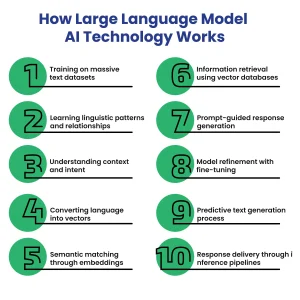
- Transformer models: Process text efficiently while understanding context across long sentences and paragraphs.
- Neural networks for language models: imitate human learning patterns to predict text sequences accurately.
- Embeddings: Convert words and phrases into numerical vectors, helping the AI understand semantic meaning.
- Vector databases: Store embeddings for fast retrieval, enabling accurate and relevant responses.
- Prompt engineering: Carefully designed prompts guide the model to produce precise outputs.
- Fine-tuning LLM models: Customizing pre-trained models on specific datasets improves task-specific performance.
- AI inference pipelines: Manage how inputs are processed, predictions are generated, and outputs are delivered efficiently.
For instance, McKinsey & Company reports that generative AI could automate 60–70% of work activities through advanced natural language understanding, underscoring how large language models are transforming business processes.
Understanding how these components work together reveals why LLM AI technology is essential for modern AI language models and enterprise solutions.
Now we can explore the practical ways businesses are applying this technology to solve real-world challenges.
What are the Use Cases of LLM Artificial Intelligence?
LLM artificial intelligence is reshaping how organizations operate across industries. Businesses are actively adopting AI language models to automate communication, analyze information, and improve operational efficiency.
Real-world LLM applications continue to grow as companies integrate intelligent systems into everyday workflows.
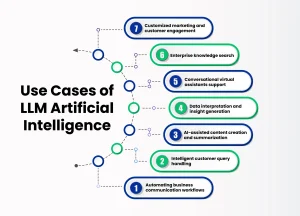
1. Customer Support Automation
Organizations use AI language models to manage customer queries through chatbots and virtual assistants, providing instant support and improving satisfaction. These systems also help businesses build smarter workflows with GPT-5, streamline routine tasks, and free up team resources so employees can focus on higher-value work that drives results.
2. Content Creation and Summarization
Content teams rely on generative AI models to draft articles, summarize reports, and generate emails efficiently. LLM AI technology processes large volumes of information quickly, helping businesses maintain consistency while reducing manual effort.
3. Data Analysis and Business Insights
Companies apply large language models to interpret structured and unstructured data. These systems identify patterns, extract insights, and generate readable summaries that support faster decision-making.
4. Virtual Assistants and Chatbots
Modern assistants powered by large language models understand conversational context and user intent. Businesses use these assistants for scheduling, internal support, and knowledge retrieval, improving productivity across departments.
5. Enterprise Knowledge Management
Many organizations implement enterprise LLM solutions to organize internal documentation and automate information retrieval. Employees gain faster access to accurate knowledge, reducing time spent searching across multiple systems.
6. Personalization in Marketing and E-Commerce
Marketing teams apply generative AI models to create personalized recommendations and messaging. These LLM applications analyze user behavior and preferences, helping businesses deliver relevant customer experiences.
Automate up to 70% of customer queries, content tasks, and workflows using practical LLM AI applications.
Now we discuss the next topic, the architecture that enables these systems to function effectively behind the scenes.
What Is the Architecture of LLM Artificial Intelligence?
The architecture of LLM artificial intelligence defines how models process information, understand context, and generate accurate responses. Modern large language models rely on layered computational systems that combine data processing, learning mechanisms, and intelligent prediction workflows.
Each component works together to make LLM AI technology reliable and scalable for real-world applications.
Understanding this architecture helps explain how generative AI models deliver meaningful outputs across enterprise and consumer environments.
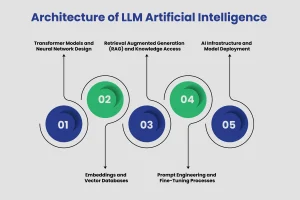
1. Transformer Models and Neural Network Design
At the core of AI language models are transformer models, which enable machines to analyze relationships between words within a sentence. These models process entire sequences simultaneously rather than reading text word by word, thereby improving contextual understanding.
Neural language models learn patterns from large datasets and adjust internal parameters during training. This learning process allows large language models to predict text accurately and generate human-like responses.
2. Embeddings and Vector Databases
Text data must be converted into numerical representations before machines can understand it. Embeddings represent words and phrases as mathematical vectors that capture meaning and context. Similar concepts appear closer together in this vector space, helping the model recognize relationships.
Vector databases store these embeddings efficiently, allowing fast retrieval of relevant information. This structure improves response accuracy and supports scalable LLM applications used in enterprise environments.
3. Retrieval Augmented Generation and Knowledge Access
Many modern systems improve accuracy using retrieval augmented generation (RAG). This approach connects generative AI models with external knowledge sources instead of relying only on pre-trained data.
RAG enables LLM-based AI to retrieve up-to-date information, combine it with learned knowledge, and generate more reliable outputs. Businesses use this method to power internal search tools and intelligent assistants.
4. Prompt Engineering and Fine-Tuning Processes
Performance depends heavily on how instructions are given to the model. Prompt engineering guides AI language models to produce structured and relevant responses. Clear prompts improve accuracy and reduce unwanted outputs.
Organizations also apply fine-tuning to LLM models using domain-specific datasets. This process adapts general-purpose models into specialized enterprise LLM solutions suited for healthcare, finance, or customer service workflows.
5. AI Infrastructure and Model Deployment
Behind every working system lies a strong AI infrastructure that supports training, inference, and scalability. AI inference pipelines manage how user input moves through the model and how responses are generated efficiently.
Successful model deployment requires reliable cloud platforms and scalable environments, often using cloud & DevOps services. Businesses often build solutions using OpenAI GPT models, Google Gemini, Anthropic Claude, Meta Llama models, Azure OpenAI, AWS Bedrock, and Hugging Face, depending on performance and integration needs.
This architectural foundation allows LLM artificial intelligence to operate efficiently across industries, supporting applications that require speed, accuracy, and adaptability.
Now we turn to understanding how organizations apply this technology directly in business environments.
What are the Business Applications of LLM Artificial Intelligence?
LLM artificial intelligence is no longer limited to experimentation or research environments. Organizations across industries are integrating AI language models into core business operations to improve efficiency, automate workflows, and improve decision-making through AI consulting solutions.
From customer engagement to internal productivity, LLM AI technology is enabling businesses to operate smarter and respond faster to changing market demands.
Below are the major business applications in which large language models are having a measurable impact.
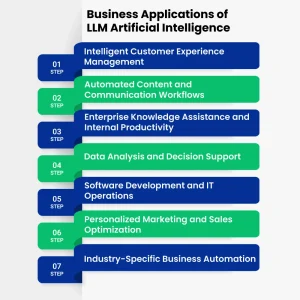
1. Intelligent Customer Experience Management
Businesses are using LLM artificial intelligence to transform customer interactions across digital platforms. AI-powered chatbots and virtual assistants provide real-time support, understand conversational intent, and deliver context-aware responses.
These systems help organizations:
- Provide 24/7 customer assistance
- Reduce support workload and operational costs
- Improve response accuracy and satisfaction rates
AI language models also analyze customer conversations to identify recurring issues and opportunities for service improvement.
2. Automated Content and Communication Workflows
Marketing, sales, and communication teams apply generative AI models to streamline content production. Large language models assist in drafting emails, reports, product descriptions, and internal documentation while maintaining consistent tone and messaging.
Businesses benefit through:
- Faster content creation cycles
- Improved communication efficiency
- Scalable personalization across channels
This application allows teams to focus more on strategy rather than repetitive writing tasks.
3. Enterprise Knowledge Assistance and Internal Productivity
Organizations generate massive amounts of internal data, making information retrieval challenging. Enterprise LLM solutions help employees access knowledge quickly by turning internal documentation into searchable conversational systems.
LLM AI technology enables:
- Intelligent internal search systems
- Automated document summarization
- Faster onboarding and training support
Employees spend less time searching for information and more time executing high-value tasks.
4. Data Analysis and Decision Support
Modern enterprises use large language models to interpret both structured and unstructured data sources. AI language models convert complex datasets into readable summaries and actionable insights.
Business leaders use LLM-powered systems to:
- Generate analytical reports automatically
- Extract insights from customer feedback
- Support strategic decision-making
This capability bridges the gap between technical data analysis and business understanding.
5. Software Development and IT Operations
Development teams integrate LLM artificial intelligence into coding workflows to improve productivity and reduce development time. AI-assisted tools help generate code snippets, debug errors, explain logic, and create technical documentation.
Common applications include:
- Code generation and review
- Automated documentation creation
- DevOps workflow assistance
- Incident analysis and troubleshooting
These capabilities accelerate development cycles while supporting engineering teams with intelligent assistance.
6. Personalized Marketing and Sales Optimization
Marketing and sales departments use LLM applications to deliver personalized customer experiences at scale. AI language models analyze user behavior, preferences, and interaction history to create targeted messaging.
Businesses apply this technology to:
- Generate personalized campaigns
- Improve lead qualification processes
- Create dynamic product recommendations
Personalization powered by generative AI models increases engagement and conversion rates.
7. Industry-Specific Business Automation
Many organizations customize LLM AI technology for sector-specific workflows. Fine-tuned models support specialized use cases across industries such as healthcare, finance, education, and e-commerce.
Examples include:
- Healthcare documentation assistance
- Financial report analysis
- Legal document summarization
- Educational tutoring systems
Industry adaptation allows businesses to apply large language models in ways aligned with regulatory and operational requirements.
This growing range of applications shows how LLM artificial intelligence is moving from experimental innovation to practical business infrastructure. As organizations continue adopting AI language models, the focus shifts toward responsible deployment, scalability, and measurable business outcomes.
Frequently Asked Questions (FAQs)
2. How Do Large Language Models Actually Work?
Large language models work by analyzing relationships between words using transformer-based neural networks. Instead of reading text sequentially, they evaluate entire sentences to understand context.
The process generally includes:
Converting text into embeddings (numerical representations)
Processing context through transformer models
Predicting the most relevant next words or responses
Generating outputs through AI inference pipelines
Because of this layered process, LLM artificial intelligence can produce responses that feel natural and context-aware.
3. What are the Main Business Benefits of LLM Artificial Intelligence?
LLM AI technology helps organizations improve efficiency, decision-making, and customer engagement. Businesses adopt large language models primarily to automate repetitive tasks and improve communication workflows.
The benefits include:
Faster customer support through AI assistants
Automated content and report generation
Improved knowledge management
Data-driven business insights
Personalized customer experiences
Consequently, companies can reduce operational effort while improving service quality.
4. Can LLM Artificial Intelligence Replace Human Workers?
No, LLM artificial intelligence is designed to assist humans rather than replace them. These systems automate repetitive or data-heavy tasks, allowing professionals to focus on strategic and creative responsibilities.
For example:
AI drafts content, while humans refine strategy and accuracy
Chatbots handle routine queries, while agents manage complex cases
AI analyzes data, while leaders make final decisions
Therefore, LLM applications typically boost human productivity instead of eliminating roles.
5. What Industries are Using LLM AI Technology Today?
LLM artificial intelligence is being adopted across multiple industries due to its flexibility and scalability. Organizations apply AI language models wherever large volumes of text or communication exist.
Common industries include:
Healthcare for documentation and clinical summaries
Finance for report analysis and risk insights
E-commerce for personalization and customer interaction
Education for tutoring and learning assistance
Software development for coding and technical documentation
As adoption grows, industry-specific LLM solutions continue to expand.
6. Is LLM Artificial Intelligence Safe for Business Use?
Yes, LLM artificial intelligence can be safe for business use when implemented responsibly with proper governance and security practices.
Organizations typically ensure safe deployment by:
Applying data privacy controls
Using secure cloud infrastructure
Monitoring AI outputs for accuracy
Implementing human oversight processes
However, businesses should combine AI automation with ethical guidelines and continuous evaluation to maintain reliability and trust.
Final Thoughts
LLM artificial intelligence has quickly become a practical business tool, helping organizations automate communication, enhance decision-making, and extract value from data. Large language models are now powering real-world applications across industries, from customer support to content automation and enterprise knowledge management.
The true opportunity lies in applying LLM AI technology strategically to address business challenges. The right implementation can improve customer experiences, simplify workflows, and enable smarter applications.
If your organization is planning to adopt AI-driven solutions, working with an experienced custom software development company can help turn ideas into scalable, business-ready systems that deliver measurable results.
Could your business make faster, smarter decisions and turn complex data into actionable results using LLM AI?