


“Every dollar counts, but most companies never know where their telecom money is going.”
This is the reality for many businesses struggling with complex invoices and unexpected charges. Telecom billing mistakes can quietly drain budgets without anyone noticing.
Studies show that up to 90% of telecom invoices contain errors, and companies can recover 10-30% of their telecom spend through audits. This highlights the hidden cost of unmanaged telecom expenses and why audits are essential.
The result is wasted budgets, hidden fees, and difficulty tracking telecom usage. Businesses often face the challenge of identifying errors, verifying contracts, and controlling recurring costs.
In this blog, we will explore what a telecom bill audit is, the step-by-step telecom audit process, the tools that make audits efficient, and how companies achieve measurable ROI from these audits.
We will show why telecom audits matter to your bottom line, how they uncover real savings, and what actions you can take today.
So let’s begin.
Telecom Bill Audits: Definition, Business Importance, and Types
Telecom invoices are often complex, with multiple services, contracts, and hidden charges that make it difficult for businesses to track spending accurately. As a result, many organizations overpay for telecom services without realizing it.
A telecom bill audit is a structured review of invoices and contracts designed to identify billing errors, overcharges, and unused services. It ensures telecom spending is accurate, justified, and aligned with contractual agreements.
Table of Contents
For organizations that need continuous oversight rather than one-time corrections, telecom management companies help automate audits and centralize expense tracking. This approach supports consistent cost control as telecom environments grow more complex.
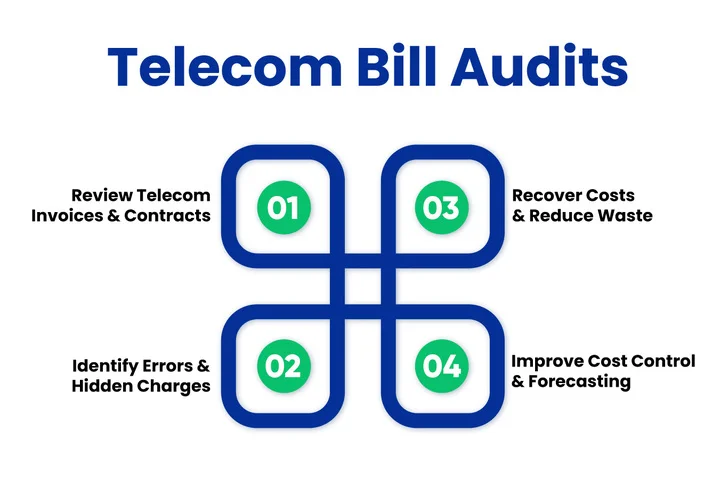
Beyond recovering costs, regular telecom bill audits improve financial visibility, strengthen budget planning, and enhance vendor accountability. By tracking every telecom expense, businesses can reduce waste, prevent recurring billing issues, and maintain operational efficiency.
The Primary Benefits Of Telecom Bill Audits Include:
- Cost recovery: Identify billing errors and hidden charges that impact budgets
- Improved forecasting: Gain clear visibility into telecom expenses for accurate budgeting
- Service optimization: Remove unused or underutilized services
- Vendor accountability: Verify contract compliance and billing accuracy
- Long-term cost control: Prevent overspending through ongoing audits
What are the Types of Telecom Bill Audit?
Telecom bill audits can be conducted in different ways depending on a company’s needs, budget, and invoice complexity. Businesses can select the best strategy to find billing errors, reduce expenses, and improve telecom expense management by being aware of the primary types of telecom audits:
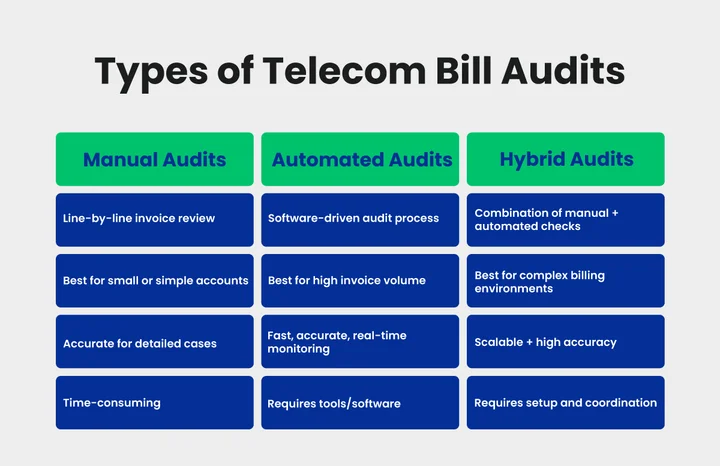
1. Manual Audits
This traditional approach involves a team reviewing invoices line by line. It’s effective for spotting complex invoice discrepancies but can be time-consuming and resource-intensive.
2. Automated Audits
Using telecom expense management software and invoice analytics tools, automated audits quickly detect billing mistakes, overcharges, and unused services. They save time, increase accuracy, and allow for real-time monitoring.
3. Hybrid Audits
Combining manual review with automation tools, hybrid audits provide the best of both worlds. They ensure high accuracy, handle complex accounts, and scale to growing businesses with multiple telecom lines and services.
What is the Step-by-Step Process of a Telecom Bill Audit?
A telecom bill audit helps businesses identify billing errors, recover costs, and control their telecom expenses. Breaking the process into clear steps makes the audit more manageable and ensures accuracy.
Following a structured process improves efficiency and maximizes savings.
The following section explains the step-by-step process of a telecom bill audit.
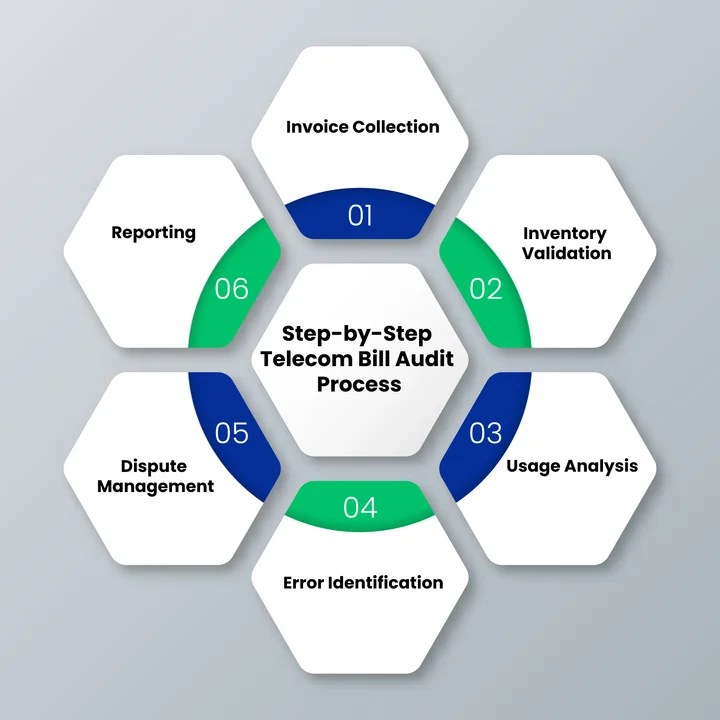
1. Invoice Collection
Businesses gather all telecom invoices from their service providers. This includes monthly bills for phone lines, internet services, mobile devices, and cloud communication tools. Having all invoices in one place ensures no charges are missed.
For example, a company might collect invoices from AT&T, Verizon, and Zoom to review all telecom-related spending. This step lays the foundation for a thorough telecom bill audit and enables auditors to accurately track all expenses.
2. Inventory Validation
Businesses verify all active telecom services, lines, and devices against their invoices and usage reports. This step ensures that each service is authorized, correctly billed, and in compliance with the company’s contracts.
For example, a company may check that 10 business mobile lines billed by Verizon are actually active and in use or confirm that all Zoom VoIP phone numbers are accounted for in its records. Inventory validation helps prevent paying for unused or duplicate services and ensures the accuracy of the telecom bill audit.
3. Usage Analysis
Businesses compare actual usage with what they are being billed to identify overcharges or unused services. This step examines call minutes, data usage, and service consumption to ensure invoices reflect actual usage.
For example, a company might discover that a team is billed for 1,000 call minutes per month but actually uses only 700 minutes, or that some mobile data plans are underutilized. Analyzing usage helps businesses recover costs, optimize services, and prevent future overspending.
4. Error Identification
Businesses carefully review invoices to identify billing mistakes, overcharges, and discrepancies. This includes checking for duplicate charges, incorrect rates, inactive lines still billed, and unexpected fees.
Detecting these errors ensures that companies only pay for services they actually use and helps prevent hidden costs from accumulating over time.
5. Dispute Management
Businesses address any billing errors or discrepancies by contacting their service providers to resolve issues. This process ensures that overcharges are corrected and unused or duplicate services are removed from invoices.
Effective dispute management also involves documenting all communications and resolutions, which helps maintain audit trails and provides proof of corrections.
Handling disputes promptly supports accurate billing, cost recovery, and better long-term vendor relationships. This process is known as telecom dispute and recovery.
6. Reporting
Businesses prepare a detailed report summarizing all findings from the telecom bill audit. This includes billing errors identified, overcharges recovered, unused services, and potential cost-saving opportunities.
Reporting provides management with a clear view of telecom expenses, highlights areas for future optimization, and helps establish an ongoing Telecom Expense Management (TEM) system to maintain long-term savings and control.
To support consistent reporting and maintain accuracy at scale, many organizations use DevOps services to automate audit workflows and build scalable data pipelines. These pipelines collect invoices, validate services, and flag billing anomalies in real time.
Monitoring systems then track audit performance and alert teams to unexpected cost spikes, ensuring continuous visibility and faster issue resolution.
This approach reduces manual effort, improves audit accuracy, and creates a repeatable process that scales with growing telecom environments.
Want To Stop Telecom Overspending? Get a clear view of hidden costs, billing errors, and unused services.
Which Tools Help Businesses Conduct Telecom Bill Audits?
While understanding the audit process is necessary, manually reviewing every invoice and usage report can be overwhelming. Fortunately, several tools are available to simplify telecom bill audits and help uncover hidden savings more efficiently.
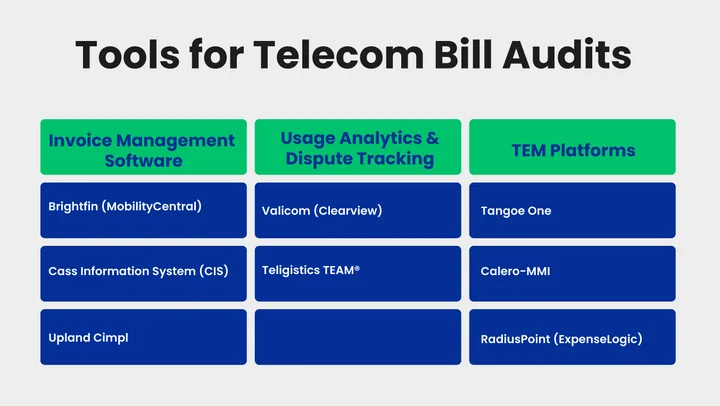
Here are the main types of tools businesses rely on:
1. Invoice Management Software
Invoice management tools help businesses collect, organize, and store all telecom invoices in one place.
Platforms like Brightfin (MobilityCentral), Cass Information System (CIS), and Upland Cimpl centralize invoices, making it easier to track charges, spot missing bills, and ensure that no service is overlooked or incorrectly billed.
2. Usage Analytics and Dispute Tracking Tools
These tools help businesses both analyze telecom usage and manage billing disputes. Usage analytics features compare billed usage with actual usage to uncover overcharges or underused services, while dispute tracking documents and resolves errors efficiently.
Solutions such as Valicom (Clearview) and Teligistics TEAM® can identify whether a mobile line is billed for more data than it actually used, helping businesses adjust plans and reduce unnecessary costs.
3. Telecom Expense Management (TEM) Platforms
TEM platforms provide comprehensive automation, analytics, and reporting to streamline the audit process.
Tools like Tangoe One, Calero-MMI, and RadiusPoint (ExpenseLogic) give businesses ongoing visibility into telecom spending and actionable insights to maintain cost control over time.
If you want to simplify the telecom expense management (TEM) process, you can choose from the top telecom expense management companies that offer built-in audit automation and reporting.
This helps businesses with billing optimization strategies and contract compliance review.
How Much ROI Can You Get from Telecom Bill Audits?
The real value of telecom bill audits lies in the measurable savings they deliver. Beyond correcting invoices, audits help businesses recover lost money, eliminate waste, and reduce ongoing telecom costs.
When conducted regularly, they can become a significant financial advantage for organizations of any size.
Now let’s look at how ROI is calculated and what savings businesses can realistically expect.
How to Calculate ROI from Telecom Bill Audits?
ROI (Return on Investment) is the ratio of total savings from the audit to the cost of performing it. A simple ROI formula looks like this:
ROI = (Savings – Audit Cost) / Audit Cost
For example, if a company spends $1,000 on an audit and recovers $3,000 in billing errors, the ROI would be:
ROI = (3000 – 1000) / 1000 = 200%
This means the business earned 2 times the amount invested in the audit.
Typical ROI and Where Savings Come From
Most telecom bill audits deliver 10% to 30% savings on total telecom spend. Companies with complex invoices or those that haven’t audited in a long time often see even higher returns.
Savings typically come from:
- Billing errors & overcharges (duplicate charges, incorrect rates, hidden fees)
- Unused or inactive services that are still billed
- Contract and plan optimization (better pricing or removing unnecessary services)
- Usage optimization (aligning plans with actual usage to avoid overages)
Telecom audits not only recover funds but also prevent future overspending by identifying and correcting these issues.
Even small percentage savings can significantly impact budgets when telecom expenses are high, making audits a strategic investment for long-term cost control.
Final Thoughts: Maximizing Value from Telecom Bill Audits
Telecom bill audits are not a one-time task but a long-term strategy to keep telecom spending under control and prevent unnecessary costs.
Regular invoice review, service validation, and billing correction help businesses recover significant money and improve cost management over time.
To maximize audit value, companies should adopt an automated and scalable audit process. Cloud-based systems and automation tools can streamline invoice collection, improve monitoring, and ensure continuous cost control without manual effort.
The real transformation happens when audits are part of a broader digital transformation service. This approach enables businesses to move beyond reactive cost recovery and build sustainable processes that improve financial visibility, operational efficiency, and long-term expense governance.
With the right technology and a structured audit approach, telecom bill audits become a powerful part of financial and operational strategy.
Frequently Asked Questions (FAQs)
2. Are Telecom Bill Audits Only Useful for Large Enterprises?
No, telecom bill audits are valuable for businesses of all sizes. Small and mid-sized companies often lack dedicated telecom expense management processes, which makes them more vulnerable to billing errors.
3. What Documents are Required to Perform a Telecom Bill Audit?
To conduct an effective telecom bill audit, businesses typically need a few essential records. These documents help verify charges and ensure billing accuracy:
- Recent telecom invoices (usually 6–12 months)
- Service contracts and rate agreements
- Inventory lists of active lines, devices, and services
- Usage reports from service providers
Having these ready improves audit accuracy and speeds up the process.
4. Can Telecom Bill Audits Help Prevent Future Billing Errors?
Yes, telecom bill audits help prevent future billing issues. Businesses can establish more robust controls by identifying contract gaps and recurrent error patterns. Additionally, audit insights support better vendor negotiations, clearer service inventories, and improved internal processes, all of which reduce the chances of repeated billing mistakes.
5. How Long Does a Typical Telecom Bill Audit Take?
The duration of a telecom bill audit varies based on invoice volume, vendor count, and audit type. In general:
- Smaller audits may take 2–4 weeks
- Larger or multi-vendor audits can take 1–3 months
Automated and hybrid audit approaches usually shorten timelines while maintaining accuracy.
6. Is It Better to Use Internal Teams or Third-Party Experts for Telecom Bill Audits?
It depends on internal expertise and available resources. Internal teams understand business operations well, but telecom billing rules and contracts can be highly complex. Third-party audit specialists often bring:
- Deep industry knowledge
- Advanced audit tools and automation
- Experience dealing with vendor disputes
For many organizations, combining internal oversight with external expertise delivers the best results and keeps audits objective and efficient.
Get a structured audit plus ongoing expense monitoring to prevent future overspending and improve budgeting accuracy.