


Many smart farms struggle to make data-driven decisions despite having sensors, drones, and connected devices.
The challenge lies in managing this data effectively. Without structured processes, farms face delays, mismatched systems, and unreliable insights.
However, the global IoT in Agriculture market was USD 15.2 billion in 2024 and is expected to grow to USD 46.3 billion by 2034, expanding at roughly 11.8% annually. This rapid growth brings more devices, more data, and greater complexity, making real-time decision-making harder than ever.
DevOps offers a solution. With connected devices, automated updates, and secure, reliable data flows, farms can act on insights instantly, reduce downtime, and get the most out of their innovative technology.
In this blog, we’ll explore how DevOps in smart farming powers AgTech IoT. We’ll cover:
- Real-time data pipelines
- Edge device coordination
- Synchronization strategies
- Security best practices
So, let’s get started and see how these strategies bring together technology!
How Does DevOps Contribute to AgTech IoT?
DevOps is essential for AgTech IoT; keeping devices, platforms, and data pipelines running efficiently. Farms can reduce downtime, optimize performance, and make faster, data-driven decisions by integrating DevOps practices.
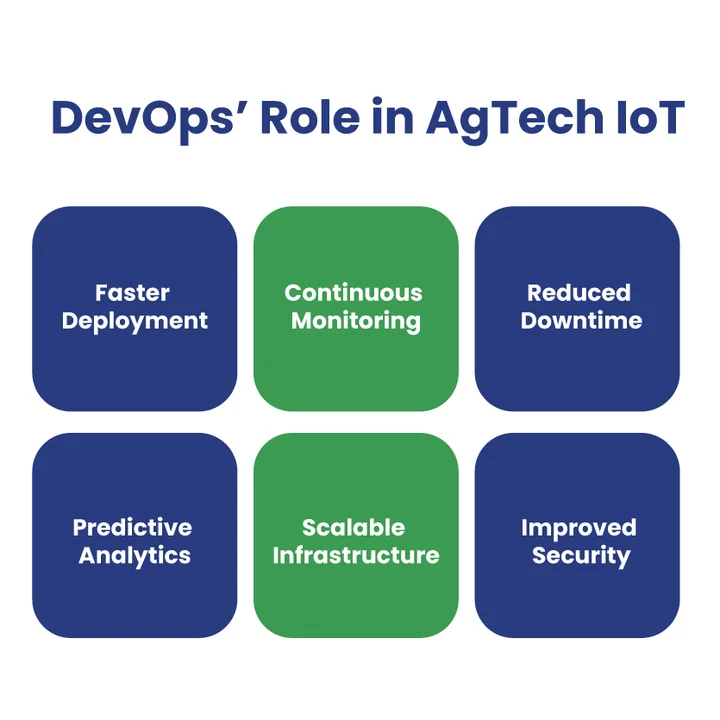
Table of Contents
Its impact can be seen across the following 3 main areas, each contributing to more innovative and more efficient farming:
1. Smart Farming Solutions
To begin with, DevOps improves day-to-day smart farming operations by automating and reducing routine tasks. DevOps engineers for smart farming solutions improve daily operations by automating and simplifying tasks.
- Automated Deployment: Ensures IoT devices and sensors are deployed and maintained efficiently.
- Continuous Monitoring: Tracks data flow from devices to quickly identify and resolve issues.
- Reduced Downtime: Helps farms maintain consistent operations and optimize performance.
Together, these practices let farms focus on core agricultural activities while ensuring technology supports accurate, timely decision-making.
2. IoT DevOps Best Practices
In addition, DevOps brings structured practices to IoT operations, ensuring that pipelines remain reliable and support real-time decision-making.
- CI/CD Pipelines: Implements DevOps CI/CD for IoT pipelines to deliver faster, reliable updates.
- Automated Testing & Monitoring: Maintains robust IoT pipelines and prevents failures.
- Real-Time Processing: Supports predictive analytics, agriculture IoT, and precision farming.
Farmers can achieve faster updates, consistent data flow, and actionable insights through the implementation of these strategies.
3. DevOps Consulting for AgTech
Expert DevOps consulting for AgTech provides tailored strategies that maximize the potential of AgTech IoT platform development services.
- Custom Platform Development: Designs AgTech IoT platforms that fit specific farm needs.
- Managed Services Optimization: Improves operational efficiency of IoT DevOps managed services.
- Expert Guidance: Provides strategic insights to ensure scalable and secure operations.
With this guidance, farms can scale effectively, maintain system security, and make informed decisions that drive long-term productivity and growth.
Overall, by addressing these three areas, DevOps for AgTech IoT connects device management, data synchronization, and platform scalability, thereby improving efficiency, reliability, and actionable insights across innovative farming ecosystems.
Stop letting delayed data slow your farm’s growth. Get a custom-built AgTech IoT solution designed to keep your operations running smoothly.
How Do Real-Time Data Pipelines Enable Smart Agriculture?
With DevOps integrated across daily operations, pipelines, and consulting support, farms are ready to explore how real-time data pipelines are helping in smart agriculture.
Real-time data pipelines, managed with DevOps practices, enable farms to collect and process information instantly.
Farmers can make timely decisions that save resources, minimize errors, and maintain consistent productivity by automating updates, monitoring performance, and ensuring pipeline reliability.
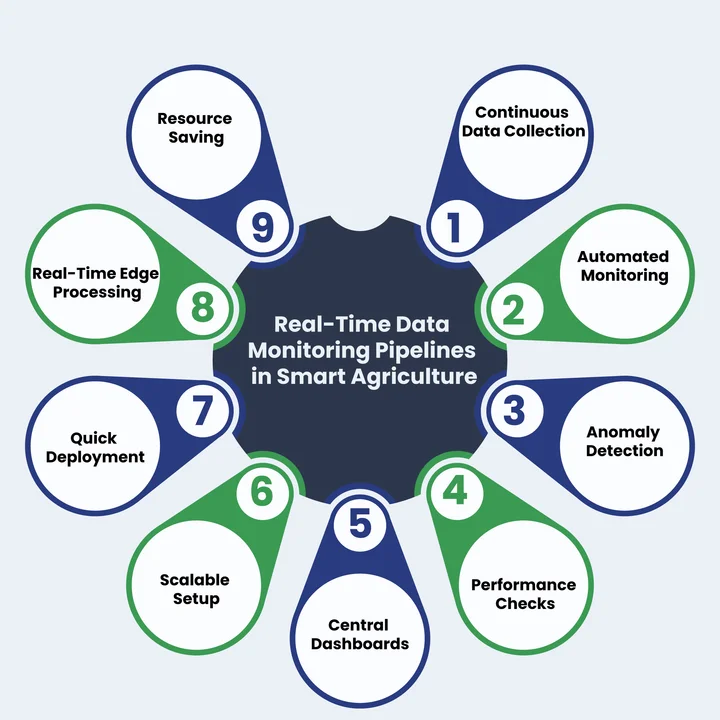
1. IoT Pipeline Management and Monitoring
Keeping devices and data running smoothly is essential. Maintaining IoT pipeline monitoring experts ensures devices and data run smoothly.
Essential Points To Notice:
- Continuous Data Collection: Gathers information from sensors, drones, and weather stations.
- Automated Monitoring: Tracks device health and connectivity.
- Anomaly Detection: Sends alerts for unexpected changes, such as irrigation or temperature issues.
- Performance Checks: Reduces downtime and keeps data flow steady.
- Automated Updates: Keeps software on each device up-to-date.
- Scalable Setup: Allows adding more devices or expanding monitoring easily.
This approach provides operators with constant visibility and faster issue response times.
2. Continuous Integration for Platforms
Automated integration helps deploy updates or new tools without interrupting operations. Benefits include:
- Quick Deployment: Updates are applied smoothly.
- Reliable System: Automated checks prevent failures.
- Flexible Setup: Platforms can adjust as operations grow.
- Central Dashboards: Shows all device activity in one place.
- Connected Data: Keeps information accurate across all devices.
This keeps operations running without delays and allows easy additions.
3. Real-Time Processing at the Edge
DevOps, edge computing, and IoT processes data close to the source for faster action. Local processing supports:
- Immediate Action: Automation of irrigation, pest control, and climate response.
- Lower Bandwidth Use: Saves network capacity by handling data on-site.
- Resource Saving: Reduces energy and bandwidth use.
- Device Coordination: Maintains alignment between local devices and central systems.
Using pipelines and local processing lets farms act quickly and make decisions based on current conditions rather than waiting for delays.
How Do Edge Devices and Synchronization Improve Farm Operations?
Edge devices and IoT DevOps data flow ensure data is processed near collection points, enabling faster decision-making. Synchronizing these devices ensures information flows smoothly, helping farms respond quickly to changing conditions and keep systems running reliably.
Keeping devices in sync and processing data locally turns scattered info into instant, actionable insights.
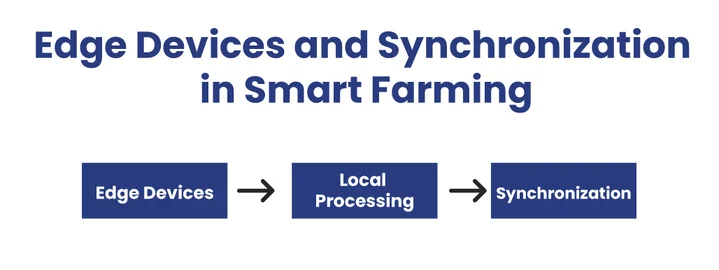
1. Device Coordination for Real-Time Monitoring
Keeping devices in sync is essential to smooth operation. Main points include:
- Device Alignment: Ensures all tools report data consistently.
- Automatic Updates: Keeps software on each device up-to-date.
- Data Checking: Ensures accurate synchronization of IoT data.
- Problem Alerts: Notifies operators when a device falls out of sync.
- Central View: Combines data from all devices into one easy-to-read interface.
This coordination allows farms to act immediately and avoid errors.
2. Local Processing vs. Cloud Processing
Processing data near the source reduces delays compared to sending everything to a central system. Significant points include:
- Fast Decisions: Local processing allows instant responses.
- Reduced Delay: Less time is spent transferring data to distant systems.
- Reduced Resource Waste: Saves network capacity by handling data on-site.
- Independent Operation: Local processing continues even if the central system has issues.
Local processing helps farms manage operations quickly and reliably.
3. Synchronization Practices for Stable Operations
Keeping all devices and systems in sync prevents mistakes and ensures smooth functioning. Practices are as follows:
- Regular Checks: Confirms devices remain coordinated over time.
- Real-Time Sync: Corrects minor mismatches without operator intervention.
- Consistent Reporting: Ensures data is reliable for decision-making.
- Seamless Updates: Adds new features without disrupting existing systems.
Proper synchronization ensures steady operations and enables quick responses to changing conditions.
Below is an FAQ section that clarifies how these different components interconnect, helping you better understand and make informed decisions.
Frequently Asked Questions (FAQ)
2. Is Real-Time Data Processing Important for Precision Farming?
Yes, it plays a significant role in precision farming. Real-time processing enables farms to respond immediately to changing soil, weather, and crop conditions.
Additionally, it supports:
- Faster irrigation adjustments
- Early pest or disease detection
- Accurate fertilizer application
- Reduced resource waste
This level of responsiveness helps farmers make more accurate decisions every day.
3. What Challenges Do Farms Face When Managing Multiple IoT Devices?
Several challenges usually appear when farms scale their IoT systems. These often include:
- Devices falling out of sync
- Delayed data transmission
- Limited connectivity in remote areas
- Manual updates that slow down operations
- Security risks across many endpoints
With DevOps automation and synchronization practices, these issues become far easier to manage.
4. Can Edge Devices Reduce Costs for Smart Farming Operations?
Yes, edge devices can significantly reduce operational costs. Since they process data locally, farms use less bandwidth, avoid unnecessary data transfers, and minimize dependency on cloud servers. This also leads to quicker responses and stronger system reliability.
5. What Role Does Security Play in AgTech IoT and DevOps?
Security is essential because farms manage sensitive operational data and rely on devices that must remain online. Therefore, secure DevOps practices help with:
- Protecting devices against unauthorized access
- Maintaining encrypted data flow
- Regularly updating firmware and configurations.
- Avoiding system interruptions caused by security breaches
Strong security ensures long-term stability and trust in connected farming systems.
6. Do Small Farms Benefit From DevOps, or Is It Only for Large Operations?
Small farms benefit as well. Even with fewer devices, DevOps provides structured processes that reduce manual work and prevent data inconsistencies. Furthermore, small farms gain:
- Easier device management
- Scalable infrastructure as they expand
- Reliable automation for everyday tasks
With the right setup, DevOps supports farms of all sizes without unnecessary complexity.
Final Takeaway
Smart farming becomes more manageable when real-time data pipelines in agriculture, DevOps for AgTech, and synchronized IoT devices work together. Farms gain faster responses, fewer delays, and reliable insights, driving efficiency, resilience, and long-term growth.
Ultimately, the entire ecosystem grows stronger because each layer reinforces the next. As the earlier sections showed, all these moving parts create meaningful value when they operate in harmony.
This connected approach turns scattered data into practical intelligence that guides efficiency, resilience, and long-term improvement. Teams aiming to improve their AgTech systems can move forward with confidence through IoT development solutions that support planning, scaling, and continuous optimization for future-ready operations.
Turn farm data into actionable results. Increase yield, reduce waste, and respond faster with synchronized devices.