


Many enterprises struggle with fragmented data across dozens of systems, making it hard for AI to uncover meaningful insights. Valuable information stays buried, and teams waste time hunting through silos.
Putting that data into a unified knowledge graph helps AI understand relationships between customers, products, operations, and more.
However, the enterprise knowledge graph market is projected to grow from US$1.18billionin2024to US$3.54 billion by 2029.
LlamaIndex offers a way to build that structured graph so your AI can grab context, connect the data, and support faster, smarter decisions.
In this blog, we will explore how LlamaIndex for Enterprises helps you:
- Organize and connect fragmented data.
- Use graph-based Retrieval-Augmented Generation for more intelligent AI.
- Build knowledge assistants and scale AI query engines.
So, let’s jump in and see how LlamaIndex can transform your enterprise AI workflows.
What is LlamaIndex, and How Can It Benefit Enterprises?
LlamaIndex is a framework that helps businesses organize, connect to, and manage their data. Many organizations struggle with scattered information across multiple systems, slowing AI workflows.
LlamaIndex’s enterprise knowledge graph provides a structured way to quickly access relevant data, supporting more intelligent decision-making and faster insights.
Table of Contents
This framework enables enterprises to transform complex data into actionable insights. Using graph-based retrieval, augmented generation, and knowledge graph query engine capabilities, AI models can retrieve information accurately, while teams get a clear view of connected data across the organization.
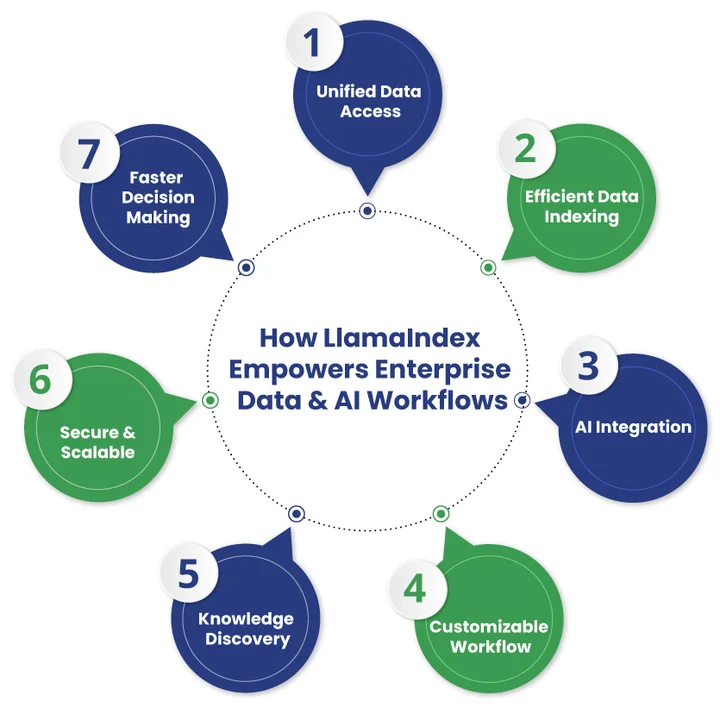
Benefits Of LlamaIndex For Enterprises:
- Faster Data Access: Quickly retrieve information from multiple sources.
- Improved AI Workflows: Improve performance with structured knowledge.
- Contextual Knowledge Graph: Connect and visualize enterprise data easily.
- Scalable Data Management: Efficiently handle large datasets.
- Better Decision-Making: Use insights from connections to inform strategies.
Now, we will explore the importance of knowledge graphs in enterprises and how they improve AI workflows.
Why Should Enterprises Use Knowledge Graphs for AI Workflows?
Modern organizations generate vast amounts of data from sales, marketing, product operations, customer support, and internal systems every day. When this information remains scattered, AI tools struggle to understand context, deliver relevant insights, or provide actionable recommendations.
Knowledge graphs solve this by connecting related data points. Instead of isolated entries, they link customers, products, transactions, documents, and operational activities into a single network. LlamaIndex builds this connected structure, enabling AI queries to run faster and with greater accuracy.
At the same time, this connected data framework supports AI development services. Teams can develop AI models, test algorithms, and build intelligent applications directly on top of the knowledge graph, using real, structured data instead of fragmented or siloed information. This makes AI development faster, more reliable, and context-aware.
Real-World Examples:
- Retail Industry: Link purchase patterns, inventory, website activity, and marketing campaigns to improve recommendations and forecast demand.
- Finance Industry: Connect transaction records, customer profiles, and market data to detect fraud faster.
- Healthcare Industry: Combine patient records, treatments, and research data for faster clinical insights.
How Does LlamaIndex Organize and Use Data for AI Workflows?
Once enterprises recognize the value of connected data, efficiently structuring it becomes crucial. LlamaIndex organizes data through:
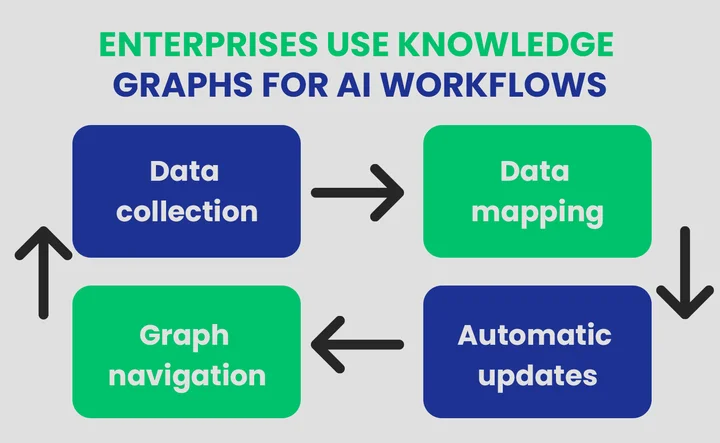
- Data Collection: Gathers information from multiple systems into one unified framework.
- Data Mapping: Transforms information into nodes and relationships to show how customers, products, or transactions connect.
- Graph Navigation: AI queries the graph to retrieve context-rich insights instead of isolated facts.
- Automated Updates: The knowledge graph refreshes as new data enters, keeping insights accurate and timely.
This structured approach ensures that AI workflows run efficiently, deliver faster insights, and provide actionable intelligence that teams can trust.
Over 70% of enterprise data stays scattered, slowing AI insights. LlamaIndex knowledge graphs consolidate information to enable faster, more accurate decisions.
Next, we will explore how LlamaIndex scales AI workflows across complex enterprise environments.
How Can LlamaIndex Scale AI Workflows in Enterprises?
AI workflows often become inefficient when data is scattered across multiple systems. LlamaIndex addresses this challenge by connecting information into a unified knowledge graph, enabling AI to quickly and accurately retrieve relevant data across the organization.
Scaling AI workflows with LlamaIndex involves several practical steps:
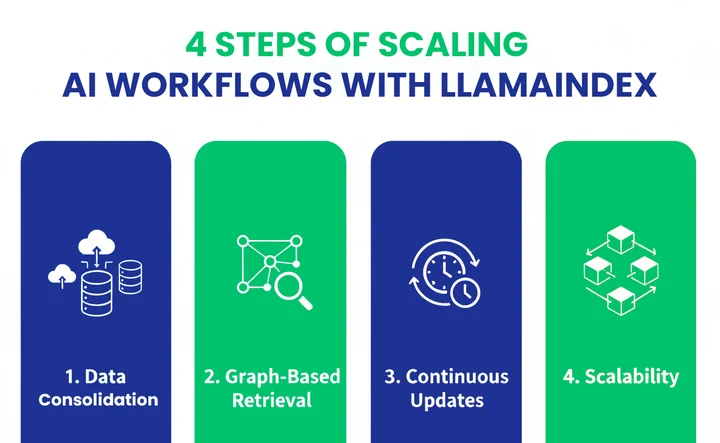
- Data consolidation across departments: Information from finance, sales, marketing, operations, and customer support systems is collected and organized into a single graph. This prevents AI models from wasting time searching through isolated silos.
- Graph-based retrieval for faster processing: Queries can follow relationships between entities (customers, transactions, products) instead of scanning each system separately. This reduces processing time and improves the speed of AI decision-making.
- Real-world workflow examples:
- A finance company can link transaction records, customer profiles, and market data. AI then detects anomalies, flags potential fraud, and generates reports faster.
- In retail, purchase patterns, inventory levels, and website activity can be linked to optimize product recommendations and forecast demand accurately.
- Real-world workflow examples:
- Continuous updates for ongoing performance: The knowledge graph automatically updates as new data is added to the system, so AI agents and teams continuously work with the latest information, improving both speed and accuracy over time.
- Scalability for adoption and stability: As the organization grows, the graph expands to include new departments, systems, and datasets, keeping AI workflows efficient even in complex environments.
Benefits of Scaling AI Workflows With LlamaIndex Include:
- Instant access to relevant data from multiple sources
- Faster and more accurate AI-driven decisions
- Reduced delays in AI-driven processes across departments
- Insights from connected data that inform more innovative strategies
This structured, connected approach transforms scattered information into actionable insights, helping teams make faster, more confident decisions.
How Can Enterprises Build Knowledge Assistants with LlamaIndex?
Enterprises can also leverage LlamaIndex AI agents to automate complex tasks and provide context-rich answers. These AI agents access the structured knowledge graph to support employees or customers, improving efficiency and decision-making across the organization.
For Example, a healthcare organization can build a knowledge assistant that connects patient records, treatment histories, and medical research data. The assistant can help doctors gain faster insights, answer queries, and support clinical decision-making through graph-based retrieval-augmented generation.
Benefits of Building Enterprise Knowledge Assistants With LlamaIndex:
- Faster Information Access: Retrieve relevant data instantly from the knowledge graph.
- Improved Decision-Making: Assist teams in making informed choices.
- Efficient AI Agents: Automate repetitive tasks and support complex queries.
- Real-World Use Cases: Customer support, finance, healthcare, and more.
In the following, we will explore LlamaIndex graph store integration and how it supports scalable, reliable enterprise AI workflows.
How Does Knowledge Graph RAG with LlamaIndex Help Enterprise AI?
Generating insights from complex, interconnected data can be challenging when information is scattered across multiple systems. Graph-based retrieval-augmented generation (RAG) with LlamaIndex enables AI to work efficiently by linking related information across the enterprise knowledge graph.
Instead of analyzing isolated datasets, AI can quickly pull relevant facts from multiple sources, providing a holistic view of the data. This connected approach also powers AI agent development, enabling them to access accurate, context-rich information for faster decision-making and task automation.
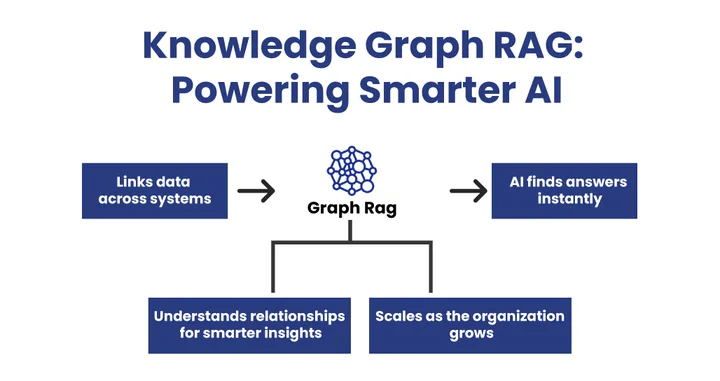
Knowledge Graph RAG provides several advantages:
- Faster information retrieval: AI navigates the graph to access connected data points in seconds, reducing the need for manual analysis.
- Context-aware insights: By understanding relationships between entities, AI delivers more accurate and relevant results.
- Unified data understanding: Structured and unstructured data from multiple systems are combined, allowing AI to generate insights across departments.
- Improved decision-making: Teams can rely on AI-generated insights to make informed business decisions without sifting through raw data.
- Scalable intelligence: As the organization grows, the knowledge graph expands, allowing AI to continue providing context-rich insights without performance loss.
This approach ensures AI responses are faster, more reliable, and context-aware, enabling teams to act confidently on the insights generated.
To address common queries and provide clarity on how LlamaIndex works in enterprise environments, here are some frequently asked questions
Frequently Asked Questions (FAQs)
2. How Secure is the Data Stored in LlamaIndex Knowledge Graphs?
Data security is a key concern for enterprises. LlamaIndex supports:
- Role-based access control to limit who can view or modify data
- Encryption of data both at rest and in transit
- Audit logs to track queries and changes
This ensures that sensitive business or customer information remains protected.
3. How Long Does it Take to Deploy LlamaIndex in an Enterprise?
Deployment time can vary depending on data complexity and system integrations. Typically:
- Small- to medium-scale enterprises: 2–4 weeks
- Large-scale enterprises with multiple data sources: 6–12 weeks
With proper planning, businesses can start seeing AI-driven insights shortly after the initial setup.
4. Can LlamaIndex Handle Real-Time Data Updates?
Yes. LlamaIndex can continuously update its knowledge graph as new data enters the system, enabling AI agents and workflows to:
- Access the latest information instantly
- Make real-time predictions and recommendations
- Avoid relying on outdated or incomplete data.
This makes it suitable for industries like finance, logistics, and healthcare, where real-time accuracy is critical.
5. What Industries Can Benefit Most From LlamaIndex?
LlamaIndex is versatile and supports multiple industries that rely on complex, interconnected data. Several sectors include
- Healthcare
- Finance
- Retail
- Logistics
Overall, any industry with fragmented data and a need for faster, intelligent AI-driven decisions can benefit from LlamaIndex.
Wrapping Up
Enterprises have faced challenges with scattered data, which often slows AI workflows. Fortunately, the LlamaIndex enterprise knowledge graph effectively organized information, enabling faster insights and more intelligent decisions.
Moreover, for teams managing complex data workflows, LlamaIndex Developers Need provides practical ways to handle large datasets and reduce inefficiencies naturally.
Looking ahead, businesses will experience smoother AI integration and more reliable knowledge management with LlamaIndex. Teams can focus on innovation while workflows remain accurate, scalable, and future-ready by effectively managing complex data relationships.
Is your enterprise struggling to scale AI workflows efficiently due to fragmented data?