


Starting a taxi business in 2026 can feel difficult for first-time founders. Most challenges come from early decisions that affect cost, operations, and long-term growth. Many founders choose the wrong business model or invest in technology before they are ready.
The good news?
The taxi and ride-hailing market is growing fast and is projected to reach $432.4 billion by 2030, showing that demand for reliable, tech-enabled transportation is stronger than ever.
The real question is not if you should start a taxi business. The real question is how to start it without creating operational and technology problems later.
This guide explains how to launch a taxi business in 2026 with practical steps. It covers business planning, fleet setup, driver hiring, and taxi app decisions. The focus stays on making the right choices early, so your business can grow without unnecessary costs.
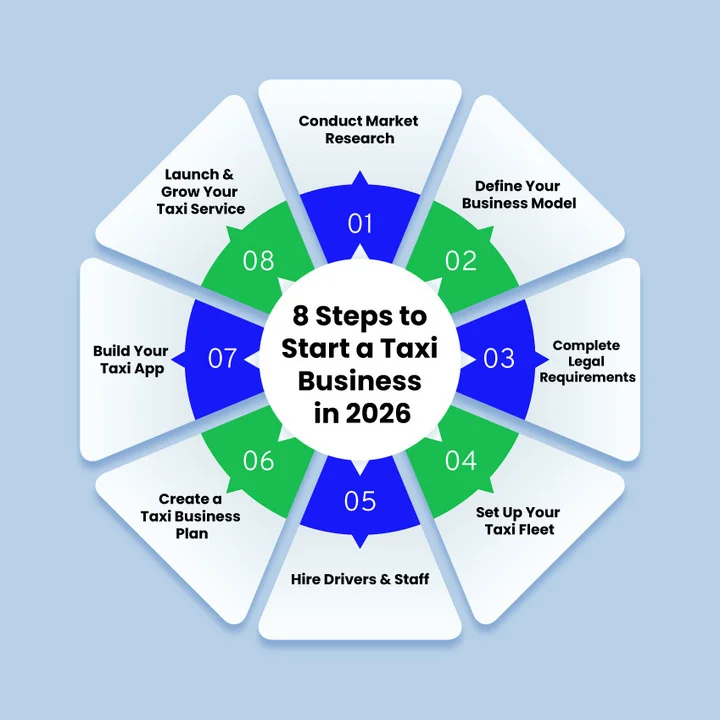
How To Build a Taxi Business Step-by-Step From Scratch?
Building a taxi business works best when each decision follows a clear order. Random choices around operations, fleet setup, or taxi app development often create problems later.
This section explains how to start a taxi business step-by-step using a structured approach. It focuses on planning a taxi business plan, selecting the right taxi company business model, and deciding when tools like taxi dispatch software or an online taxi booking app actually add value.
Each step highlights decisions that affect cost, control, and long-term growth. The goal is to help founders launch a taxi business with clarity rather than guesswork.
Table of Contents
Step 1: Researching Your Market and Setting Goals
This step is all about understanding your city, your customers, and where your taxi business can fit in. Intense market research helps you make smart decisions, avoid mistakes, and plan your operations efficiently.
Here’s what to focus on:
- Identify Demand: Which areas or neighborhoods need reliable taxi services? Are there gaps during peak hours or underserved locations?
- Study Competitors: Look at existing taxi and ride-hailing services. What do they offer? What do customers like or complain about?
- Understand Customer Preferences: Do people prefer traditional taxi rides, app-based bookings, or both? Are they price-sensitive or looking for premium options?
- Set Clear Goals: Define what you want to achieve: number of rides per day, revenue targets, or customer satisfaction ratings.
- Plan your Niche: Decide if you want to focus on airport transfers, corporate rides, night services, female drivers, or budget/premium options.
Skipping research or copying competitors unthinkingly is the main reason new taxi startups struggle. A clear understanding of demand, customer behavior, and local competition prevents costly mistakes later.
Step 2. Define Your Taxi Company Business Model
Once you understand your market, the next step is to choose a business model that aligns with your goals, budget, and long-term vision. Your taxi company’s business model determines how you will operate, manage costs, and generate revenue.
Standard models you can choose from:
| Model | Description | Ideal For | Estimated Startup Cost |
|---|---|---|---|
| Owner–Operator | You own and drive one or more vehicles | Test local demand, start small | $5,000–$15,000 |
| Fleet Ownership | Own multiple vehicles and hire drivers | High control, branding, service quality | $50,000+ |
| Driver-Partner | Independent drivers use their own cars | App-based taxi business startup | $2,000–$5,000 |
| Hybrid | Mix of company-owned vehicles + independent drivers | Gradual scaling with flexibility | $20,000–$50,000 |
- Owner-Operator: You own and drive one or more vehicles. Ideal for testing local demand. Estimated Startup Cost: $5,000–$15,000.
- Fleet Ownership: Own multiple vehicles and hire drivers. Ideal for high control, branding, and service quality. Estimated Startup Cost: $50,000+.
- Driver-Partner: Independent drivers use their own cars. Ideal for app-based business startup. Estimated Startup Cost: $2,000–$5,000.
- Hybrid: Mix of company-owned vehicles + independent drivers. Ideal for gradual scaling with flexibility. Estimated Startup Cost: $20,000–$50,000.
What To Consider When Defining Your Model?
- Startup investment and operating costs.
- Your target customers (local riders, corporate clients, airport travelers).
- Relying on an online taxi booking app works best with a custom software development team to ensure smooth operations.
- The level of control you want over vehicles and drivers.
- Cost vs control trade-off: high control increases cost, low cost reduces reliability.
Pro Tips To Consider:
- New founders often choose a model without checking operational risks or app requirements.
- Start with an MVP taxi app ($5k–$15k) before investing in a full-featured app ($20k–$50k+).
- Plan fleet size, driver setup, and software integration according to the chosen model.
Unsure which app fits your business model? Clustox can help you boost retention and simplify your fleet.
Step 3: Legal Requirements and Licensing
Starting a taxi business requires more than just vehicles and drivers; complying with legal requirements is essential for a successful taxi business startup. Proper licensing and adherence to regulations establish credibility and trust for your taxi company business model.
Necessary legal steps to follow:
| Step | What to Do | Estimated Cost | Notes / Risks |
|---|---|---|---|
| Business Registration | Register your taxi company according to local laws | $100–$500 | Skipping registration can lead to fines or business closure |
| Vehicle Registration | Register all taxis for commercial use | $50–$300 per vehicle | Non-compliance may prevent vehicles from operating legally |
| Insurance Coverage | Obtain comprehensive insurance for cars, drivers, and passengers | $500–$2,000 per vehicle/year | Lack of insurance exposes founders to high liability and lawsuits |
| Driver Verification | Verify licenses and run background checks | $20–$100 per driver | Hiring unverified drivers can damage a reputation and lead to accidents |
| Regulatory Compliance | Follow city and regional rules for fares, operating hours, and vehicle standards | $0–$200 (permits, certifications) | Ignoring regulations can result in penalties or the revocation of licenses |
- Business Registration: Register your taxi company according to local laws. Estimated Cost: $100–$500. Notes/Risks: Skipping registration can lead to fines or business closure.
- Vehicle Registration: Register all taxis for commercial use. Estimated Cost: $50–$300 per vehicle. Notes/Risks: Non-compliance may prevent vehicles from operating legally.
- Insurance Coverage: Obtain comprehensive insurance for cars, drivers, vehicle/year and passengers. Estimated Cost: $500–$2,000 per vehicle/year. Notes/Risks: Lack of insurance exposes founders to high liability and lawsuits.
- Driver Verification: Verify licenses and run background checks. Estimated Cost: $20–$100 per driver. Notes/Risks: Hiring unverified drivers can damage a reputation and lead to accidents.
- Regulatory Compliance: Follow city and regional rules for fares, operating hours, and vehicle standards. Estimated Cost: $0–$200 (permits, certifications). Notes/Risks: Ignoring regulations can result in penalties or the revocation of licenses.
Priority Tips To Consider:
- Start with registration and insurance before buying vehicles or hiring drivers.
- Driver verification should happen early to prevent operational issues.
- Regulatory compliance should be ongoing, not a one-time effort.
Common Founder Mistakes:
- Assuming registration or insurance is optional to save money.
- Hiring drivers before verifying credentials.
- Ignoring city regulations, thinking “it won’t be enforced.”
- Overlooking compliance requirements for app-based taxi operations.
Step 4: Building Your Fleet and Hiring Drivers
A successful taxi business depends on two main assets: vehicles and drivers. Poor decisions here can quickly increase costs and reduce service quality.
1. Building Your Fleet
| Task | What to Do | Estimated Cost | Notes / Risks |
|---|---|---|---|
| Vehicle Purchase | Choose car types based on the target market (economy, premium, or specialized) | $10,000–$30,000 per vehicle | Buying too many cars too early increases financial risk |
| Fleet Size | Start small if the budget is limited; scale as demand grows | - | Overexpansion can lead to idle vehicles and higher maintenance costs |
| Branding | Apply consistent logos and designs | $200–$500 per vehicle | Poor branding reduces recognition and trust |
| Maintenance | Schedule regular servicing | $50–$150 per vehicle/month | Neglect increases breakdowns, repair costs, and downtime |
| Tech Integration | Equip vehicles with GPS, taxi apps, and dispatch systems | $500–$2,000 per vehicle (software + devices) | Poor tech setup reduces efficiency and tracking accuracy |
Partnering with a reliable software development partner ensures these systems are well-built and tailored to your fleet’s needs.
2. Hiring Drivers and Staff
| Task | What to Do | Estimated Cost | Notes / Risks |
|---|---|---|---|
| Driver Hiring | Find licensed, experienced, professional drivers | $300–$1,000 per driver (onboarding + background check) | Hiring unverified drivers can harm reputation and safety |
| Training Programs | Teach customer service, safety, and app usage | $100–$300 per driver | Lack of training reduces satisfaction and increases complaints |
| Incentives & Rewards | Motivate drivers with performance-based bonuses | $50–$200 per driver/month | Low incentives → low motivation, high turnover |
| Support Staff | Hire people for operations, bookings, and customer service | $1,000–$2,500 per month | Insufficient staff → delays, poor service |
Strong drivers and a professional support team help deliver a reliable, efficient, and customer-friendly taxi service, boosting your reputation and business growth.
Step 5: Taxi App Development and Technology Tools
In 2026, a taxi app is essential for smooth operations and a great customer experience. Choosing the right technologies ensures efficiency, reliability, and scalability. Here’s a quick look at each category and its purpose:
Before exploring the tools, it’s helpful to know how each contributes to your app’s performance and features:
Programming Languages
These form the foundation of your app’s interface and core features:
- Java & Kotlin: Best for Android app development.
- Swift: Used for iOS app development.
- React Native & Flutter: Cross-platform apps for both Android and iOS.
Backend Technologies
These handle your app’s server-side logic, ensuring smooth communication between the app and the database. To manage ride requests, booking logic, and data processing, you can use Node.js, Python (Django/Flask), Ruby on Rails, or PHP (Laravel).
Databases
Efficient data storage is for managing users, rides, payments, and real-time updates:
- MySQL & PostgreSQL: Structured relational data like accounts and transactions.
- MongoDB & Firebase: Real-time tracking, notifications, and flexible data storage.
APIs and Services
Integrating third-party services enhances your app’s functionality and user experience:
- Google Maps API: Navigation, route optimization, and live tracking.
- Stripe, PayPal, Razorpay: Secure in-app payment processing.
- Twilio & OneSignal: SMS and push notifications for ride alerts, promotions, and communication.
Cloud & Hosting
Hosting your backend on reliable cloud platforms ensures scalability and minimal downtime. Platforms like AWS, Google Cloud, and Microsoft Azure allow you to manage backend services, databases, and APIs efficiently, providing a robust infrastructure to support your app’s performance and growth.
Admin & Dispatch Software
These tools simplify operations and provide actionable insights by offering custom dashboards or SaaS solutions for fleet management, driver tracking, ride dispatching, and operational analytics.
With these tools properly integrated, your taxi app becomes more than just a booking platform. Using technology effectively leads to smoother operations, happier riders, and long-term business growth.
How Can Founders Make the Right Decisions for Their Taxi App?
Your business can succeed or fail based on the strategy you choose for your taxi app. Every decision impacts cost, timeline, and scalability. Founders need a clear framework to avoid common mistakes and build a reliable app that supports growth.
1. What Decisions Matter?
- Custom vs. White-Label: Decide if you need complete control and scalability (custom) or a faster, cheaper launch (white-label/SaaS).
- Build Once vs. Iterate: Launch a basic MVP first, then improve features based on honest user feedback.
2. MVP vs Phase-2 Features
- MVP: Core features like ride booking, GPS, payments, and driver management. Launch fast, lower cost (~2–3 months, $5k–$10k).
- Phase 2: Add loyalty programs, multi-city support, and advanced analytics after MVP proves itself.
3. Common Scalability and Cost Mistakes
- Adding too many features too early → increases cost and slows down launch.
- Ignoring dispatch software or backend scaling → creates operational bottlenecks.
- Choosing tools simply because they are popular leads to unnecessary expenses with no real business value.
Making the right decisions early sets the foundation for a successful taxi app. Focus on core features first, use resources wisely, and scale gradually.
Testing your MVP, choosing the right technology, and avoiding common mistakes will save time, reduce costs, and help your taxi business grow sustainably.
Step 6: Launching and Marketing
Launching a taxi service is about attracting riders, creating trust, and scaling efficiently. A structured launch and clever marketing help your business grow steadily while avoiding costly mistakes.
1. Soft Launch
- What to do: Start in one area or neighborhood to test operations, driver performance, and app reliability.
- Timeline / Cost: 1–2 months, $500–$1,000 for basic marketing and local promotions.
- Risks to avoid: Launching city-wide too early can overwhelm drivers and operations.
2. Promotions & Discounts
- What to do: Offer introductory deals to attract first-time riders.
- Tips: Limit the duration and number of discounted rides to avoid hurting profits.
- Risks to avoid: Heavy discounts for too long → reduced revenue and customer expectation of always getting deals.
3. Partnerships
- What to do: Collaborate with hotels, local businesses, or corporate offices for regular bookings.
- Benefits: Steady demand, brand visibility, and early loyal customers.
- Risks to avoid: Partnering without clear terms can lead to missed revenue or unreliable bookings.
4. Online Presence & Advertising
- What to do: List your service on Google Maps, social media, and local directories.
- Tips: Run targeted ads to attract local riders; monitor cost vs ROI.
- Estimated cost: $100–$500 for initial campaigns.
- Risks to avoid: Spending too much on ads without tracking conversions.
5. Referral & Loyalty Programs
- What to do: Encourage existing customers to refer friends and reward repeat rides.
- Benefits: Low-cost growth and higher customer retention.
- Risks to avoid: Overcomplicated rewards that confuse customers or are costly to maintain.
6. Collect Feedback & Iterate
- What to do: Gather reviews and monitor app performance, driver ratings, and ride experience.
- Benefits: Improves operations, reduces complaints, and builds trust.
- Risks to avoid: Ignoring feedback → repeated mistakes, lower retention.
A successful taxi launch combines a controlled rollout, innovative marketing, and continuous learning.
Start small, test your systems, focus on customer experience, and expand only when operations are stable. This approach reduces costs, avoids operational chaos, and sets the foundation for sustainable growth.
Need help planning your soft launch or rider acquisition strategy?
Your taxi company can draw customers, establish a solid reputation, and experience long-term growth by combining a strategic launch, focused marketing, and ongoing development.
What are the Tips for Developing a Successful Taxi App?
A well-planned taxi app can make your service convenient, reliable, and professional. Early decisions on features, technology, and approach affect costs, scalability, and user satisfaction. Founders should focus on building the right app for today while planning for growth tomorrow.
Here are some of the Tips:
1. Focus on Core Features First (MVP)
- MVP features: Ride booking, GPS tracking, fare calculation, online payments, and driver management.
- Why: Launch faster, lower cost ($5k–$10k, ~2–3 months), and test real user behavior.
- Phase-2 features: Loyalty programs, multi-city support, and advanced analytics added later once MVP proves successful.
- Tip: Founders who want a solution built specifically for their operational needs can rely on mobile app development services that provide robust backend support.
2. Build vs. Buy
- Custom App: Full control, scalable, ideal for long-term growth. Costlier and longer to develop.
- White-Label / SaaS App: Faster, cheaper, less flexible. Good for small startups or testing markets.
- Tip: Decide based on budget, timeline, and growth plan.
3. Design for Users
- Keep the interface simple and intuitive for passengers and drivers.
- Avoid cluttered features; prioritize usability and clear navigation.
4. Choose Reliable Technologies
- Pick technology stacks that support growth and smooth operations.
- Include GPS, payment gateways, push notifications, and fleet management tools.
5. Test Thoroughly
- Conduct beta tests, fix bugs, and ensure performance across devices.
- Collect feedback from early riders and drivers.
6. Common Mistakes to Avoid
- Adding too many features before launch → delays and high costs.
- Ignoring dispatch software or backend scalability → operational bottlenecks.
- Selecting tools just because they are popular → unnecessary expense, low business value.
Building a taxi app is about making smart, phased decisions. Start with MVP, choose the right approach (build vs. buy), test with real users, and iterate gradually. Thoughtful planning now reduces costs, avoids operational problems, and sets your taxi business up for sustainable growth.
Following these steps will help you develop a taxi app that improves the customer experience, supports your operations, and contributes to the growth of your taxi business.
Frequently Asked Questions (FAQs)
2. How Much Time Does It Take to Break Even in a Taxi Business?
The break-even timeline varies based on location, operating costs, and demand. In many cases, a taxi business starts covering its costs within the first few months if rides are consistent. Factors such as fuel expenses, driver payouts, maintenance costs, and pricing strategy influence how quickly profitability is achieved.
3. Is It Better to Start With a Local Taxi Service or Expand City-Wide?
Starting with a local taxi service is often the more innovative approach. It allows you to understand customer behavior, fix operational issues, and build a strong reputation before expanding. Once demand grows and processes are stable, scaling to additional areas becomes easier and less risky.
4. Do Taxi Businesses Still Attract Customers Without Heavy Discounts?
Yes, many customers value reliability and service quality over discounts. While promotions can help during launch, long-term growth depends more on punctual drivers, clean vehicles, fair pricing, and consistent availability. As trust builds, customers are more likely to return without needing constant offers.
5. What Makes a Taxi Business Sustainable in the Long Run?
Long-term sustainability comes from balancing service quality, cost control, and customer satisfaction. Successful taxi businesses usually focus on:
- Maintaining well-serviced vehicles
- Training drivers regularly
- Listening to customer feedback
- Adapting operations as demand changes
Over time, these practices help build a stable and trusted transportation service.
Conclusion
Starting a taxi business in 2026 is easier when you approach operations, fleet management, driver hiring, and app development step by step. Combining a clear business model with the right technology, like a reliable taxi app and dispatch tools, creates a service that customers trust and prefer.
Founders should focus on making the right early decisions, from choosing the business model to planning app features, so the business can grow without unnecessary costs or operational issues.
Some principles from weather app development, such as smooth navigation, real-time updates, and scalable infrastructure, can be applied when building a taxi app to ensure reliability and performance.
With careful planning, consistent service quality, and smart technology choices, a taxi business can scale steadily, attract loyal customers, and stay ahead in a competitive market.
Partner with Clustox to develop a taxi app that increases ride bookings and operational efficiency.