


Ever wondered why generative AI feels like both an unstoppable force and a massive gamble at the same time?
Many companies are pouring resources into AI, yet struggle to justify the cost when the returns aren’t always obvious. That tension between high investment and unclear payoff is precisely what’s driving so much buzz (and anxiety) around AI adoption today.
And yet, challenges remain. Organizations often face difficulties with integration, measuring the ROI of generative AI, and scaling AI initiatives effectively without losing control or value. Amid this complexity, comprehending where generative AI is already delivering measurable results is essential.
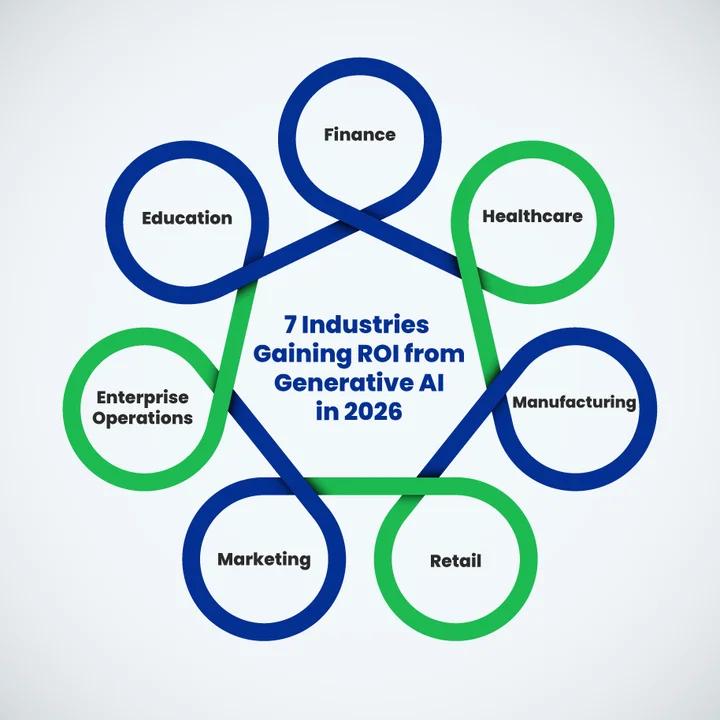
This blog explores 7 industries that are gaining real ROI from generative AI, the generative AI use cases by industry underlying that success, and how these insights can help you make smarter, future-ready decisions.
Let’s get going!
How Do Industries Measure ROI from Generative AI?
As generative AI adoption in industries grows, companies are increasingly focused on understanding its tangible value. Measuring ROI ensures investments are justified, initiatives are prioritized, and AI solutions can scale effectively.
Industries typically evaluate ROI using several important metrics:
- Cost Savings: Reductions in manual labor, operational expenses, or resource wastage.
- Productivity Gains: Automation of repetitive tasks, faster workflows, and more time for higher-value activities.
- Revenue Growth: AI-driven innovations, such as personalized products, better customer experiences, or faster time-to-market.
- Innovation Impact: Better decision-making, creativity, and competitive advantage.
Different sectors measure ROI in ways that reflect their unique priorities. For instance, healthcare organizations track faster diagnostics and better patient outcomes. In finance, efficiency in fraud detection and risk analysis is essential. Manufacturing often focuses on reduced downtime and effective production processes.
Table of Contents
Overall, recognizing these metrics helps organizations identify which generative AI use cases by industry deliver results, supporting successful adoption and long-term growth, while avoiding common pitfalls that lead to project failures.
Struggling with the unclear ROI & business impact? Generative AI can simplify processes, increase productivity by 40%, and cut costs by 25%.
Industry #01: Generative AI in Healthcare (Improving Outcomes and Efficiency)
Healthcare is one of the fastest-growing adopters of generative AI, driven by the need for faster, more accurate diagnostics and better patient care. Hospitals, clinics, and research centers are using AI tools to simplify complex tasks and medical outcomes.
Many HealthTech development companies are building AI solutions specifically for these purposes.
Important applications include:
- Medical imaging and diagnostics: AI platforms like Aidoc and Zebra Medical Vision analyze scans and detect anomalies faster and more accurately than traditional methods.
- Drug discovery and research: Generative AI improves the development of new compounds and predicts their effectiveness, reducing time and costs.
- Personalized patient care: AI helps design custom treatment plans based on patient data, improving recovery rates and outcomes.
- Operational efficiency: Automating scheduling, documentation, and administrative tasks allows healthcare staff to focus on critical care.
These applications generate measurable ROI, including faster diagnosis, reduced errors, and cost savings. As a result, healthcare organizations can deliver higher-quality care while optimizing resources.
Industry #02: Generative AI in Finance (Risk Management and Automation)
The finance industry is rapidly adopting generative AI to improve decision-making, improve efficiency, and reduce operational risks. Banks, investment firms, and insurance companies are leveraging AI tools to process large volumes of data, identify patterns, and automate repetitive tasks.
Many financial institutions are investing in AI-driven fintech solutions to stay competitive and ensure efficient operations.
Here’s how AI is being applied in practice:
- Fraud detection and prevention: Tools like Darktrace and Kount analyze transactions in real time to identify suspicious activity, reducing potential losses by 30–40% in some organizations.
- Risk assessment and management: Platforms such as Zest AI and Upstart analyze market trends, assess risks, and improve credit and investment decision-making.
- Automated reporting and compliance: AI solutions like Workiva simplify regulatory reporting, reduce human errors, and cut reporting time by 50% or more.
- Customer service automation: AI-powered chatbots and assistants. It handles routine queries, freeing staff to focus on complex cases and improving response time.
These applications provide measurable ROI, including faster decision-making, lower operational costs, and improved risk management. As generative AI continues to develop, finance organizations can use these tools to maintain competitiveness and improve overall efficiency.
Industry #03: Generative AI in Manufacturing (Smooth Production and Operations)
Manufacturing companies are increasingly adopting generative AI to maximize efficiency, reduce downtime, and improve production processes. AI tools analyze large datasets from machines, supply chains, and operations to make smarter, faster decisions.
The following applications are essential:
- Predictive maintenance: AI forecasts equipment failures before they occur, minimizing unplanned downtime and repair costs.
- Process optimization: Generative AI identifies inefficiencies in production lines, helping manufacturers improve throughput and product quality.
- Supply chain forecasting and inventory management: AI predicts demand trends, enabling better planning and reducing excess inventory.
- Operational cost reduction: Automation of repetitive tasks and data-driven insights helps lower expenses and maximize resource utilization.
These AI-driven solutions deliver measurable ROI, such as higher production efficiency, cost savings, and reduced operational risks. As manufacturers continue to integrate generative AI, they gain a competitive edge through smarter operations, faster decision-making, and strengthened overall performance.
Industry #04: Generative AI in Retail (Better Customer Experience and Operations)
Retailers can improve customer experiences, improve operations, and increase sales with Generative AI. AI tools help analyze customer behavior, predict trends, and personalize shopping experiences, making retail more data-driven and efficient.
Important applications include:
- Personalized recommendations: AI suggests products based on customer preferences and purchase history, increasing engagement and conversions.
- Inventory and demand forecasting: AI predicts product demand, helping retailers manage stock efficiently and reduce overstock or shortages.
- Dynamic pricing and promotions: Generative AI adjusts pricing strategies in real-time to maximize revenue and competitiveness.
- Customer service automation: AI chatbots and virtual assistants handle inquiries, returns, and support, freeing human agents for complex issues.
These applications generate measurable ROI by boosting sales, improving operational efficiency, and increasing customer satisfaction. As generative AI continues to grow, the retail industry can deliver more personalized, efficient, and profitable experiences for its customers.
Industry #05: Generative AI for Marketing (Content Creation and Personalization)
Marketing teams are increasingly adopting generative AI to create content faster, strengthen campaigns, and deliver highly personalized experiences.
Recent reports show that 88% of marketers now use AI tools in their daily workflows. These systems help analyze customer behavior, generate creative materials, and strengthen targeting for stronger campaign performance.
Here’s where it delivers impact:
- Content generation: AI creates blog posts, social media updates, email campaigns, and ad copy, saving time and reducing costs.
- Personalized campaigns: Generative AI analyzes customer data to deliver customized offers, improving engagement and conversion rates.
- Market analysis and insights: AI identifies trends, competitor strategies, and customer preferences to support informed decision-making.
- Customer interaction automation: AI-powered chatbots handle routine queries, allowing marketers to focus on strategy and creative tasks.
These applications deliver measurable ROI by increasing engagement, accelerating content production, and improving the efficiency of campaign management. Marketing companies can increase brand visibility, reach their audience more effectively, and increase overall marketing performance with GenAI.
Industry #06: Generative AI in Enterprise Operations (Scaling Efficiency and Innovation)
Enterprises are seeing measurable benefits from generative AI across operations, decision-making, and innovation. Platforms like Microsoft Copilot, Google Vertex AI, IBM WatsonX, and ServiceNow’s GenAI capabilities help consolidate data, automate processes, and support teams across departments.
Applications include:
- Process automation: AI handles reporting, data entry, workflow routing, and document generation, reducing errors and saving time.
- More intelligent decision-making: Large datasets are analyzed instantly to support forecasting, planning, and operational improvements.
- Innovation acceleration: AI assists in designing product variations, testing strategies, and improving services through rapid simulations.
- Stronger collaboration: AI-powered enterprise platforms foster knowledge sharing and simplify communication across teams.
These capabilities help enterprises cut operational costs, increase output, and foster innovation. As adoption continues to grow, organizations can maintain a competitive edge while delivering better products and services at scale.
Industry #07: Generative AI in Education (Transforming Learning and Administration)
Educational institutions are increasingly converting to generative AI to transform learning experiences, improve administrative processes, and deliver personalized education at scale. Advanced EdTech solutions enable schools and universities to integrate AI, helping educators to analyze student data, craft dynamic learning content, and maintain high levels of engagement across classrooms.
Primary uses of generative AI in education:
- Customized learning Material: AI tailors lessons and study materials to individual student needs, helping learners progress at their own pace.
- Content generation: AI helps create quizzes, assignments, and educational resources quickly, reducing teacher workload.
- Administrative automation: AI efficiently manages scheduling, grading, and student records, freeing educators to focus on teaching.
- Insights and analytics: Generative AI identifies student performance trends and predicts potential challenges, enabling timely interventions.
With these AI capabilities, educational institutions can improve learning outcomes, maximize resource allocation, and maintain operational excellence. Schools and universities are better equipped to offer scalable, customizable, and technology-driven learning experiences that prepare students for the future with GenAI.
Frequently Asked Questions (FAQs)
2. Which Industries are Seeing the Highest ROI From Generative AI?
Healthcare, finance, manufacturing, retail, marketing, enterprise operations, and education are currently leading in ROI gains. Moreover, emerging sectors such as logistics, legal services, and entertainment are increasingly adopting AI for efficiency and innovation, making them potential high-ROI areas in the near future.
3. How Can Small Businesses Benefit From Generative AI?
Small businesses can also use generative AI, even with limited budgets. Important benefits include:
- Automating repetitive tasks
- Creating marketing content faster
- Improving customer service with AI-powered chatbots
Additionally, cloud-based AI solutions make adoption more accessible, allowing smaller companies to compete with larger enterprises.
4. Is Generative AI Expensive To Implement In Organizations?
No, implementing generative AI does not always require massive investments. Costs vary depending on the tools, infrastructure, and scale of implementation. Companies can start with pilot projects, SaaS-based AI platforms, or cloud solutions to minimize initial expenses while testing ROI.
5. How Do Companies Measure The Success Of Generative AI Initiatives?
Success is measured through multiple metrics, including:
- Cost reduction and efficiency improvements
- Increased revenue or new product creation
- Increased user engagement or customer satisfaction
- Reduction in errors or operational risks
Using these metrics allows organizations to prioritize AI initiatives that deliver measurable impact and justify further investment.
6. Can Generative AI Replace Human Jobs Completely?
No, generative AI is designed to augment human work rather than replace it entirely. While AI automates repetitive and time-consuming tasks, humans remain essential for:
- Strategic decision-making
- Creativity and innovation
- Complex problem-solving
Therefore, AI complements human expertise, enabling teams to focus on higher-value work and improved outcomes.
Conclusion: Important Takeaways and Future Outlook
Generative AI is altering industries at an unprecedented pace, delivering measurable ROI across healthcare, finance, retail, marketing, and education.
Companies are seeing faster decision-making, cost savings, and innovation like never before, proving that AI is a strategic advantage. As sectors adapt, linking AI to real-world business outcomes is becoming essential for staying competitive and driving sustainable growth.
Looking ahead,
- The global generative AI market is expected to grow from US$37.9 billion in 2025 to US$1,005.07 billion by 2034, reflecting massive growth potential across industries.
With careful planning and practical application, organizations can use generative AI services to turn opportunities into actionable outcomes, improve efficiency, and create long-term value.
High AI project costs and unclear outcomes are holding back your growth? Implement Generative AI to deliver measurable ROI and boost operational efficiency.