


Should your team keep paying for AI SaaS tools or invest in custom AI agents that align with your product architecture?
Why does this matter now? Over 70% of enterprises adopt third-party AI platforms to reduce initial engineering effort, but many later face limits in customization, data control, and system interoperability.
As AI increasingly powers core workflows, decision engines, and internal automation, founders and CTOs must keep pace with enterprise AI trends influencing strategic adoption.
- Can your systems scale?
- Will data stay secure?
- Are workflows built for efficiency?
At the same time, building custom AI agents brings its own hurdles: high upfront costs, infrastructure planning, and ongoing maintenance.
This guide helps founders and CTOs weigh the technical, financial, and strategic trade-offs of building versus buying AI.
Additionally, you’ll see when AI SaaS tools suffice, when custom AI agents drive competitive advantage, and how each choice affects governance, scalability, and product differentiation.
Let’s begin by exploring the considerations in the AI build vs. buy decision.
What Does Buying “AI SaaS Tools” Mean?
Buying AI SaaS tools means subscribing to ready-made AI platforms or services that handle tasks like automation, data analysis, and decision-making without building AI models or infrastructure in-house.
For many enterprises, this approach accelerates AI adoption while reducing the need for large upfront engineering investments.
Table of Contents
It also allows teams to see a faster ROI, often within 3–6 months for early-stage deployments, depending on scale and usage.
Use Cases of AI SaaS
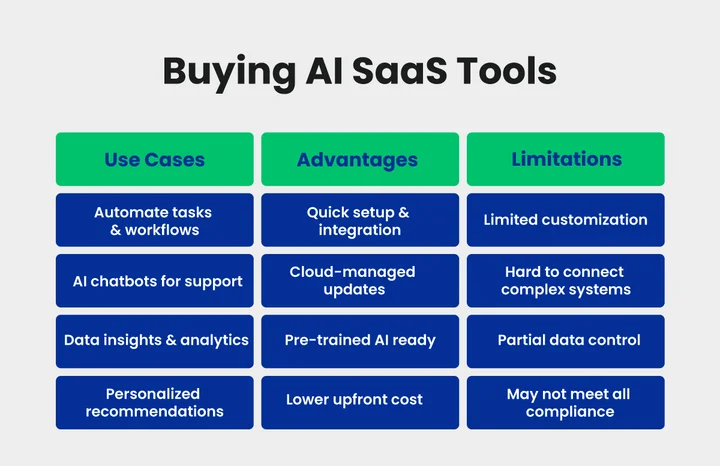
The Typical AI SaaS use Cases Include:
- Workflow automation: simplify repetitive business processes to save time and reduce errors.
- AI-powered customer support: Improve responsiveness and handle common queries with AI chatbots.
- Data analytics: Generate insights and trends from large datasets without building in-house models.
- Personalized recommendations: Deliver built-for-experiences to customers using AI-driven predictions.
The Advantages of Using AI SaaS Tools Include:
- Faster deployment: Teams can integrate AI capabilities into workflows without long development cycles.
- Managed infrastructure: Providers handle updates, model maintenance, and scalability, reducing operational burden.
- Access to pre-trained AI models: Businesses can utilize advanced AI without extensive model training or specialized expertise.
- Lower upfront costs: Subscription-based pricing reduces initial expenditure compared to building custom AI agents from scratch.
However, AI SaaS Tools Also Have Limitations.
The Limitations of AI SaaS Platforms:
- Limited customization: Pre-built tools may not adapt to unique product requirements.
- Integration challenges: Complex or proprietary systems can be hard to connect with third-party AI.
- Restricted data control: Sensitive or proprietary data may be harder to manage securely.
- Compliance gaps: SaaS tools may not fully meet strict regulatory or industry standards.
These considerations often lead founders and CTOs to evaluate custom AI agents, especially when product differentiation, data governance, and long-term scalability are critical.
What Does Building “Custom AI Agents” Mean?
Building custom AI agents involves developing in-house AI models and systems that correspond to your product and business needs. Unlike pre-built platforms, custom AI agents vs. AI tools give enterprises full control over data, workflows, and integrations, making it a central consideration in the build vs. buy AI debate.
How Do Custom AI Agents Work?
Custom AI agents are designed to align with your product architecture and internal requirements. The development process typically includes:
- Data collection and preparation: Curating proprietary datasets for model training to ensure accuracy and compliance.
- Model training and fine-tuning: Developing AI that reflects your unique business logic and predictive analytics requirements.
- Integration into workflows and systems: Embedding AI into internal operations, customer workflows, or decision engines.
- Continuous monitoring and updates: Ensuring models remain accurate, optimized, and compliant over time.
This approach forms the foundation of a reliable AI implementation strategy, allowing AI to become an integral part of enterprise operations rather than a standalone feature.
However, many organizations improve this process by implementing AI Agents for Businesses to automate monotonous workflows and improve overall efficiency.
Business Use Cases for Custom AI Agents
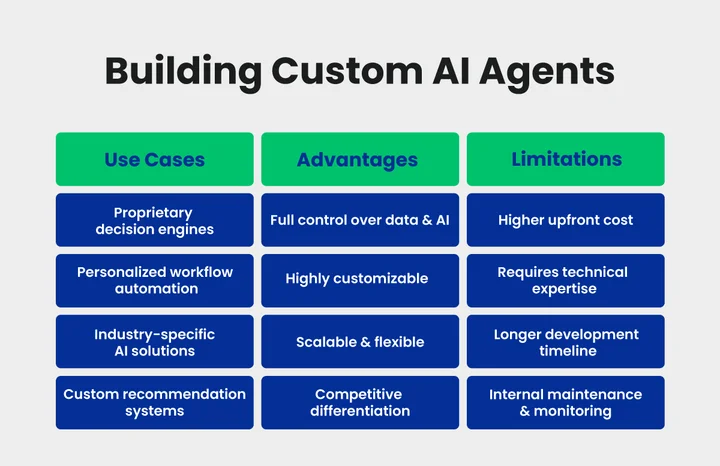
Enterprises often opt for custom AI when differentiation and control are crucial. Common applications include:
- Proprietary decision engines and predictive analytics.
- Personalized automation workflows adapt to unique business processes.
- Industry-specific AI solutions require compliance and regulatory alignment.
- Custom recommendation systems for better user experiences.
Benefits of Building Custom AI Agents
- Full control over data and AI behavior: Minimize AI vendor lock-in risks.
- High customization: Align AI with unique product workflows and architecture.
- Scalability and long-term flexibility: Supports growth in enterprise AI solutions.
- Competitive advantage: Differentiated AI functionality can distinguish products in the market.
- Supports strategic evaluation in the AI build vs. buy decision framework.
Limitations of Custom AI Agents
- Higher upfront costs: Requires significant investment, reflected in the AI cost comparison of SaaS vs. custom.
- Technical expertise required: Teams need AI knowledge, infrastructure skills, and ongoing maintenance capabilities.
- Longer development timelines: Building custom solutions takes more time than adopting AI SaaS tools for startups.
- Infrastructure and maintenance responsibility: Continuous monitoring and updates are fully managed internally, unlike managed SaaS solutions.
Choosing between AI SaaS vs. custom AI agents, or deciding whether to build or buy AI software, depends on your business priorities, product architecture, and long-term AI strategy.
For enterprises with complex workflows or compliance requirements, working with an AI agent development expert often offers greater control and strategic benefits than off-the-shelf solutions.
Build vs. Buy: How Do AI SaaS Tools and Custom AI Agents Compare?
Choosing the right AI strategy shapes cost, control, scalability, and long-term product goals. For many enterprises, decisions about AI adoption also impact compliance, data security, and competitive differentiation.
In fact, A global survey of nearly 1,500 enterprise IT leaders found that 96% plan to expand their use of AI agents in the next 12 months, signaling strong momentum toward agent‑based solutions beyond simple SaaS tools.
The comparison below highlights essential factors to guide an effective AI build vs. buy decision framework.
| Factors | Buy (AI SaaS Tools) | Build (Custom AI Agents) |
|---|---|---|
| Upfront Cost | Lower; subscription-based pricing reduces initial investment | Higher; requires investment in models, infrastructure, and AI expertise |
| Long-Term Cost | Can increase with scaling and subscription fees | Potentially lower if infrastructure and models are optimized internally |
| Customization | Limited to pre-built features and templates | Fully adaptable to business logic, workflows, and internal product architecture |
| Data Control | Provider manages most data; sensitive info partially exposed | Complete control over internal datasets, data pipelines, and compliance protocols |
| Scalability | Dependent on vendor cloud and API limits | Designed to scale with enterprise growth and complex workflows |
| Vendor Lock-in | Moderate to high, dependent on vendor ecosystem | Minimal; systems fully owned internally, reducing AI vendor lock-in risks |
| Security | Relies on vendor protocols, access management, and monitoring | Tailored security, encryption, and compliance measures aligned with enterprise requirements |
| Competitive Advantage | Standard AI capabilities are widely available to competitors | Unique AI solutions provide differentiation and strengthen enterprise AI solutions |
Overall, AI SaaS tools prioritize fast adoption and early execution. Because they rely on pre-trained models and vendor-managed infrastructure, they work best for pilots, short-term use cases, and non-core workflows where customization and data ownership are limited.
In contrast, custom AI agents position AI as a foundational system capability. With full control over models, orchestration logic, data pipelines, and integrations, enterprises can align AI with internal architecture and compliance needs.
However, this approach follows a custom software development approach, where AI becomes part of the long-term product infrastructure.
As a result, the build vs. buy decision extends beyond cost alone. While SaaS platforms reduce initial effort, they introduce long-term dependency through APIs and pricing models.
Custom AI systems require greater upfront investment but support predictable scaling, stronger governance, and strategic flexibility over time.
Thinking About Whether to Build or Buy Your AI Solution?
Our experts will help you choose the right approach to speed up AI adoption by 50% and make the most of your investment.
Continue reading to learn about the cost details for the build vs. buy approaches.
How Much Does It Cost to Build or Buy AI for Startups and Enterprises?
The cost of adopting AI depends on scale, usage, compliance requirements, and system complexity. Teams must decide whether to prioritize speed, upfront investment, or long-term control, as this directly affects the build vs. buy decision.
Below is a practical breakdown of estimated costs for building custom AI agents versus subscribing to AI SaaS tools, along with hidden costs that are often overlooked.
Estimated Cost of Building Custom AI Agents
Building custom AI agents requires upfront investment but offers long-term control and flexibility. Costs typically include engineering, infrastructure, and ongoing operations.
| Organization Type | Cost Breakdown | Estimated Total | Timeframe |
|---|---|---|---|
| Early-Stage Startup | AI engineers & backend: $40k–$80k Cloud infrastructure (AWS/Azure/GCP): $5k–$15k Initial model training & testing: $10k–$20k | $55k–$115k | 12–18 months |
| Scaling SaaS Company | AI engineering & system integration: $100k–$200k Infrastructure & inference: $25k–$50k Monitoring, retraining & optimization: $20k–$40k | $145k–$290k | 12–24 months |
| Enterprise | Dedicated AI & data teams: $250k–$450k+ Secure cloud & pipelines: $80k–$150k Compliance, monitoring & governance tooling: $50k–$100k | $380k–$700k+ | 12–24 months |
These costs reflect custom AI App development designed around proprietary workflows, internal systems, and regulatory requirements.
Subscription and Implementation Cost of Buying AI SaaS Tools
AI SaaS platforms offer faster deployment and lower upfront costs, especially for teams without in-house AI expertise. However, expenses scale with usage.
| Organization Type | Cost Breakdown | Estimated Total | Timeframe |
|---|---|---|---|
| Early-Stage Startup | SaaS subscription: $200–$1,500/month API usage & integration: $2k–$5k annually | $5k–$25k | 12–18 months |
| Scaling SaaS Company | Subscription tiers & API usage: $2k–$6k/month Engineering time for integrations & workflows: $10k–$25k annually | $35k–$120k | 12–24 months |
| Enterprise | Enterprise SaaS licensing: $8k–$20k+/month High-volume API usage: $30k–$80k annually Advanced integrations & security reviews: $25k–$50k | $150k–$350k+ | 12–24 months |
While AI SaaS tools for startups deliver quick ROI, long-term costs increase as usage grows and systems become more complex.
What are the Hidden Costs Enterprises Often Miss?
Many organizations underestimate indirect expenses when evaluating AI SaaS vs custom AI agents. These costs can significantly increase the total cost of ownership (TCO), especially in regulated or high-scale environments.
Hidden Costs of AI SaaS Tools
- API overage fees as usage scales
- Limited customization requiring workaround engineering
- Vendor lock-in increases switching costs
- Compliance gaps necessitating additional controls
Hidden Costs of Building Custom AI Agents
- Model retraining as data evolves
- DevOps and monitoring overhead (often 20–30% annually)
- Infrastructure optimization and scaling adjustments
- Security audits and governance tooling
Highlighting DevOps and compliance overhead helps strategic leaders plan accurate budgets and reduce surprises during scaling.
Practical Cost-Based Decision Guidance
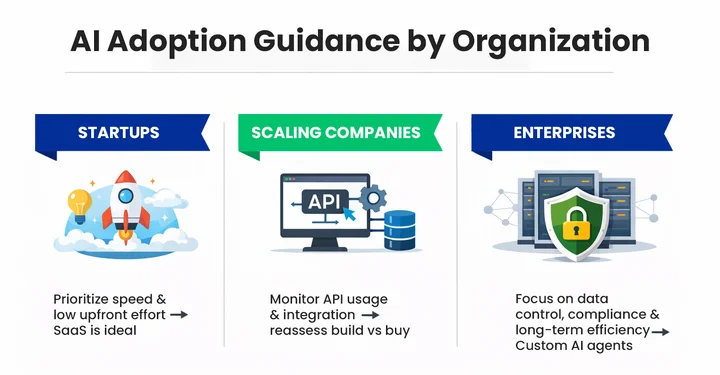
- Startups: AI SaaS tools are best when speed and low upfront investment matter most.
- Scaling SaaS Companies: Reassess once API usage or integration complexity grows.
- Enterprises: Custom AI agents are often justified for data governance, alignment with compliance requirements, and long-term efficiency.
In short, SaaS tools minimize upfront effort, while custom AI agents offer control, compliance, and strategic benefits, making the right choice highly dependent on your business priorities.
AI Costs Out of Control?
Many scaling SaaS companies overspend 2–3× on AI SaaS. Our team helps you compare build vs. buy to control costs and improve your AI strategy.
What Is the Technical Architecture of a Custom AI Agent?
A custom AI agent architecture is typically modular, allowing teams to swap models, tools, and infrastructure as requirements evolve. Unlike AI SaaS tools, this architecture gives full control over data flow, orchestration logic, and system integrations.
At a high level, a custom AI agent stack consists of 5 core layers.
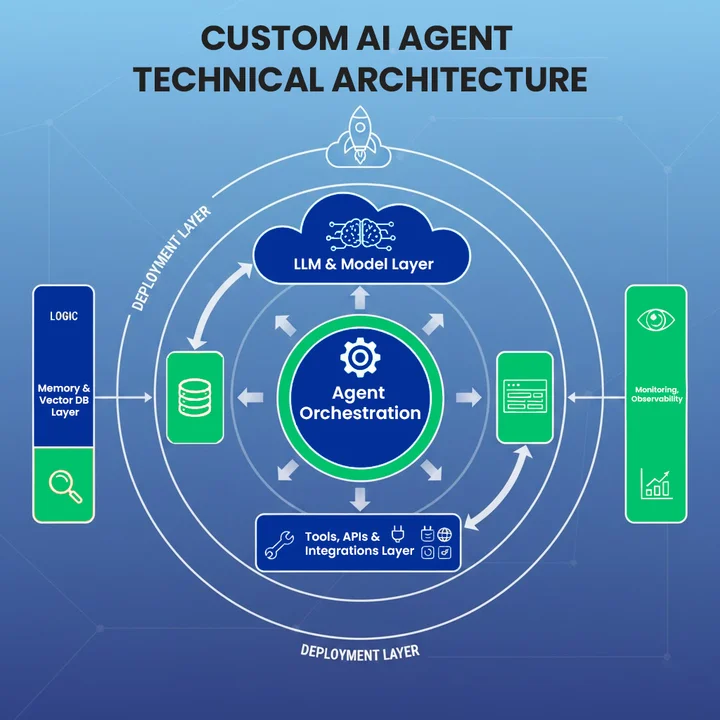
1. LLM and Model Layer
This layer contains the core AI intelligence, including LLMs or task-specific ML models. It handles reasoning, predictions, and content generation. Proprietary data can be used for fine-tuning, and multiple models can be combined to balance accuracy, cost, and performance.
2. Tools, APIs, and Integrations Layer
AI agents interact with internal systems and external services through this layer. It connects the agent to APIs, databases, SaaS tools, and workflow engines, enabling effortless task execution while integrating with your existing product architecture.
3. Memory & Vector DB Layer
This layer maintains context and supports reasoning by storing short-term and long-term memory. Vector databases allow semantic search and retrieval-augmented generation, helping agents make decisions based on historical data, documents, or user behavior.
4. Agent Orchestration & Logic Layer
Orchestration defines how the agent thinks and acts. It manages task planning, decision flows, conditional logic, multi-agent coordination, and error handling, ensuring predictable and reliable behavior.
5. Monitoring, Observability, and Deployment Layer
This layer heavily depends on robust Cloud & DevOps services to manage infrastructure scalability, automate deployments, control operational costs, and maintain reliability across evolving AI workloads.
A modular architecture allows scalable AI systems, better governance, controlled costs, and reduced vendor lock-in. For founders and CTOs, it ensures AI is not just a feature but a core part of enterprise operations.
What Are the Risks and Challenges of Build vs. Buy AI?
Despite the growing adoption of AI, industry studies show that only about 5% of enterprise AI projects successfully scale into production. This low success rate highlights why understanding the risks of both AI SaaS tools and custom AI agents is critical for founders and CTOs planning AI adoption.
Each approach comes with trade-offs affecting cost, control, and long-term strategy.
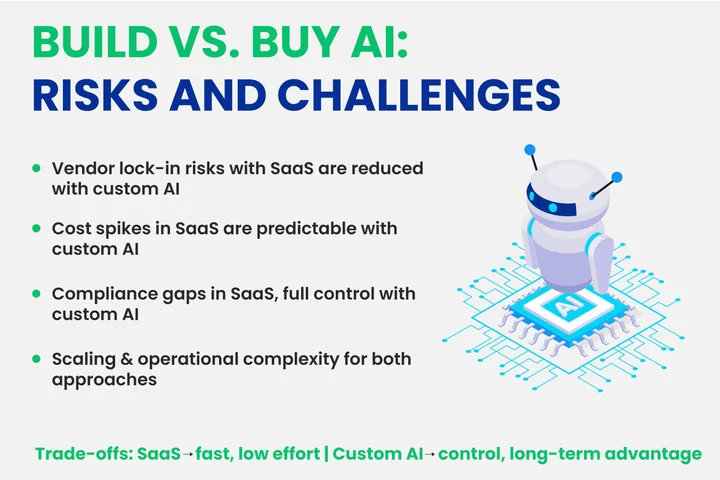
Vendor Lock-In and Dependency Risks
SaaS tools often tie workflows and data to a single provider, making changes difficult and expensive. Custom AI agents reduce this dependency, though they require internal expertise to manage and maintain systems.
Cost and Pricing Volatility
Subscription fees and API usage for SaaS solutions can increase quickly as usage grows. In comparison, custom AI agents shift costs to infrastructure and engineering, offering more predictable expenses but requiring upfront investment.
Compliance and Data Governance
SaaS platforms may not meet strict regulatory or internal governance requirements, creating potential compliance gaps. Custom AI development allows full control over data pipelines and auditing, but maintaining compliance demands careful processes and monitoring.
Scaling and Operational Complexity
As AI systems grow, SaaS platforms may face performance or API capacity limits. Custom agents require planning for infrastructure, workflow integration, and ongoing monitoring. Both approaches introduce operational complexity that teams must address proactively.
SaaS tools provide speed and lower initial effort, making them ideal for early-stage implementation. Custom AI agents deliver greater control, flexibility, and long-term strategic benefits.
However, recognizing these risks early ensures AI adoption aligns with both immediate needs and long-term enterprise goals.
How Does Clustox Help Enterprises Make Smarter AI Build vs. Buy Decisions?
Enterprises often face uncertainty when deciding between AI SaaS tools and custom AI agents. Long-term scalability, data ownership, and cost control make the choice even more complex. Clustox helps teams evaluate technical readiness, system constraints, and strategic priorities before committing to an AI approach.
Before deciding, it’s important to understand where AI can deliver real value.
Guiding AI Strategy for Enterprises
Clustox works closely with founders and CTOs to map workflows, data dependencies, and integration points. This reveals where AI SaaS tools are sufficient and where custom AI agents offer greater differentiation.
Early experimentation is conducted through phased validation, similar to MVP development. Teams can test AI use cases before making larger investments.
To make the right build-or-buy choice, weigh cost, flexibility, and long-term control.
Optimizing Build vs. Buy Decisions
Clustox evaluates architecture fit, scaling needs, and ownership considerations to guide decisions.
This structured approach helps teams move forward with confidence and reduces the risk of misaligned AI investments.
Scaling AI safely requires planning for compliance and production readiness.
Supporting Scalable and Compliant AI Implementations
Clustox integrates monitoring, governance, and infrastructure planning into AI adoption. This ensures AI systems grow with the business while meeting security and regulatory standards, without resorting to short-term patches.
With Clustox, teams can confidently adopt AI, balancing speed, control, and long-term value across build-and-buy decisions.
Final Takeaways: Making the Right Build vs. Buy AI Decision for Your Enterprises
Deciding between AI SaaS tools and custom AI agents is about balancing speed, cost, control, and long-term strategy. SaaS solutions offer quick deployment and lower upfront investment, while custom AI agents provide full control and deeper customization.
These insights help CTOs and founders plan AI adoption that supports growth, compliance, and operational efficiency. To make this evaluation even easier, consider the following checklist to guide your decision-making process:
| Factor | Questions |
|---|---|
| Use Case Complexity | Are workflows unique or industry-specific? |
| Customization Needs | Will pre-built SaaS meet your product requirements? |
| Data Control & Compliance | Is sensitive data involved? Are regulatory standards strict? |
| Budget & Cost Horizon | What are the short-term vs. long-term cost implications? |
| Scalability & Growth | Will the solution scale with enterprise needs? |
| Internal Expertise | Does your team have AI and infrastructure capabilities? |
| Vendor Lock-In Risk | How critical is independence from external providers? |
Completing this checklist ensures your AI strategy aligns with both immediate priorities and long-term enterprise goals.
For organizations that decide to build rather than buy, partnering with AI development services helps translate strategy into scalable, secure, and production-ready AI systems aligned with business goals.
Frequently Asked Questions
2. How Long Does It Take to Build Custom AI Agents?
The timeline varies depending on scale, data complexity, and compliance needs:
- Early-stage startups: 12–18 months
- Scaling companies: 12–24 months
- Enterprises with complex workflows: 12–24 months or more
3. Can Startups Afford to Build AI Agents?
Yes, startups can build AI agents, but careful budget planning and phased development are critical.
- Many startups begin with AI SaaS tools to validate their use cases.
- Transitioning to custom AI agents later allows better control and scalability once funding and growth justify the investment.
4. What Is Vendor Lock-In in AI Platforms?
Vendor lock-in occurs when a company becomes dependent on a single AI provider for models, APIs, or infrastructure, making it difficult to switch without incurring high costs or effort. Limited flexibility can impact scalability and integration with proprietary systems.
5. Are AI SaaS Tools Secure for Enterprise Data?
Yes, many SaaS tools follow industry-standard security protocols, but security levels vary:
- Data may be stored on third-party servers, which introduces compliance and control considerations.
- Enterprises with strict regulatory requirements often combine SaaS use with internal security measures or move to custom AI agents to achieve full data control.
6. When Should Companies Move From AI SaaS to Custom AI Agents?
Companies should consider moving when:
- AI use cases become complex or proprietary
- Long-term costs of SaaS subscriptions grow significantly
- Off-the-shelf tools cannot fully meet data governance, compliance, or customization needs
Transitioning in phases, such as starting with hybrid solutions, helps minimize risks and ensures smoother adoption.
96% of enterprises plan to expand their use of AI agents this year. Let Clustox guide you to the solution that saves time, reduces costs, and fits your workflows.