

Introduction: The Hidden Cost of Insurance Claim Denials in DME
For Durable Medical Equipment (DME) providers, delivering quality medical equipment is only half the challenge. Getting reimbursed accurately and on time is equally important.
Unlike many healthcare businesses, DME providers operate in a reimbursement environment that involves complex documentation requirements, payer-specific policies, medical necessity verification, prior authorizations, HCPCS coding, and strict billing timelines.
A single missing physician signature, incorrect modifier, expired authorization, or incomplete medical necessity document can cause an insurance claim to be denied.
And when denials accumulate, they create a chain reaction:
- Revenue becomes trapped in unpaid claims.
- Billing teams spend additional hours investigating and correcting errors.
- Accounts receivable (AR) aging increases.
- Cash flow becomes less predictable.
- Administrative costs rise without generating additional revenue.
- Patients may experience delays in receiving essential medical equipment.
According to the Centers for Medicare & Medicaid Services (CMS), improper Medicare payments can result from insufficient documentation, medical necessity issues, and incorrect coding, among other causes. Importantly, an improper payment is not necessarily fraud, and improper payment rates should not be confused with claim denial rates.
For DME providers, these problems create an opportunity to improve reimbursement operations through artificial intelligence.
AI-powered revenue cycle management can help DME providers identify claim risks before submission, detect missing documentation, automate repetitive verification tasks, and prioritize denied claims for recovery.
The objective is not simply to process claims faster. It is to prevent avoidable denials before they happen.
Table of Contents
In this guide, you’ll explore the common causes of DME claim denials and how AI can help prevent billing errors, streamline denial management, and improve revenue cycle performance.
The following sections explore why DME claims get denied, where AI can help, and how providers can implement and measure its impact across the revenue cycle.
1. Why DME Insurance Claims Are More Complex Than Traditional Medical Claims
DME billing involves requirements that differ significantly from those associated with standard physician visits or routine medical procedures.
A DME claim may require information from multiple sources, including the prescribing physician, patient, supplier, insurer, and delivery documentation.
For example, consider a provider supplying a power wheelchair to a Medicare beneficiary.
Before submitting the claim, the provider may need to verify:
- Whether the patient meets applicable medical necessity requirements.
- Whether the medical records support the prescribed equipment.
- Whether the required order and supporting documentation are complete.
- Whether prior authorization is required.
- Whether the selected HCPCS code accurately represents the equipment.
- Whether the supplier has the necessary proof of delivery.
- Whether the correct modifiers and billing rules have been applied.
The exact requirements depend on the equipment, payer, coverage policy, and date of service.
A failure at any stage may create reimbursement risk.
What Are the Common Causes of DME Claim Denials?
| Denial causes | Example | Potential AI application |
|---|---|---|
| Missing documentation | Incomplete medical necessity records | Document completeness detection |
| Incorrect HCPCS codes | Equipment billed under an incorrect code | AI-assisted coding validation |
| Eligibility issues | Patient coverage inactive on service date | Automated eligibility checks |
| Prior authorization | Authorization missing or invalid | Authorization workflow monitoring |
| Medical necessity | Clinical notes do not support coverage criteria. | Clinical documentation analysis |
| Duplicate claims | Claim already submitted | Duplicate detection |
| Incorrect modifiers | Required rental or purchase modifier missing | Rules-based validation |
| Timely filing | Claim submitted after payer deadline | Deadline prediction and alerts |
| Proof of delivery | Required delivery evidence missing | Document verification |
These issues are often preventable, but traditional billing systems frequently identify them only after the claim has already been rejected or denied.
This is where AI can change the workflow.
2. How AI Transforms DME Claims Management?
AI can help DME billing teams identify potential claim issues before submission, giving staff an earlier opportunity to correct missing documentation, coding inconsistencies, and authorization gaps.
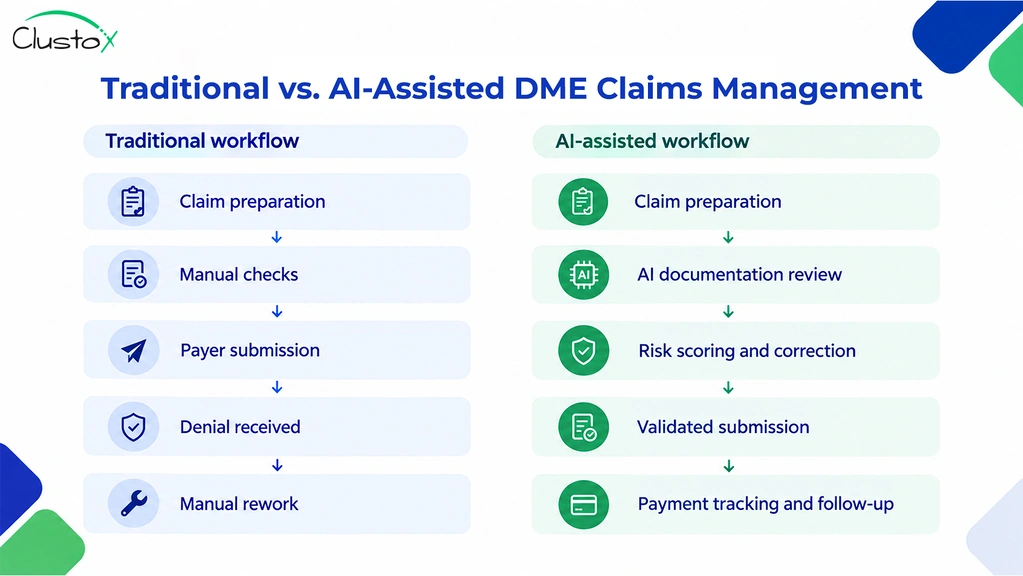
In a traditional workflow, billing specialists prepare claims and perform manual checks. Some issues may only become apparent after a payer rejects or denies a claim, creating additional work and delaying reimbursement.
An AI-assisted workflow adds document analysis, risk scoring, and targeted alerts to support these checks.
Here’s how the two approaches compare across key stages of DME claims management.
Traditional vs. AI-Assisted DME Claims Management
| Workflow stage | Traditional approach | AI-assisted approach |
|---|---|---|
| Documentation review | Staff manually review orders, clinical records, and supporting documents. | AI extracts relevant information and flags potentially missing or inconsistent details for staff review. |
| Claim validation | Billing teams check codes, modifiers, and payer requirements using billing tools and manual review. | AI supports data extraction and comparison, while maintained rules validate coding and payer requirements. |
| Review prioritization | Staff work through claims using queues, deadlines, and established priorities. | Risk scores help staff identify claims that may need additional attention before submission. |
| Claim submission | Claims are submitted after standard checks, with unresolved errors potentially leading to rework. | Flagged issues are routed for correction and human review before submission. |
| Denial management | Specialists investigate denial reasons and gather records for corrections or appeals. | AI helps classify denials, retrieve relevant records, and draft supporting materials for review. |
| Payment follow-up | Staff check claim status and prioritize outstanding balances manually. | AI-assisted workflows organize follow-up tasks using claim status, outstanding amounts, and deadlines. |
Example: Flagging Missing Hospital Bed Documentation Before Submission
Consider a hospital bed claim with incomplete supporting clinical documentation. If the gap goes unnoticed during manual review, the claim may be submitted and later denied.
An AI-assisted system can flag the potential gap, identify the source document for review, and create a task for the billing specialist to obtain the required information. Staff can then verify the documentation before releasing the claim.
The practical value is earlier intervention: billing teams can address preventable issues before they become denial-related rework.
3. 7 Ways AI Can Reduce DME Insurance Claim Denials
3.1 AI-powered medical documentation verification
Incomplete or inconsistent documentation is a major source of reimbursement risk for DME providers.
Depending on the equipment and payer, documentation may include:
- Standard written orders
- Physician progress notes
- Certificates or other medical necessity documentation where applicable
- Prior authorization records
- Supporting clinical evaluations
- Proof of delivery
- Patient eligibility information
Reviewing these documents manually can be time-consuming, especially for providers processing hundreds or thousands of claims monthly.
How AI helps:
AI systems combining document extraction, natural language processing (NLP), and rules engines can examine documents and identify missing or inconsistent information.
For example, an AI system could analyze a physician’s clinical notes and determine whether the documentation appears to address the applicable coverage criteria for a prescribed oxygen device.
If required information is absent, the system can notify the billing team before submission.
The AI should not independently declare medical necessity or fabricate missing clinical evidence. Instead, it should identify documentation gaps and provide references for qualified staff to review.
Business impact: Less manual document review, earlier identification of incomplete records, and fewer avoidable documentation-related denials.
3.2 Predictive claim denial risk scoring
Not all DME claims have the same likelihood of denial. Some claims involve straightforward eligibility and billing requirements. Others involve expensive equipment, complicated medical necessity criteria, or payer-specific authorization rules.
AI can analyze historical claims data to identify patterns associated with previous denials. Relevant variables may include payer, HCPCS code, equipment category, authorization status, documentation completeness, modifier combinations, and historical denial reasons.
For example, an AI model might identify that claims involving a particular equipment category and payer frequently encounter documentation-related denials. The system can then assign a risk score to similar claims before submission.
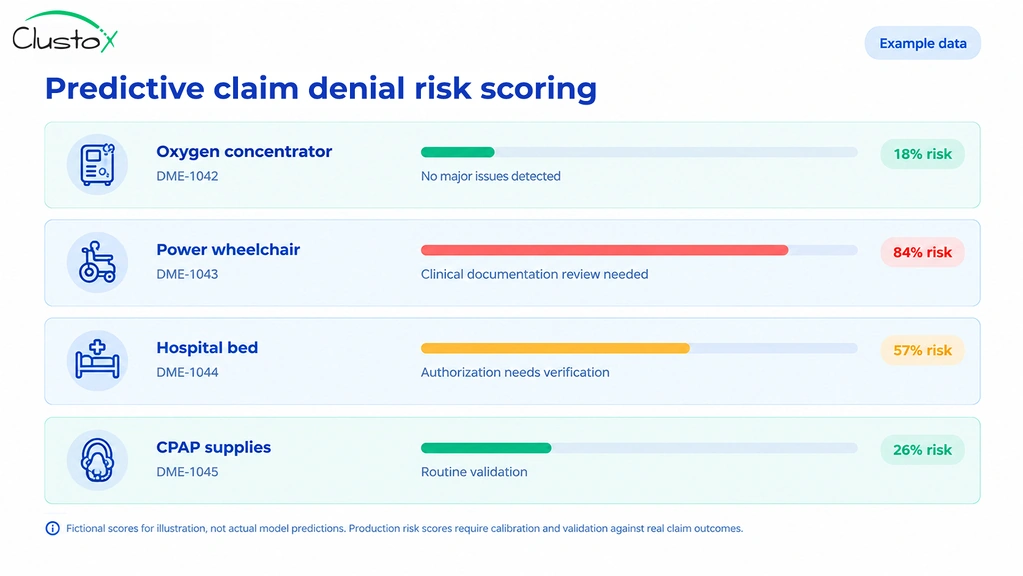
With predictive scoring, billing managers can prioritize high-risk claims for review rather than spending equal effort on every claim.
Business impact: More efficient allocation of billing resources, fewer preventable errors, and potentially higher clean-claim submission rates.
3.3 Intelligent HCPCS coding and modifier validation
HCPCS coding plays a critical role in DME reimbursement. Incorrect equipment codes or missing modifiers can lead to denials, underpayments, or additional administrative work.
AI can support coding teams by analyzing the equipment description, physician order, payer requirements, and relevant billing rules.
For example, a DME provider submitting a claim for rental equipment may need to use specific modifiers depending on the applicable payment rules.
An AI-assisted validation system could compare the claim against current coding requirements and flag a missing modifier.
However, coding accuracy requires more than generative AI. A reliable solution should combine AI-based extraction with maintained HCPCS reference data, payer-specific rules, and human review.
Business impact: Reduced coding errors, improved billing consistency, and less time spent correcting rejected claims.
3.4 Automated insurance eligibility and prior authorization checks
Insurance eligibility and authorization requirements can change.
A patient may have active coverage during equipment evaluation but different coverage when the equipment is delivered.
Similarly, an authorization may expire before a claim is submitted.
AI-enabled workflows can integrate with payer portals, clearinghouses, eligibility services, and authorization systems to monitor these conditions.
For example, before a power wheelchair is delivered, the system could:
- Request current eligibility information.
- Check whether the equipment requires prior authorization.
- Confirm the authorization status and applicable dates.
- Compare the authorization details with the planned equipment.
- Alert staff if information is missing or inconsistent.
AI can also assist in interpreting payer responses and routing exceptions to the appropriate employee.
It is important to distinguish the roles of AI and external verification: AI cannot reliably establish active insurance coverage without current information from an authoritative payer or eligibility source.
Business impact: Fewer eligibility-related submission errors, fewer authorization-related delays, and improved operational coordination.
3.5 AI-assisted denial analysis and appeals preparation
Even well-managed DME providers experience insurance claim denials. The challenge is determining which denials are recoverable, what caused them, and what actions should be taken.
Traditional denial management often requires billing specialists to examine explanation-of-benefits documents, remittance advice, clinical records, and payer policies manually.
AI can help classify denials by reason, identify patterns, recommend next steps, and prepare supporting materials for appeal.
For example, a denied claim may include a remittance adjustment code indicating that additional documentation is required.
An AI-assisted system can extract the relevant code, retrieve associated claim records, identify potentially missing documents, and draft an appeal package for human review.
The final appeal should be checked by qualified personnel to ensure that it accurately represents the medical record and meets payer requirements.
Business impact: Faster denial triage, reduced repetitive administrative work, and improved prioritization of potentially recoverable revenue.
3.6 Intelligent accounts receivable management
DME providers often have substantial working capital tied up in unpaid claims.
Not every unpaid claim deserves the same level of attention.
Some claims may require a simple status inquiry, while others need corrected documentation, reconsideration, or formal appeal.
AI can help categorize outstanding claims based on:
- Outstanding dollar amount
- Age of receivable
- Payer
- Denial reason
- Expected recovery probability
- Filing or appeal deadline
- Estimated staff effort
A billing team can then focus on claims with the greatest expected recovery value while ensuring that time-sensitive claims receive attention before deadlines.
For example, an AI-driven AR dashboard could prioritize a $4,000 recoverable claim approaching its appeal deadline ahead of a low-value claim that is still within the normal processing period.
This approach can help organizations improve collections without necessarily increasing billing headcount.
3.7 AI agents for repetitive revenue cycle tasks
One of the emerging opportunities in DME operations is the use of AI agents.
Unlike basic automation that follows fixed rules, an AI agent can coordinate multiple steps across connected systems, interpret information, and request human intervention when necessary.
For example, an AI claims follow-up agent could:
- Identify claims that have not received a payer response.
- Retrieve the latest status through an authorized integration.
- Interpret status codes and payer messages.
- Determine the next permitted workflow step.
- Create a follow-up task.
- Escalate exceptions to a billing specialist.
- Update the revenue cycle dashboard.
Where payer interfaces permit, an agent could also prepare structured status inquiries or retrieve relevant documents.
However, autonomous actions such as changing clinical records, submitting appeals, or making material billing decisions should be governed by explicit permissions, audit logs, and human approval where appropriate.
4. How Much Can AI Save a DME Provider?
The financial value of AI depends on the provider’s claim volume, denial rate, average claim value, recovery performance, and implementation costs.
Consider a hypothetical mid-sized DME provider.
DME denial reduction ROI calculator
DME Denial Reduction ROI Calculator
Adjust your billing numbers to estimate how AI-powered denial prevention could improve your annual collections.
Your Estimated Financial Opportunity
Illustrative estimates based on your selected billing inputs
These estimates assume prevented denials are paid in full and that the selected percentage of denied dollars would otherwise have been recovered. Results exclude implementation costs, payer adjustments, patient responsibility, and payment timing. Actual results may vary.
In the default example, a DME provider processing 3,000 claims monthly with a 15% initial denial rate experiences approximately 450 initial denials per month.
Reducing that denial rate by 30% relative would prevent approximately 135 denials monthly, lowering the initial denial rate to 10.5%.
At an average claim value of $450, the face value of those prevented denials would be approximately $729,000 annually.
However, that figure is not equivalent to additional revenue. Many denied claims are eventually corrected and paid. Assuming 60% of the denied dollars would otherwise have been recovered, the illustrative incremental collections opportunity is approximately $291,600 annually, before costs and other adjustments.
These are hypothetical assumptions, not verified industry-wide AI performance benchmarks.
5. AI Use Cases Across Different DME Equipment Categories
Not every DME category faces identical reimbursement challenges. AI solutions should therefore be designed around equipment-specific documentation and billing workflows.
| DME category | Common reimbursement challenge | AI opportunity |
|---|---|---|
| Oxygen equipment | Medical necessity and qualifying test documentation | Clinical document completeness analysis |
| CPAP and respiratory supplies | Continued coverage and adherence documentation | Adherence data and record reconciliation |
| Power wheelchairs | Detailed clinical evaluations and authorization | Multi-document review and authorization tracking |
| Hospital beds | Documentation supporting coverage criteria | Clinical evidence extraction |
| Orthotics and prosthetics | Coding, documentation, and payer-specific rules | Code validation and documentation matching |
| Diabetic testing supplies | Coverage limits and refill documentation | Utilization monitoring and refill validation |
| Mobility aids | Coverage requirements and proof of delivery | Automated documentation checks |
For example, a respiratory equipment supplier may benefit most from automating documentation review and continued-coverage monitoring.
A power mobility provider may obtain greater value from AI-assisted clinical document analysis and prior authorization workflows.
The right AI strategy depends on the provider’s product mix, payer mix, claim volume, and historical denial patterns.
6. Building an AI-Powered DME Revenue Cycle Management System
Implementing AI does not necessarily require replacing an existing DME billing platform.
In many cases, AI can be integrated into existing workflows.
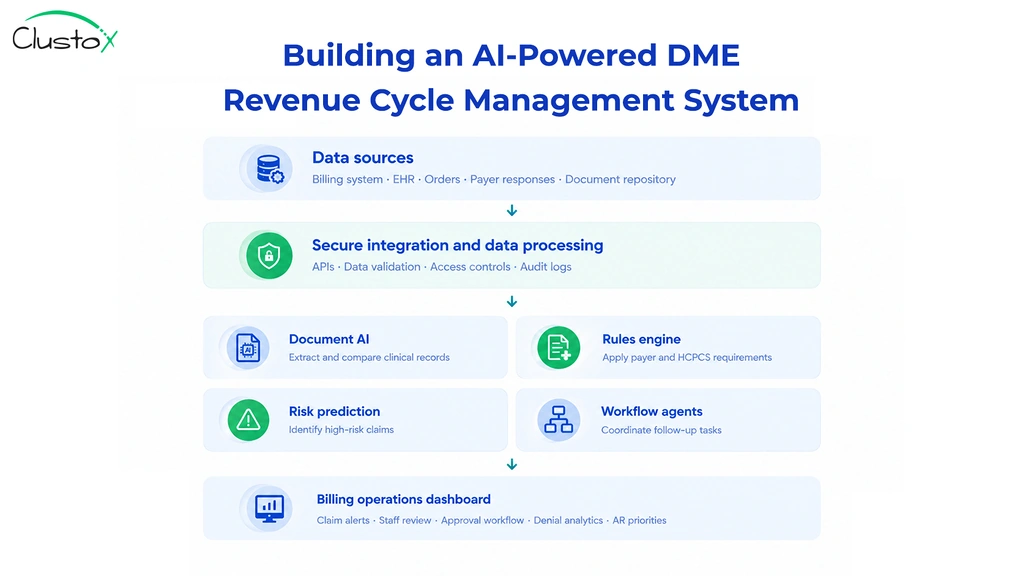
A practical solution can connect to billing software, document management systems, electronic health records, clearinghouses, and payer services through available APIs or approved integrations.
Reference architecture
The architecture should keep deterministic payer rules separate from probabilistic AI predictions.
For example, an AI model may extract a physician’s order date from a scanned document, but a maintained rules engine should determine whether that date satisfies the relevant coverage requirement.
This combination is generally more reliable than asking a large language model to make every billing decision independently.
7. A Practical 90-Day AI Implementation Roadmap for DME Providers
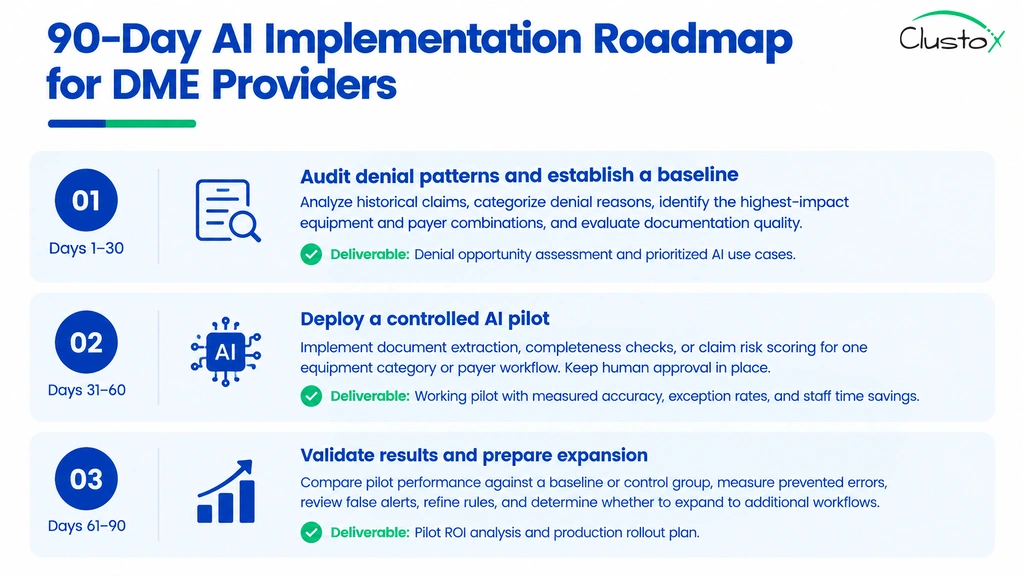
DME organizations do not need to automate their entire revenue cycle on day one.
A phased implementation reduces risk and makes it easier to measure business outcomes.
8. KPIs Every DME Provider Should Track
AI initiatives should be evaluated against operational and financial outcomes rather than model accuracy alone.
| KPI | What it measures | Why it matters |
|---|---|---|
| Initial denial rate | Denied claims divided by adjudicated claims | Tracks payer denial performance |
| Clean claim rate | Claims accepted without required corrections | Measures submission quality |
| First-pass payment rate | Claims paid without rework | Measures reimbursement efficiency |
| Days in AR | Average time receivables remain outstanding. | Indicates cash flow efficiency |
| Denial recovery rate | Denied dollars eventually recovered. | Measures recovery effectiveness |
| Cost per claim | Administrative expense per processed claim | Tracks operating efficiency |
| Documentation completeness | Claims with required documents before submission | Measures preventable risk |
| AI alert precision | Share of flagged issues that are genuine | Helps control unnecessary manual review |
Organizations should define these metrics consistently and segment them by payer and equipment category.
A reduction in denial rate is valuable, but it should not come at the expense of unnecessarily delaying valid claims or increasing administrative costs.
9. The Common Challenges When Implementing AI in DME Billing
Although AI offers significant potential, implementation requires careful planning. Before adopting AI in DME billing, providers need to address four key challenges that can affect accuracy, compliance, and day-to-day operations.
1. Data quality and system integration
Many DME providers maintain information across disconnected systems. Clinical records may reside in one platform, insurance eligibility in another, and billing data in a third.
AI effectiveness depends on obtaining accurate, consistent, and appropriately authorized information from these systems.
2. HIPAA compliance and patient privacy
DME billing frequently involves protected health information (PHI). Organizations implementing AI should establish appropriate safeguards under HIPAA, including access controls, encryption, audit logging, minimum necessary data practices where applicable, and Business Associate Agreements with vendors that qualify as business associates.
Not every public AI service is suitable for processing PHI. Providers must evaluate the service’s contractual terms, security controls, and permitted data use before integrating it into clinical or billing workflows.
3. Changing payer policies
Insurance policies, coverage requirements, and billing guidelines change over time. An AI system trained on historical claims may not reflect current payer requirements.
A production solution needs maintained rules, effective-date tracking, version control, and procedures for validating policy updates.
4. AI errors and human oversight
AI can misunderstand clinical language, extract incorrect information, or produce unsupported recommendations.
For that reason, high-impact decisions should include validation against source documents and appropriate human review.
The goal should be AI-assisted billing accuracy, not uncontrolled automation of reimbursement decisions.
10. Should DME Providers Buy an AI Solution or Build a Custom One?
There is no universal answer. Off-the-shelf AI revenue cycle tools may be appropriate for organizations with standardized workflows and common billing platforms.
Custom AI solutions may be more suitable for providers with complex operations, specialized equipment categories, multiple payer integrations, or substantial existing technology investments.
| Consideration | Off-the-shelf solution | Custom AI solution |
|---|---|---|
| Implementation speed | Often faster | Depends on integration complexity |
| Initial investment | Typically subscription-based | Requires development investment |
| Workflow customization | Limited to vendor capabilities | Designed around specific processes |
| Integration flexibility | Depends on supported systems | Potentially more flexible |
| Proprietary denial models | Vendor-dependent | Can use provider-specific data |
| Maintenance | Primarily vendor-managed | Requires ongoing ownership |
| Scalability | Depends on product limits | Depends on architecture and investment |
For many mid-sized DME providers, the most practical approach is a hybrid model: retain the existing billing system while adding targeted AI capabilities for documentation verification, denial risk detection, and workflow automation.
11. The Future of DME Revenue Cycle Management: From Reactive Billing to Intelligent Revenue Operations
AI is creating an opportunity to change how DME providers manage reimbursement. Historically, billing teams have focused heavily on processing claims and correcting problems after payer responses arrive.
The next generation of revenue cycle operations will increasingly focus on identifying risks earlier, coordinating information automatically, and giving staff more actionable insights.
Three developments are especially relevant:
- Predictive revenue operations: Instead of reporting only which claims were denied, AI systems can help identify claims that are likely to encounter reimbursement problems before they are submitted.
- Agent-assisted workflows: AI agents can coordinate documentation requests, claim status checks, and billing tasks across approved systems, reducing repetitive administrative work.
- Continuous process improvement: By analyzing recurring denial reasons, providers can identify upstream operational problems such as incomplete physician orders, delayed authorization checks, or inconsistent delivery documentation.
The long-term opportunity extends beyond automating the billing department. AI can connect intake, clinical documentation, equipment fulfillment, authorization, billing, and collections into a more coordinated revenue cycle.
12. How Clustox Can Help DME Providers Adopt AI?
For DME providers looking to modernize their revenue cycle operations, the challenge is often determining where AI can generate measurable value without disrupting existing systems.
Clustox helps organizations design and build custom software, AI-enabled workflows, and system integrations.
For DME providers, potential solutions include:
- AI claim denial prediction: Identify high-risk claims and prioritize pre-submission reviews.
- Intelligent documentation processing: Extract information from orders and clinical records, then flag missing or inconsistent documentation.
- Billing workflow automation: Connect existing systems and automate repetitive administrative tasks.
- Denial analytics dashboards: Identify recurring denial patterns by payer, equipment category, and root cause.
- AI-assisted AR management: Prioritize outstanding claims and support collections workflows.
- Custom AI agent development: Build controlled agents that coordinate approved tasks across billing and document systems.
Rather than beginning with a large-scale system replacement, a focused AI opportunity assessment can identify where automation is likely to produce the strongest return.
Identify preventable denial causes and explore how AI-assisted workflows can improve documentation and reduce manual billing work.
Are Recurring DME Claim Denials Driving Up Your Costs?
Identify preventable denial causes and explore how AI-assisted workflows can improve documentation and reduce manual billing work.
Assess Your Denial Workflow
Frequently Asked Questions
How does AI predict whether a DME claim will be denied?
AI models can analyze historical claim outcomes, payer information, equipment codes, documentation completeness, authorization status, and other relevant variables to estimate denial risk. These predictions require validation and ongoing monitoring.
Can AI integrate with existing DME billing software?
Potentially, yes. Integration depends on the billing platform's APIs, export capabilities, data access permissions, and vendor agreements. Some systems support direct integration, while others may require middleware or approved workflow automation.
Is AI-powered DME billing HIPAA compliant?
AI technology is not automatically HIPAA compliant. Compliance depends on how the system is designed, deployed, contracted, accessed, and operated. Handling PHI requires appropriate safeguards and agreements.
What is the best AI use case for a small DME provider?
A practical starting point is often document completeness verification or automated denial classification. These use cases can be implemented incrementally and measured against clear operational outcomes.
How long does it take to implement AI for DME claim management?
A focused pilot may be possible within 60–90 days when data access and integrations are straightforward. Complex multi-payer implementations or extensive legacy-system integrations can take substantially longer.