

What if the kingdom built on oil becomes a global leader in digital technology?
Saudi Arabia is rapidly transforming its economy and digital environments, but businesses and governments face challenges in keeping up with emerging technologies and growing cyber threats.
The ICT sector in Saudi Arabia is booming, with software and cybersecurity investments rising steadily as digital transformation expands across finance, healthcare, and smart city projects. According to Oxford Business Group, these sectors are set to play a significant role in the nation’s economic diversification.
However, growth brings complexity. Organizations must innovate while managing cybersecurity risks and addressing the talent gap. Strategic planning, investment in skills, and robust cyber strategies will be critical in shaping Saudi Arabia’s tech future.
In this blog, we’ll find out how IT, software, and cybersecurity are expected to evolve in Saudi Arabia from 2026 to 2030, the trends driving this growth, the challenges ahead, and what it means for businesses and professionals.
What Does the Future Hold for IT in Saudi Arabia?
Saudi Arabia is embracing a new era of technology, with the Saudi technology industry expanding rapidly through digital services, smart city initiatives, and enterprise modernization.
These efforts support Saudi Vision 2030 technology goals and are transforming how businesses and government agencies operate through structured digital transformation strategies.
The Saudi Arabia ICT market was valued at around USD 60 billion in 2025 and is expected to continue growing as companies adopt modern IT systems and cloud services. This growth reflects rising demand for scalable IT solutions that drive efficiency, innovation, and competitiveness.
Table of Contents
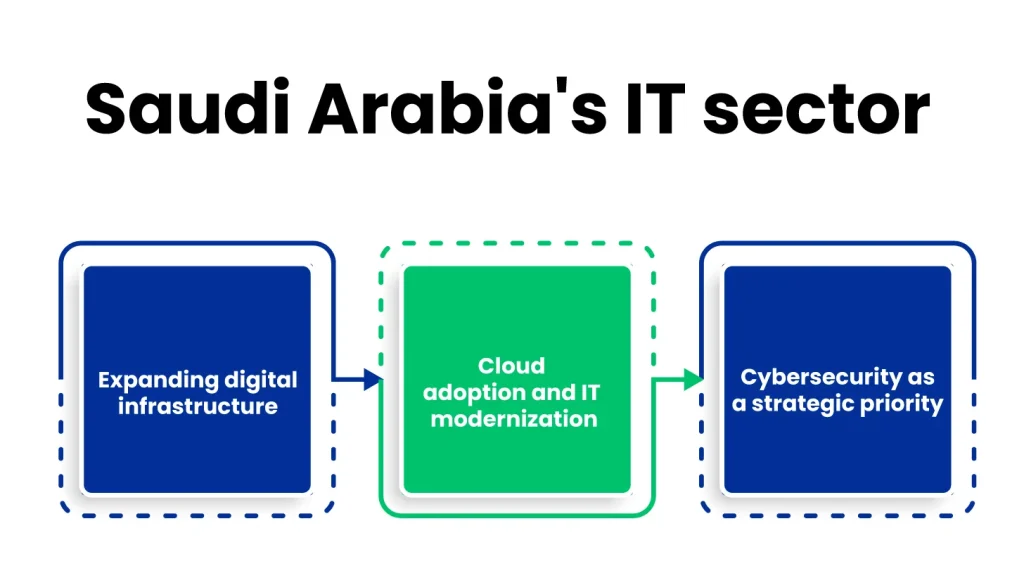
Several areas are shaping the Kingdom’s IT future. Understanding these trends helps identify where infrastructure, cloud adoption, and cybersecurity efforts will have the most impact, particularly through DevOps in IoT and real-time data pipelines that enable scalable and efficient digital operations.
1. Expanding Digital Infrastructure
Investments in Saudi Arabia’s digital transformation are strengthening broadband networks, 5G coverage, and data centers nationwide. Smart city projects and industrial zones are building the foundation for a thriving digital economy in Saudi Arabia.
2. Cloud Adoption and IT Modernization
Additionally, the Saudi Arabian cloud computing market is growing quickly as organizations adopt hybrid and cloud-native platforms. These solutions improve operational flexibility, enable AI-driven tools, and accelerate innovation across multiple sectors, often with DevOps consulting services to ensure smooth deployment and operational efficiency.
3. Cybersecurity as a Strategic Priority
At the same time, cybersecurity in Saudi Arabia is becoming essential. Organizations are investing in security infrastructure, real-time threat detection, and compliance measures, making the Saudi Arabian cybersecurity market a critical component of IT planning.
Overall, these developments show that the future of IT in Saudi Arabia will focus on stronger infrastructure, increased cloud adoption, and robust cybersecurity.
This momentum is setting the stage for growth across the Saudi Arabian software industry and the broader technology ecosystem.
Promote IT modernization with strategies that improve operational efficiency by up to 40% and reduce system downtime.
What Role Will Software Development Play in Saudi Arabia’s Digital Future?
Software is becoming a fundamental driver of Saudi Arabia’s digital transformation, enabling businesses and government organizations to deliver smarter, faster digital services.
As industries modernize operations, the Saudi Arabia software industry is expanding through enterprise applications, automation tools, and cloud-based platforms, while also focusing on legacy software modernization services to ensure older systems meet modern business needs, aligning with Saudi Vision 2030 technology goals.
In fact, Saudi Arabia’s software market revenue is projected to reach over USD 2.3 billion by 2027, reflecting growing demand for digital platforms and enterprise solutions.
This growth highlights how software solutions are becoming essential to innovation and the long-term growth of Saudi Arabia’s tech sector.
This momentum also reflects broader Saudi Arabia tech sector growth, driven by innovation investments, startup expansion, and increasing enterprise digital adoption.
As software adoption grows, several trends are shaping how organizations build and deploy modern digital solutions across the Kingdom.
1. Software Market Growth and Local Development
The Saudi Arabian software industry is witnessing increased investment in local development and technology startups. Government initiatives supporting innovation hubs and entrepreneurship are strengthening Saudi Arabia’s digital economy, creating opportunities for regional software providers and global partnerships.
Additionally, businesses are investing in customized software solutions to improve efficiency and customer experiences. This demand continues to support expansion in the broader Saudi Arabian technology industry and to encourage sustainable innovation across sectors.
2. AI-Driven Software and SaaS Adoption Across Industries
Moreover, the rise of the Saudi Arabian AI industry is transforming how software is designed and used. Organizations are adopting AI-powered applications and SaaS platforms to automate workflows, analyze data, and improve decision-making processes.
The growing Saudi Arabia cloud computing market is further accelerating SaaS adoption, allowing companies to deploy scalable software solutions without heavy infrastructure investments. These technologies play a central role in advancing Saudi Arabia’s digital transformation across healthcare, finance, retail, and government services.
As reliance on software platforms increases, protecting applications and digital assets becomes equally important. This growing dependence naturally shifts attention toward cybersecurity in Saudi Arabia, where securing systems and data is essential for sustaining digital growth.
How Will Cybersecurity Shape Saudi Arabia’s Digital Future?
As digital services expand across industries, cybersecurity in Saudi Arabia is becoming a fundamental part of technological progress. Organizations in the Saudi Arabian technology industry that adopt cloud platforms, AI solutions, and connected systems must prioritize security to protect sensitive data and maintain trust. Strong cybersecurity practices now play a central role in supporting Saudi Arabia’s digital transformation.
According to PwC Middle East, the Saudi Arabian cybersecurity market is expected to grow by more than 13% annually, driven by increasing cyber risks and regulatory requirements.
This growth shows how security investment has become essential to the expansion of Saudi Arabia’s ICT market and digital infrastructure.
As digital adoption accelerates, several cybersecurity priorities are shaping how organizations secure systems, applications, and essential networks.
1. Evolving Cyber Threats and Risk Environment
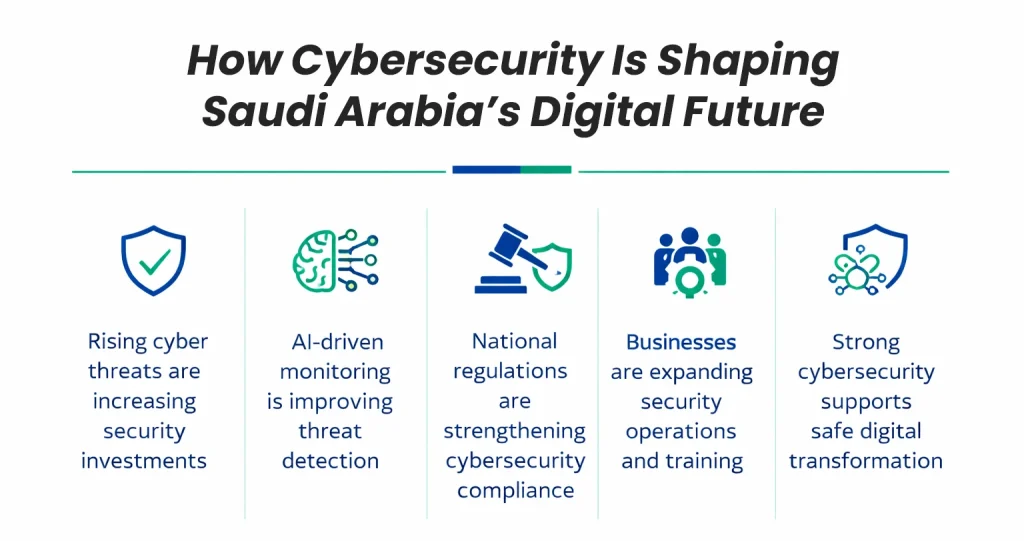
The expansion of the digital economy in Saudi Arabia has increased exposure to cyber threats targeting enterprises, financial institutions, and government platforms.
As a result, businesses are implementing advanced monitoring systems and AI-driven detection tools to strengthen cybersecurity in Saudi Arabia and reduce operational risks.
2. Regulations, Compliance, and Security Investments
Additionally, national cybersecurity frameworks aligned with Saudi Vision 2030 technology initiatives are encouraging stronger compliance standards.
Organizations are increasing spending on security operations, employee training, and risk management solutions, contributing to continued growth in the Saudi Arabia cybersecurity market.
Robust cybersecurity capabilities are helping organizations innovate with confidence while protecting digital assets. As security maturity improves, it also creates new opportunities across the broader Saudi Arabian software industry and technology ecosystem.
What Opportunities Will IT, Software, and Cybersecurity Create in Saudi Arabia by 2030?
As Saudi Arabia speeds up its digital transformation under Vision 2030, the IT, software, and cybersecurity sectors are opening exciting opportunities for businesses, tech professionals, and innovators across multiple industries.
These opportunities span careers, entrepreneurship, and strategic investments, making the Kingdom a hub for technological growth.
1. Growing Demand for IT & Cloud Professionals
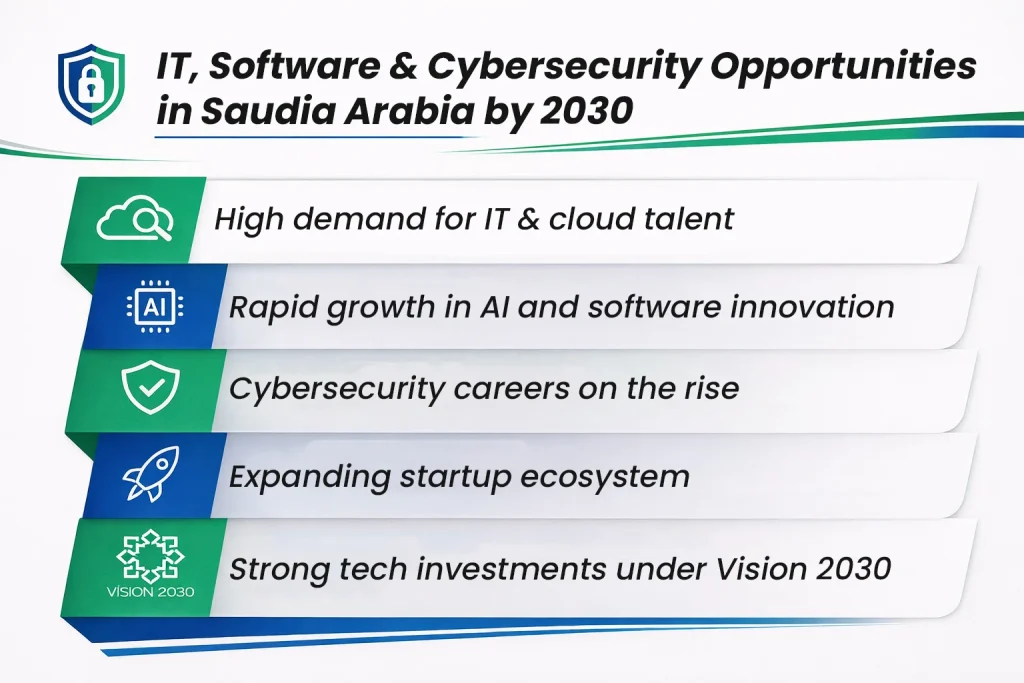
The swift adoption of cloud computing and the modernization of enterprise systems are driving a surge in demand for skilled IT professionals. Roles in Saudi Arabia IT jobs, cloud management, and digital transformation initiatives are becoming essential as organizations seek to improve efficiency and innovation.
2. Software Development & AI Innovation
Saudi Arabia’s expanding software industry is creating opportunities for AI software development, enterprise software solutions, and SaaS adoption across sectors like healthcare, finance, and retail.
Businesses and startups are investing in intelligent applications that streamline operations and improve customer experiences.
3. Cybersecurity & Risk Management Careers
With increasing cyber threats targeting enterprises and government platforms, the need for cybersecurity experts is stronger than ever. Careers in risk management, real-time threat detection, and compliance solutions are thriving, as organizations prioritize protecting sensitive data and maintaining trust.
4. Investment & Startup Ecosystem
Government-backed innovation hubs, smart city projects, and tech-focused initiatives are encouraging entrepreneurship and global partnerships. The Saudi tech startup ecosystem is growing rapidly, offering opportunities for digital innovation, technology investment, and collaborative software development.
In addition to promoting economic diversification. These IT, software, and cybersecurity opportunities will establish Saudi Arabia as a regional technology leader and a hub for innovation and digital excellence by 2030.
Frequently Asked Questions (FAQs)
2. How Will Software Development Impact Saudi Arabia’s Digital Transformation?
Software is central to Saudi Arabia’s digital future. Organizations are leveraging AI-driven applications, SaaS platforms, and enterprise software solutions to automate operations, improve efficiency, and improve customer experiences. Additionally:
Government initiatives support local software startups and innovation hubs.
Businesses are investing in customized software to meet sector-specific needs.
3. Why is Cybersecurity Important in Saudi Arabia’s Tech Industry?
Cybersecurity has become a strategic priority due to rising digital adoption. Companies and government agencies focus on:
Real-time threat detection and risk management.
Compliance with national cybersecurity regulations.
Protecting sensitive data in sectors like finance, healthcare, and smart cities.
Strong cybersecurity ensures that innovation can continue without compromising safety or trust.
4. What Career Opportunities are Emerging in Saudi Arabia’s IT, Software, and Cybersecurity Sectors?
Yes, the Kingdom offers numerous opportunities for professionals:
IT & Cloud Professionals: Roles in cloud infrastructure, IT modernization, and digital services.
Software & AI Developers: Work on enterprise applications, SaaS solutions, and AI-driven platforms.
Cybersecurity Experts: Focus on threat detection, risk management, and compliance.
Entrepreneurs and startups can also benefit from government-backed innovation hubs and investment programs.
5. What are the Challenges For Saudi Arabia’s Tech Industry Growth?
Saudi Arabia’s digital transformation faces several challenges:
Talent Gap: Skilled IT and cybersecurity professionals are in high demand.
Cyber Threats: Expanding digital networks increase exposure to attacks.
Regulatory Compliance: Navigating evolving national cybersecurity frameworks can be complex.
Technology Integration: Modernizing legacy systems and adopting AI or cloud solutions requires careful planning.
Addressing these challenges is essential to sustain growth and maximize the benefits of digital transformation.
Final Takeaway
There is no doubt that Saudi Arabia’s journey toward a digital economy is accelerating, powered by growing investments in IT infrastructure, modern software solutions, and stronger cybersecurity frameworks.
As discussed throughout this blog, cloud adoption, AI-driven applications, and proactive security strategies are helping organizations modernize operations while supporting Vision 2030 goals.
At the same time, businesses that align technology with long-term strategy will gain a clear advantage in this changing environment.
What matters now is how organizations turn this momentum into practical action. A strong digital foundation supported by scalable platforms such as modern web app development solutions can help companies deliver secure, efficient, and user-focused digital experiences.
Ultimately, success will belong to businesses and professionals who adapt early, invest in innovation, and treat technology as a driver of sustainable growth rather than just a tool for change.
Is your organization ready to scale securely and modernize technology for Saudi Arabia’s digital future by 2030?