


Imagine logging in to your online store and seeing a flood of customer messages, pending orders, inventory alerts, and marketing tasks all at once. Managing all of this manually can quickly lead to delays, mistakes, and frustrated customers.
However, Many retailers face inefficiencies from repetitive tasks and slow workflows, making it harder to scale operations and provide a smooth shopping experience. AI agents offer a solution, handling routine tasks while giving teams time to focus on strategic decisions.
In fact, Industry data shows that 80+ online stores already use AI for personalization, inventory management, marketing, and other core workflows, highlighting how AI is becoming essential in eCommerce operations.
In this blog, we’ll explore how eCommerce AI agent automation can simplify customer support, product recommendations, inventory, marketing, and fulfillment, helping your store operate more efficiently and scale successfully.
What are AI Agents?
AI agents are intelligent software that perform tasks, make decisions, and learn from data with minimal human input.
In eCommerce, they automate workflows like customer support, inventory management, product updates, and content creation, helping businesses save time, reduce errors, and scale efficiently.
Al-powered automation enables stores to respond more quickly to customer needs, while AI content generation generates product descriptions and personalized recommendations.
Working with experts in AI agent development ensures these solutions fit your store’s specific workflows.
How Do AI Agents Work in eCommerce?
AI agents help eCommerce businesses automate tasks and make smarter decisions, especially when integrated with custom eCommerce software solutions that support automated workflows and Al-driven operations. Their workflow can be broken down as follows:
Table of Contents
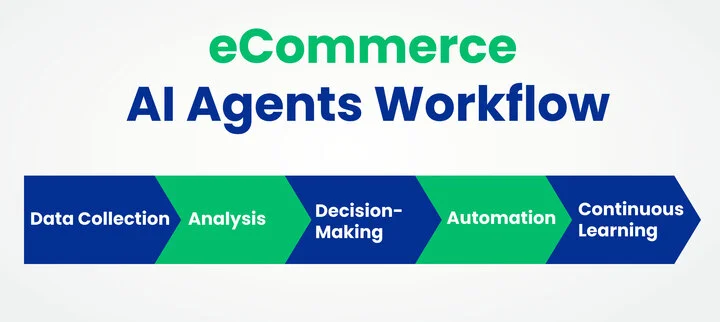
- Data Collection: Gather information from customer interactions, sales, and inventory.
- Analysis: Identify patterns and trends to inform decisions automatically.
- Decision-Making: Take actions such as adjusting inventory or sending personalized offers.
- Continuous Learning: Improve performance over time based on outcomes and new data.
Real Examples of AI Agents in Action
- Chatbots answer customer queries instantly.
- Automating online store workflows with AI updates product catalogs and marketing campaigns.
- AI for product catalog management ensures accurate, up-to-date listings.
- Al-driven inventory forecasting for eCommerce prevents stockouts and overstock situations.
Overall, AI agents enable eCommerce businesses to operate more intelligently, serve customers better, and scale efficiently without increasing staff.
Overloaded with customer queries and repetitive tasks? Let AI agents handle routine workflows, so your team can focus on strategic growth.
How Do AI Agents Automate and Scale Core eCommerce Operations?
In 2026, eCommerce AI agent automation is becoming essential for online stores. These intelligent systems reduce manual work, improve accuracy, and speed up operations across support, inventory, marketing, and fulfillment.
With the growing adoption of Al-powered eCommerce automation and agentic AI, brands can scale faster without increasing workload. As a result, AI in eCommerce operations is now a key driver of efficiency and growth.
Now, we’ll explore the specific areas where AI agents are making the most significant impact in eCommerce operations.
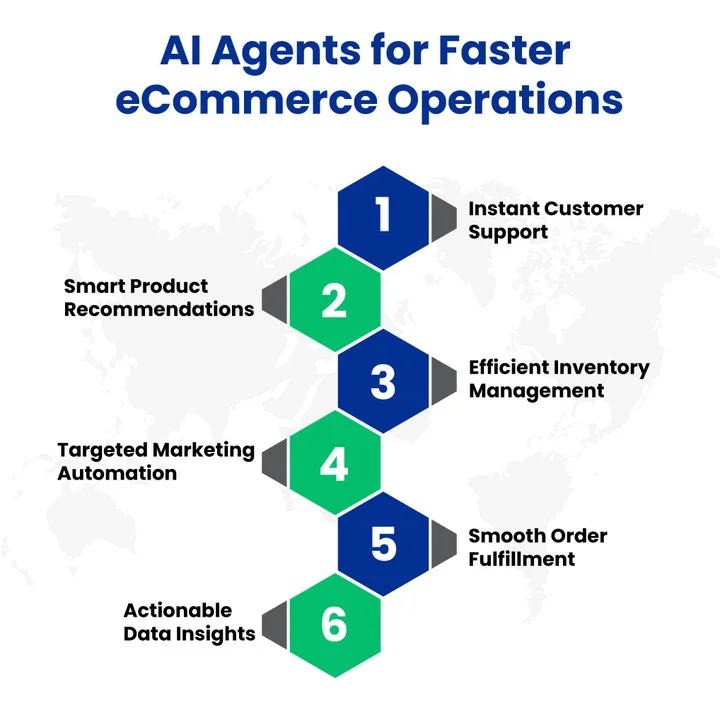
1. Customer Support Automation
AI agents make customer support faster and more reliable by handling routine questions and keeping response times steady even during peak hours. They help online stores manage large volumes of queries without increasing team size.
In simple terms, AI takes over repetitive support tasks so your team can focus on complex customer issues.
- Provides instant answers for order status, returns, product details, and FAQs
- Offers 24/7 support across chat, email, and social platforms
- Reduces wait times by automating common queries
- Uses customer history to deliver more relevant responses
- Escalates only complicated issues to human agents
- Maintains consistent support quality during busy periods
Together, these capabilities help eCommerce teams deliver faster, smarter, and more personalized customer service.
2. Product Recommendations Powered by AI
AI agents help online stores deliver more innovative, more relevant product suggestions, boosting sales and customer satisfaction. Using Al-powered eCommerce automation and generative AI, brands can analyze shopping behavior and predict which customers are most likely to buy next.
This approach makes shopping faster and more personalized for every visitor. The benefits include:
- Uses browsing history and purchase patterns to suggest products
- Automates upselling and cross-selling opportunities in real time
- Improves conversion rates with data-driven recommendations
These Al-driven recommendations help online stores increase revenue while keeping the shopping experience personalized.
3. Inventory and Supply Chain Management with AI
AI agents help online stores manage inventory and supply chains more efficiently. With AI for product catalog management and Al-driven inventory forecasting for eCommerce, businesses can predict demand, prevent stockouts, and automate restocking without manual intervention.
Intelligent AI ensures products are always available when customers need them. They provide:
- Forecasts product demand to reduce overstock and understock issues
- Automates restocking and optimizes supplier orders
- simplifies logistics and warehouse operations using data-driven insights
eCommerce businesses can save time, reduce costs, and maintain a smoother supply chain by applying AI in these areas.
4. Marketing and Sales Operations with AI
AI agents help online stores optimize marketing and sales efforts, making campaigns more innovative and more targeted.
Using Al-powered eCommerce automation and generative AI services, businesses can personalize promotions, dynamically adjust pricing, and reach the right customers at the right time.
Al ensures marketing efforts are data-driven and highly effective. They help businesses:
- Uses customer behavior and preferences to deliver personalized campaigns
- Adjusts product pricing in real time to maximize sales and profit
- Automates email, social, and ad campaigns for better engagement
This approach allows eCommerce teams to increase revenue while saving time on repetitive marketing tasks.
5. Order Fulfillment and Delivery with AI
AI agents optimize order fulfillment and delivery, ensuring packages reach customers quickly and accurately. Using Al-powered eCommerce automation, businesses can optimize routing, track shipments, and reduce delays.
Smart AI helps online stores deliver a faster and more reliable experience. They can:
- Automates order routing to the nearest warehouse or fulfillment center
- Predicts delivery times for better customer communication
- Monitors shipments and resolves potential delays proactively
This level of automation improves customer satisfaction while reducing operational bottlenecks.
6. Data Analytics with AI
AI agents turn raw data into actionable insights, helping eCommerce businesses make smarter decisions. With AI in eCommerce operations and generative AI for eCommerce, brands can track performance, analyze customer behavior, and optimize strategies in real time.
AI makes data-driven decision-making faster and more accurate. They:
- Provides real-time business insights to spot trends and opportunities
- Analyzes customer behavior to improve targeting and engagement
- Identifies patterns for inventory, marketing, and sales optimization
These insights help online stores respond quickly to changing market conditions and customer needs.
What are the Best Practices for Using AI Agents in eCommerce?
AI agents can transform online store operations, and AI Agents for Business Leaders provides guidance on optimizing them effectively by integrating AI into business workflows.
Using AI in eCommerce operations and implementing Al-powered automation correctly helps businesses scale efficiently and deliver better customer experiences.
Essential strategies to implement AI effectively:
- System Integration: Connect AI agents with your existing platforms to automate workflows without disrupting operations.
- Responsible Data Use: Handle customer data carefully to improve personalization, recommendations, and predictions.
- Start Small and Scale: Begin with high-impact areas, then gradually expand AI across operations.
- Performance Monitoring: Regularly track AI accuracy and make adjustments to maintain reliability.
- Human Oversight: Combine AI automation with human judgment for complex tasks and decision-making.
Following these strategies helps businesses fully benefit from agentic AI, improving efficiency, decision-making, and customer satisfaction.
Frequently Asked Questions (FAQs)
2. What Is the Role of AI in Personalized Shopping Experiences?
Yes, AI agents play a key role in personalizing the shopping journey. They analyze customer behavior to:
- Suggest products based on browsing and purchase history
- Customize promotions for individual shoppers.
- Optimize website content for better engagement
- Improve customer satisfaction and retention
As a result, shoppers receive a more relevant and smooth experience.
3. Can AI Agents Predict Inventory and Prevent Stockouts?
Absolutely. AI agents use historical sales data, seasonal trends, and real-time analytics to forecast demand. This allows businesses to:
- Optimize restocking schedules
- Avoid overstock or stock shortages.
- Reduce storage costs
- Improve supply chain efficiency.
Implementing AI-driven inventory forecasting ensures your store is always prepared for customer demand.
4. How Do AI Agents Help Small and Mid-Sized eCommerce Stores Compete?
Yes, even smaller retailers benefit from AI agents. They provide:
- Cost-effective automation of repetitive tasks
- Real-time insights to improve decision-making
- AI content generation for product listings and marketing
- Tools to scale operations without adding extra staff
This levels the playing field, allowing smaller stores to compete with larger brands efficiently.
5. Are AI Agents Reliable for Customer Support During Peak Hours?
Yes, AI agents maintain consistent support quality 24/7. They can:
- Answer FAQs instantly across chat, email, and social platforms
- Escalate only complex issues to human agents
- Track customer history for more relevant responses
This ensures your store delivers fast and accurate service, even during peak shopping times.
Conclusion: Future Trends and Opportunities with AI Agents in eCommerce
AI agents are transforming online stores by handling routine tasks efficiently while allowing teams to focus on critical decisions. Across customer support, product recommendations, inventory, marketing, fulfillment, and analytics, eCommerce AI agent automation helps businesses respond faster and scale operations without adding complexity.
Looking ahead, two trends highlight why adopting AI agents will become increasingly valuable:
- Nearly 77% of eCommerce professionals use AI daily, and many retailers are already seeing benefits from Al-powered eCommerce automation, including operations.
- AI for inventory management and demand forecasting is reducing stockouts and improving supply chain efficiency, enabling smoother operations and better planning.
To maximize these benefits, businesses should address operational complexities and scale intelligently. Understanding AI agents’ enterprise challenges can help ensure smooth integration, optimize workflows, and maintain efficiency as your eCommerce operations grow.
Implementing these strategies allows teams to focus on strategic decisions while AI handles routine tasks, making your store more agile and responsive to market changes.
Having issues with workflow or customer support that are slowing down your eCommerce business?