


What happens when you pick the wrong stack for your web application?
You end up stuck chasing performance issues, dealing with confusing state bugs, or doing endless refactoring. The right tool for the right job is what separates good developers from great ones.
Node.js and React.js are the backbones of modern web development and the most widely used runtime environment and JavaScript library.
Stack Overflow’s 2025 survey showed that nearly half of developers (48.7%) are working with Node.js, and just as many (44.7%) rely on React. That’s proof these tools dominate (but only when used wisely).
So how do you know which one fits your project? Which will handle your I/O-heavy applications efficiently or make your dynamic user interfaces smooth?
In this blog, we’ll compare Node.js and React on parameters such as learning curves, performance, and best use cases.
Keep on scrolling to find out when to choose one or the other, or both.
What is Node.js, And Why Is It Popular For Backend Development?
Node.js is a JavaScript runtime that lets developers run JavaScript outside the browser. It’s built on Google Chrome’s V8 engine and designed to handle multiple tasks at once without slowing down.
Table of Contents
That’s why it’s a go-to for backend development and building apps that need real-time updates or heavy data handling.
Characteristics Of Node.js
To really understand how Node.js works, it helps to know its core components:
- Event Loop: Manages multiple tasks simultaneously without blocking execution, keeping apps responsive.
- npm/yarn Package Management: Offers a vast library of reusable modules to speed up development.
- Express.js / Koa / Nest.js: Frameworks that make creating REST APIs and server routes straightforward.
- File System & Streams: Efficiently handles files and real-time data, perfect for apps with constant input/output.
What Are The Pros and Cons Of Node.js?
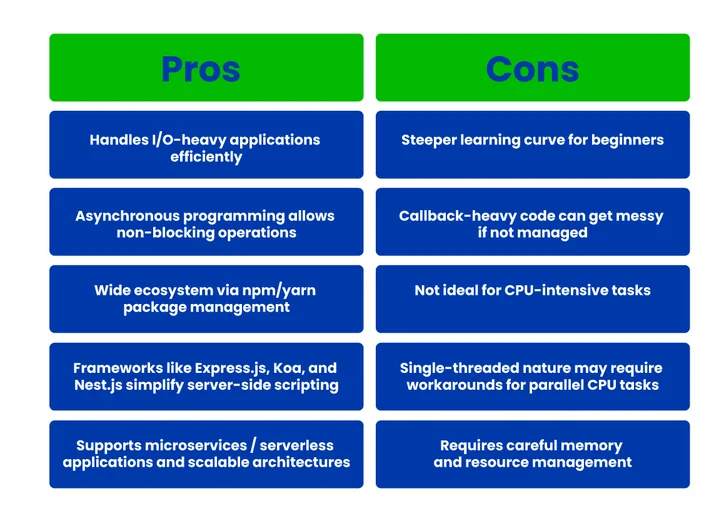
Choosing Node.js comes with clear benefits, but there are trade-offs to consider. Understanding these helps you decide if it’s the right fit for your project.
The following infographic gives you a quick look at the main advantages and disadvantages of Node.js:
What is React, And Why Do Developers Choose It For Frontend Development?
According to Statista, React.js (or React) is the most widely used JavaScript library among developers for building dynamic, interactive user interfaces.
Its component-based approach makes complex layouts easier to manage, while the Virtual DOM ensures smooth updates without reloading the entire page. This makes React unarguably one of the best frontend JavaScript frameworks for developers.
Characteristics of React
Here’s what makes React a favorite for modern frontend development:
- Components: Reusable UI elements that keep code organized and modular.
- Virtual DOM: Updates only what’s necessary on the page, keeping apps fast.
- State Management (Redux, Context API, MobX): Manages dynamic data and ensures consistent UI behavior.
- Hooks: Functions like useState and useEffect simplify logic and prevent unnecessary re-renders.
- JSX Syntax: Lets you write HTML-like code inside JavaScript, making UI code easier to read and maintain.
What Are the Pros and Cons of React.js?
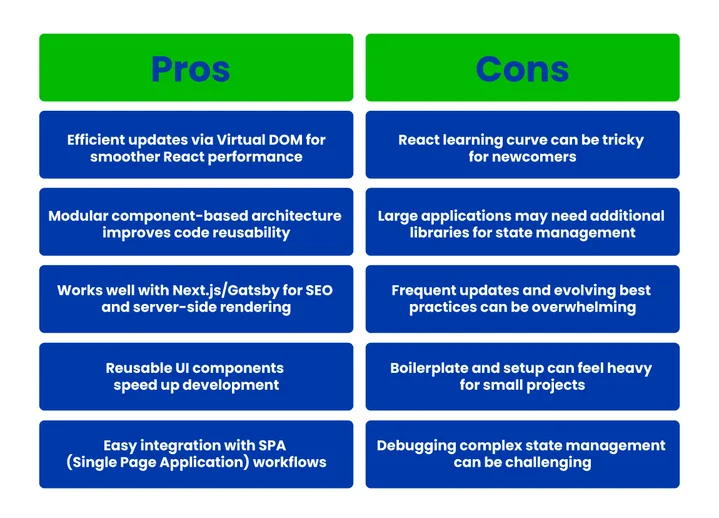
React.js makes building dynamic frontends easier, but like any tool, it has its downsides. Knowing them helps you plan your frontend development strategy.
The infographic below gives you a quick breakdown of its benefits and drawbacks:
Around 40–53% of users abandon a website if it takes longer than 3 seconds to load. Need help deciding between Node.js and React for your next project? Our team can guide you with clear technical direction and hands-on development support.
What’s The Learning Curve For Node.js And React?
For Node.js developers, the learning curve is smooth if you know JavaScript. The main challenge is becoming adept at asynchronous programming and event-driven architecture. Once you get that, building scalable full-stack JavaScript or MERN Stack backends becomes straightforward.
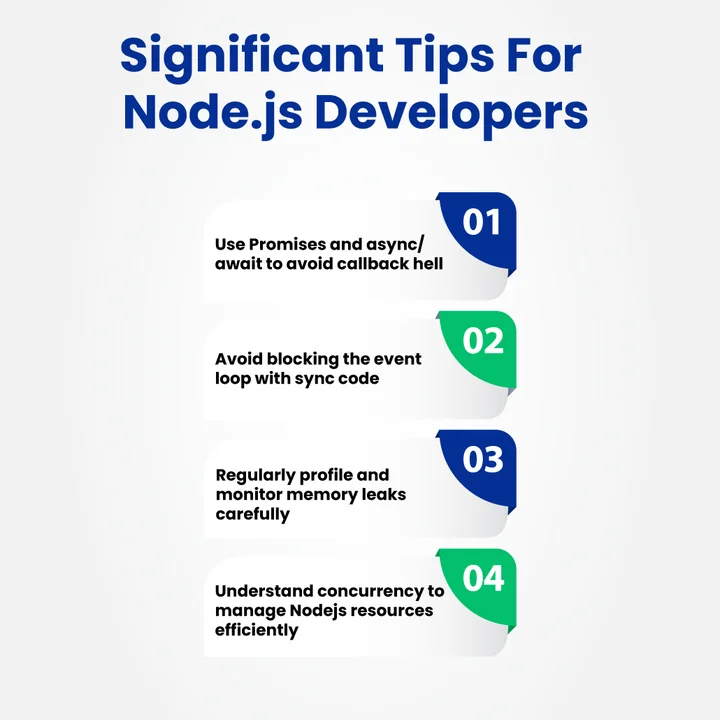
Below are the practical tips for developers who are using (or planning to use) Node.js:
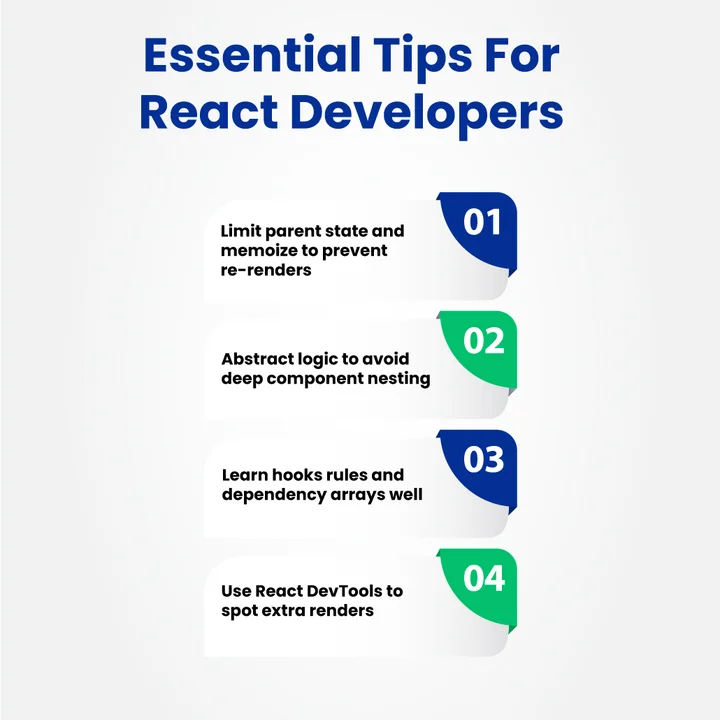
React developers face a slightly steeper learning curve, mainly due to component reusability & modularity and managing state with Redux or Context API. Understanding React Virtual DOM performance optimization and one-way data flow keeps your frontend fast and predictable.
If you’re planning to use React for your next project, make sure to go through the following vital tips:
How Do Node.js And React Compare In Performance?
Let’s understand how both of these open-source JavaScript technologies compare in performance with the help of a table:
| Metric | Node.js | React |
|---|---|---|
| Throughput | 25k-50k requests/sec on simple APIs (Fastify benchmarks) | N/A, frontend rendering not measured in req/sec |
| Latency | 2-6 ms average response under load | 3-5 ms component render/update |
| Concurrency | Handles thousands of concurrent connections | Sustains 60+ FPS for smooth UI interactions |
| Startup Time | ~185 ms cold start in Node.js v24 | ~1-2.5 seconds Time To Interactive (TTI) for SPAs |
| Memory Usage | 13% memory improvement in Node.js v24 over prior | Core bundle ~40 KB plus additional app code |
What Are the Best Use Cases for Node.js and React?
When you’re choosing between Node.js and React, the easiest way to cut through the noise is to understand what each one actually helps you build. Once you see the kind of problems they solve, the right choice stops feeling like a gamble and starts feeling like obvious.
So let’s look at where each technology naturally pulls its weight.
Node.js Use Cases
-
- Ideal for apps that deliver real-time updates
- Fits microservices and serverless setups efficiently
- Speeds up development with a large npm ecosystem
- Handles growing traffic in full-stack JavaScript workflows
- Supports scalable backend systems with REST API/GraphQL
Real-World Application of Node.js
Netflix relies on Node.js to serve millions of streams smoothly. Its asynchronous nature and ability to handle I/O-heavy applications make scaling much easier for its platform.
React Use Cases
- Manages dynamic data with modern state management tools
- Encourages modular, reusable components for cleaner UI
- Integrates easily in full-stack workflows with Node.js
- Ideal for building smooth, interactive SPA interfaces
- Works well with Next.js or Gatsby for SEO/SSR
Real-World Application of React.js
Facebook, the creator of React.js, uses it to manage its dynamic feeds. With component-based architecture and reusable UI components, updates feel instant and predictable across the platform.
The Bottom Line
Choosing between Node.js and React is like picking the right pair of shoes for an important day. You wouldn’t wear heels for a hike or sneakers to a formal event. The right fit makes everything smoother and easier. Pick the wrong one, and every step feels like a struggle.
So, which fits your vision? Are you building the engine or the dashboard of your web app development journey?
Node.js supports scalable back-end systems, asynchronous handling, and full-stack JavaScript workflows. React shines in dynamic frontends, reusable UI components, and smooth state management. Understanding their strengths, learning curves, and use cases separates projects that get stuck from those that thrive.
Now ask yourself: for your next project, will you rely on Node.js, React, or a MERN Stack combo to maximize your development workflow?
Frequently Asked Questions (FAQs)
2. Can Node.js And React Handle High-Traffic Applications?
Yes, Node.js asynchronous handling and React’s optimized component re-renders allow apps to scale without slowing down. This makes them ideal for projects that expect lots of concurrent users or real-time data updates. Proper architecture ensures performance remains smooth.
3. How Do Node.js And React Fit Into OTT App Development?
Node.js handles backend streaming, API calls, and real-time notifications, while React creates interactive UIs for users. Together, they provide a consistent experience for OTT app development, supporting platforms like Netflix with smooth content delivery and responsive interfaces.
4. How Do I Decide Between Node.js Or React For My Project?
Choosing the right tool depends on the project’s focus and requirements. Key factors to consider:
- Backend vs. Frontend: Node.js enables scalable server-side logic, while React handles dynamic user interfaces.
- Real-time vs. Interactive UI: Node.js excels in real-time updates; React is best for interactive, responsive frontends.
- Project Complexity: Node.js handles API-heavy and microservices setups efficiently. React works well for component-based, reusable UI structures.
- Team Expertise: Node.js developers may prefer asynchronous, event-driven coding; React developers focus on React state management and virtual DOM optimization.
This approach helps you align your choice with your project needs, team skills, and web app development goals.
Bring Your Idea to Life With Proven Engineering. From architecture to deployment, we support full-cycle development using Node.js, React, and modern JS tooling. Share your requirements, and we’ll help you move from planning to production.