


Your billing team is chasing prior authorizations. Your intake coordinators are manually entering the same data into three systems. Your denial rate is climbing, and you are not adding headcount fast enough to keep up. This is the operational reality for most DME providers in 2026.
AI workflow automation offers a direct path out of that cycle. Not by replacing your team, but by removing the repetitive, rules-based tasks that eat time and produce errors. The DME providers seeing real results are not deploying AI broadly and hoping for the best. They are applying it to specific, well-defined workflow patterns where automation has a measurable track record.
This guide covers seven of those patterns. Each one is grounded in how DME operations actually run, from Brightree-based billing environments to NikoHealth intake workflows. You will learn what each pattern addresses, how it works, and what realistic outcomes look like.
What Is AI Workflow Automation in DME, and Why Does It Matter Now?
AI workflow automation in DME uses software agents to run repetitive operational tasks from start to finish. The agents read documents, check payer rules, draft submissions, and update your system of record. A staff member reviews and approves the output. The goal is fewer manual touches, faster turnaround, and steadier cash flow.
The shift is practical, not theoretical. DME operations run on structured data and clear payer rules, which is exactly where modern agents perform well. Tools like Brightree, NikoHealth, TIMS, and Bonafide already hold the patient, order, and claim data these agents need. That makes DME a strong fit for targeted automation rather than a science project.
Adoption is also moving fast. More than 25 percent of provider organizations now use AI tools in administrative workflows, according to the 2025 CAQH Index. Federal rules are pushing the same direction. The CMS Interoperability and Prior Authorization Final Rule (CMS-0057-F) requires impacted payers to support electronic prior authorization through FHIR-based APIs, with most API requirements due by January 1, 2027.
That rule covers Medicare Advantage, Medicaid, CHIP, and certain Marketplace plans, not traditional Medicare fee-for-service. The trend is clear either way: manual, fax-driven workflows are on their way out.
One caution before the patterns. AI augments your team. It does not replace clinical judgment, and it should never approve or deny care on its own. Every pattern below keeps a person in the loop for review and final sign-off.
Table of Contents
How Does AI Automation Fit Into an Existing DME Tech Stack?
Before covering the seven patterns, it is worth addressing the integration question directly. Most DME providers run on platforms like Brightree, NikoHealth, TIMS, or Universal Software Solutions. AI automation does not require you to replace those systems.
Modern AI automation layers connect to your existing platforms through APIs, HL7 feeds, or document-level integrations. The AI reads data from your system of record, takes action based on defined logic, and writes results back. Your team continues working in the tools they know.
The table below maps common DME platforms to the automation patterns most applicable to each environment. Use it as a starting reference, not a definitive compatibility list.
| DME Platform | Primary Automation Fit | Integration Approach |
|---|---|---|
| Brightree | Prior auth, denial management, eligibility | API + document layer |
| NikoHealth | Intake automation, eligibility, resupply | Native API integration |
| TIMS Medical | Documentation compliance, claim prep | HL7 / document extraction |
| Universal Software | Prior auth, billing workflows | API + RPA layer |
| Bonafide | Clinical documentation, LMN management | Document AI + API |
Pattern 1: Does AI-Driven Prior Authorization Routing Actually Cut Turnaround Time?
Prior authorization is the single most time-consuming workflow in DME operations. A typical manual prior auth process involves staff pulling clinical notes, matching them against payer criteria, building the submission packet, and following up with payers over days. For complex equipment like power wheelchairs or home ventilators, this process can run three to ten business days.
AI-driven prior auth routing changes this by automating three core steps.
Here is how each layer of the pattern works.
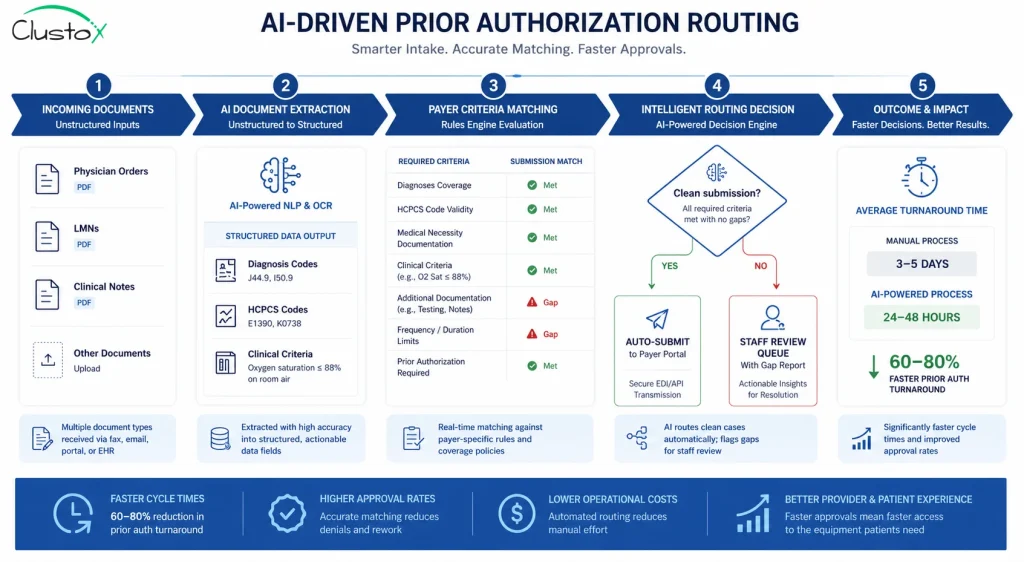
How the prior auth routing pattern works
The first step is document extraction. An AI reads incoming physician orders, letters of medical necessity (LMNs), and clinical notes. It extracts structured data: diagnosis codes, HCPCS codes, equipment type, and supporting clinical criteria.
The second step is criteria matching. The AI compares the extracted data against payer-specific prior auth criteria. It flags gaps before submission, reducing the back-and-forth that delays approvals.
The third step is intelligent routing. Submissions that meet criteria go directly to the payer portal. Submissions with gaps route to a staff queue with a specific gap report, so your team knows exactly what to fix rather than reviewing the entire packet from scratch.
The result is a reduction in average turnaround time from the manual range of three to ten days down to one to two days for clean submissions. Incomplete submissions still require human review, but the time spent per case drops significantly.
Pattern 2: Can AI Eligibility Verification Reduce Denied Claims Before They Start?
Eligibility errors are one of the most preventable sources of claim denials in DME. A patient whose insurance information has changed, whose coverage does not include the ordered item, or whose plan requires a different payer path represents a denial that should never reach the submission stage.
Automated eligibility verification runs benefit checks against Medicare, Medicaid, and commercial payer sources at the time of intake, not the day before delivery. The AI pulls the patient record, queries the payer, and returns a structured benefits summary that includes coverage status, deductible remaining, authorization requirements, and any plan-specific documentation rules.
This is where AI adds specific value beyond traditional batch eligibility checks. It can flag edge cases that a standard 270/271 transaction misses, such as plan-specific HCPCS exclusions or secondary payer coordination requirements.
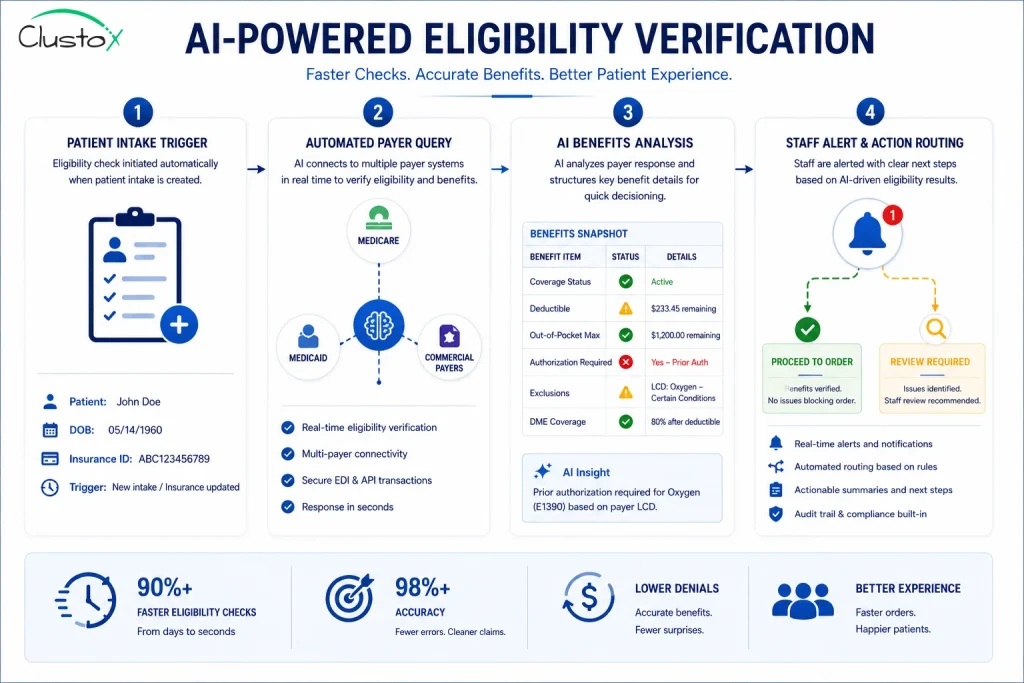
What eligibility automation catches that manual checks miss
Below are the most common eligibility issues that AI-driven verification consistently identifies before claim submission.
- Coverage terminations that occurred after the original order date.
- Medicare Advantage plan enrollment that differs from traditional Medicare in the patient record.
- Coordination of benefits flags requiring secondary payer sequencing.
- Plan-specific prior auth requirements that vary from standard Medicare rules.
- Deductible and out-of-pocket status affecting patient financial responsibility disclosures.
Catching these issues at intake, rather than post-denial, eliminates the write-off and appeal cycle entirely for a meaningful share of your order volume.
Pattern 3: Can AI check documentation compliance before a claim goes out?
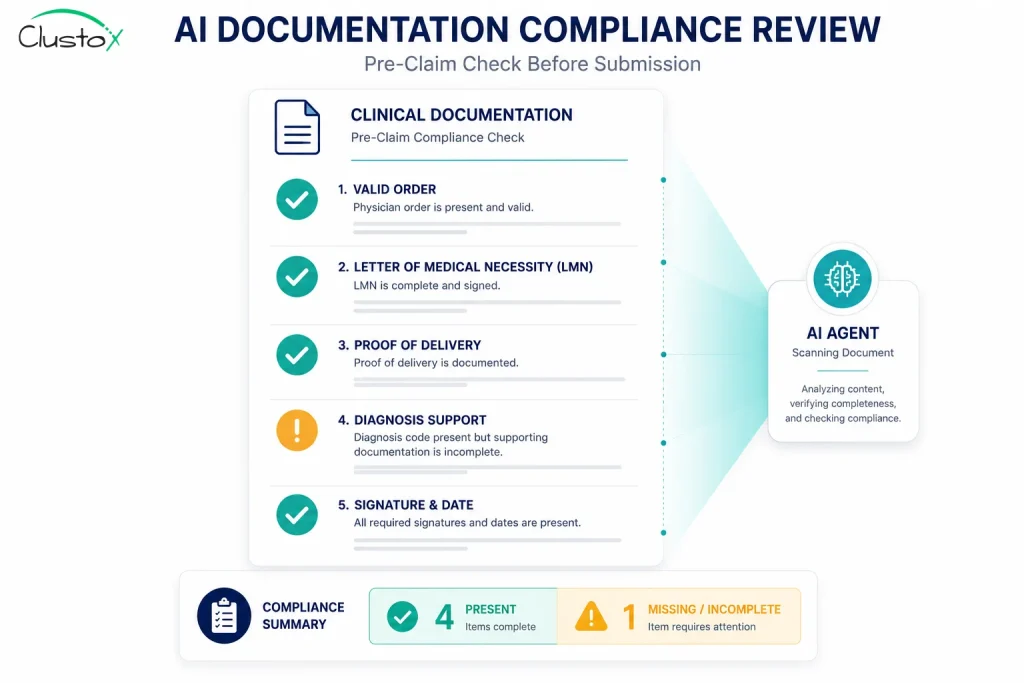
Yes, and this is one of the highest-value patterns. AI-driven documentation automation allows DME providers to review clinical records against documentation requirements before a claim is submitted, helping teams identify gaps while there is still time to correct them.
The AI agent compares physician orders, supporting clinical notes, and related documentation against Medicare and payer-specific requirements. It checks for a valid order, a dated Letter of Medical Necessity (LMN), proof of delivery, appropriate diagnosis support, and other required elements. The system then generates a concise pre-claim compliance report highlighting what is present, what is missing, and what requires further review.
Instead of discovering problems after a denial or during an audit, billing and intake teams can resolve documentation issues before the claim leaves the organization. This proactive approach improves claim quality and reduces administrative rework.
This pattern delivers value in two important ways. First, it reduces preventable denials caused by incomplete or non-compliant documentation. Second, it strengthens audit readiness by ensuring records consistently meet Medicare and payer standards. The key to success is maintaining an up-to-date rules engine and having compliance experts regularly review documentation requirements as policies evolve.
Pattern 4: How does AI workflow automation reduce DME claim denials?
AI reduces denials in two places. It prevents many of them upstream through documentation checks, and it works on the ones that still happen faster and more consistently. The result is more recovered revenue with less manual effort.
On the recovery side, the agent reads each denial and sorts it by reason code. It groups soft denials that follow a clear appeal path, such as a missing document or a coding mismatch. It drafts the appeal with the right supporting evidence and routes it to a biller for review. It then tracks the appeal status so nothing falls through the cracks. Your team focuses on judgment calls instead of repetitive triage.
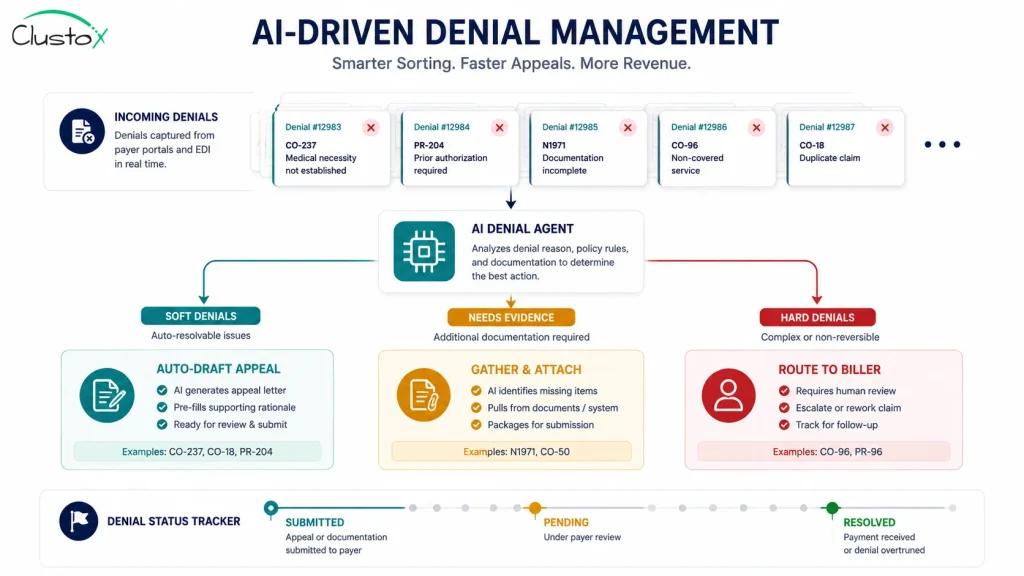
Be clear-eyed about scope. AI will not win every appeal, and hard denials still need experienced billers. Use the agent to clear the high-volume, low-complexity work first, then measure recovery by denial category.
Pattern 5: How Can AI Automate Patient Intake Without Losing the Personal Touch?
Patient intake in DME involves collecting demographic data, insurance information, physician orders, and delivery preferences, often while coordinating across a hospital discharge planner, a physician office, and the patient directly. It is high-volume, time-sensitive, and error-prone when done manually.
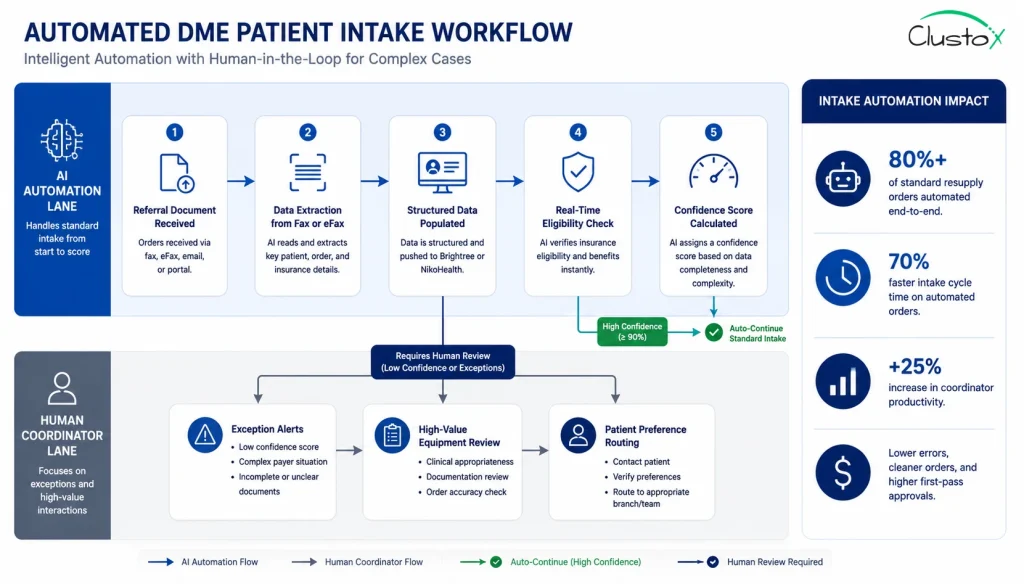
AI intake automation handles the data collection and validation steps so your intake coordinators focus on exceptions, not data entry. The pattern works as follows.
Incoming referrals arrive via fax, eFax, portal, or EDI. An AI document processing layer reads the referral, extracts structured data, and populates your intake system, Brightree or NikoHealth, for example. The system immediately runs eligibility verification on the extracted insurance information and flags any issues before the intake coordinator reviews the record.
For resupply orders, AI can handle outbound outreach via automated text or voice, confirm resupply needs, and create the order without staff involvement for standard, in-policy resupply items.
Where human oversight stays essential in intake automation
Automation accelerates intake, but several scenarios should always route to a human coordinator. These are not limitations of the technology. They are design decisions that protect the quality of care.
- New patients with complex, multi-payer situations
- Referrals with incomplete or conflicting clinical documentation
- Patients who have expressed a preference for direct staff contact
- Orders for high-value equipment requiring detailed benefit verification
- Any intake record where the AI confidence score falls below the threshold set during implementation
Pattern 6: Does AI Resupply Outreach Improve Patient Compliance and Revenue?
Resupply represents a significant share of recurring revenue for DME providers serving CPAP, nebulizer, and incontinence supply patients. The challenge is that resupply outreach at scale requires consistent, timely contact across a patient population that varies in communication preferences, compliance history, and insurance status.
AI-driven resupply outreach automates the contact cadence. The system identifies patients approaching their resupply eligibility window based on insurance rules, sends outreach via the patient’s preferred channel (text, phone, email), collects responses, and creates confirmed orders for standard, in-policy items.
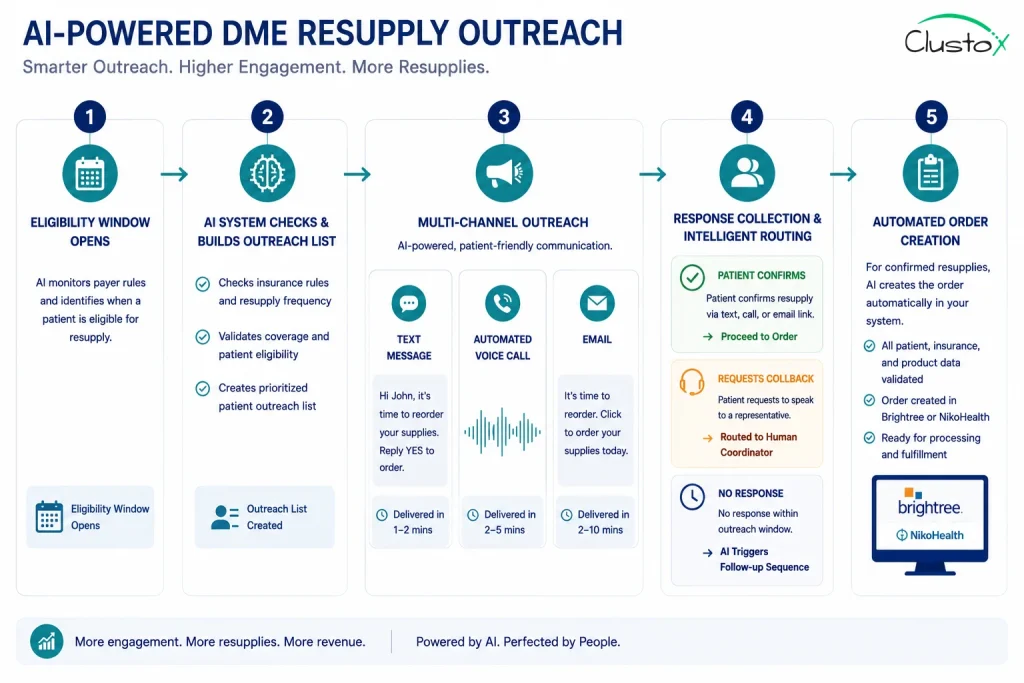
According to published outcomes from DME providers using automated resupply platforms, contact rates via AI-driven outreach consistently outperform manual calling campaigns, primarily because automated systems can reach patients at optimal times and through preferred channels without staffing constraints.
Pattern 7: How Does AI-Assisted Coding and Claim Scrubbing Reduce Submission Errors?
HCPCS coding errors and claim scrubbing failures are a quiet, persistent revenue drain. A modifier missing from a power wheelchair claim. A diagnosis code that does not support the ordered equipment under the applicable LCD. An incorrect billing date that triggers a timing edit. These errors reach clearinghouses and get rejected before a human ever reviews them.
AI-assisted coding analyzes the clinical documentation and order information in your system and suggests the correct HCPCS codes, modifiers, and ICD-10 codes before claim generation. Pre-submission claim scrubbing then validates the complete claim against payer-specific edits, CMS rules, and clearinghouse logic.
The combination of AI coding assistance and pre-submission scrubbing addresses the majority of clean claim failures before they leave your system. This is different from the scrubbing that happens at the clearinghouse. It happens inside your workflow, where your staff can correct the issue with full context.
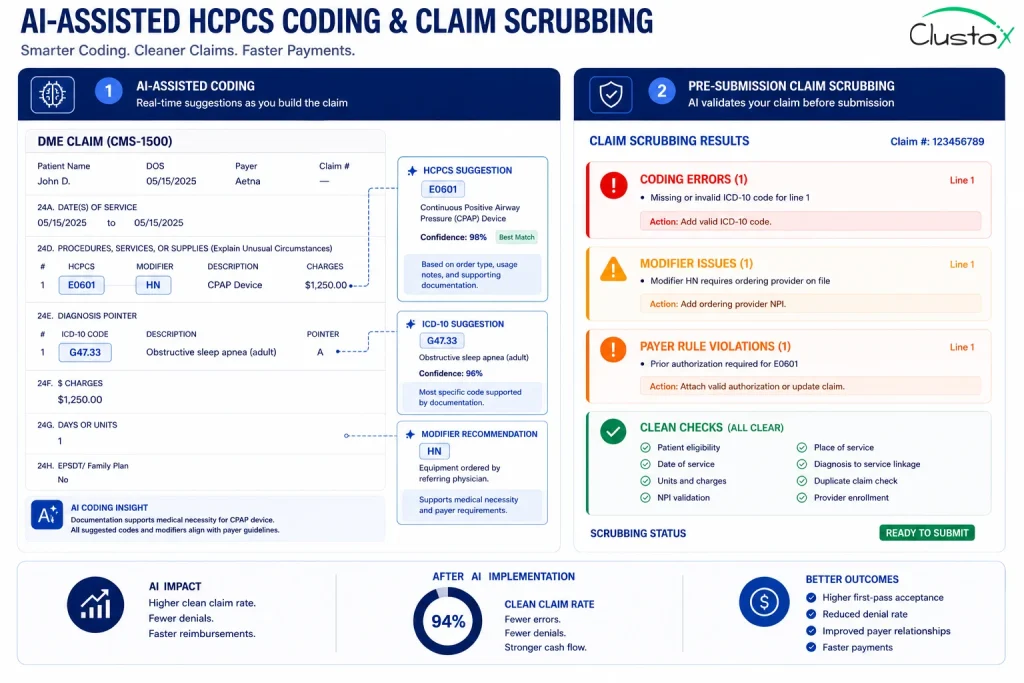
Common coding and scrubbing errors AI catches before submission
The list below reflects the most frequently caught issues in AI-assisted claim review implementations at DME providers.
These are the errors that, when caught pre-submission, have the highest direct impact on first-pass acceptance rates.
- Missing or incorrect KX modifier on Medicare claims requiring documentation of medical necessity.
- Mismatched diagnosis and HCPCS code combinations that do not align under the applicable LCD.
- Billing date or service period errors that conflict with authorization dates.
- Place of service codes that do not match the documented delivery location.
- Units of service that exceed payer-specific billing frequency limits.
- Secondary payer sequencing errors when Medicare is not the primary payer.
How Do You Choose Which AI Automation Patterns to Implement First?
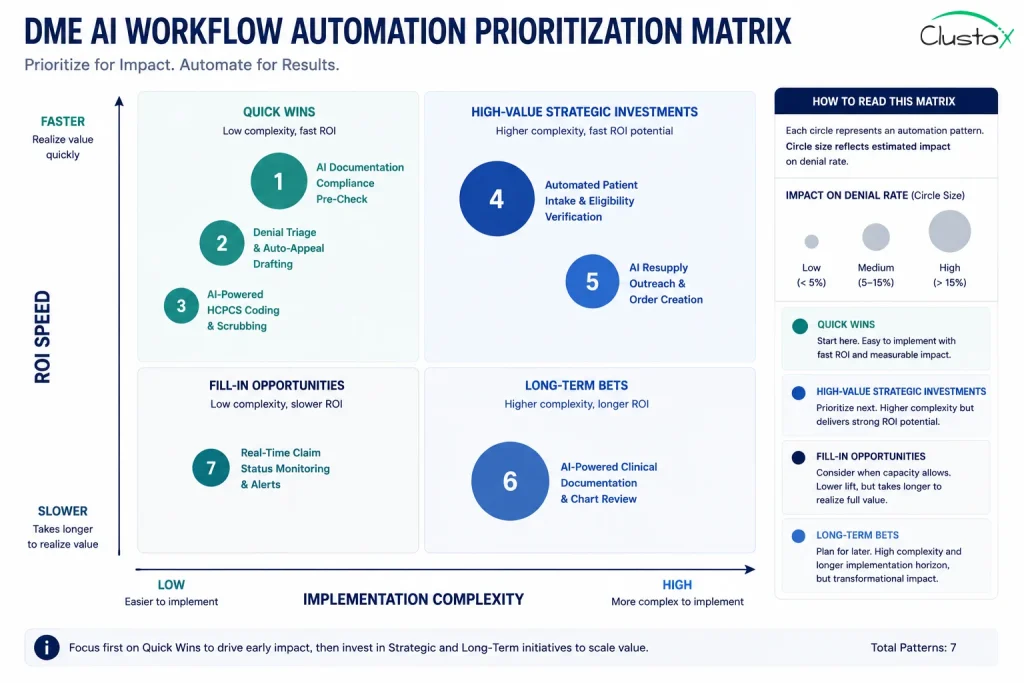
You do not need to implement all seven patterns at once. In most DME organizations, two or three patterns applied well produce more measurable results than a broad deployment handled poorly.
Use the framework below to prioritize. Score each pattern against three dimensions: current pain level (how much time or money is the problem costing you today), implementation complexity (how much integration and configuration work is required given your current stack), and time to measurable results.
| Pattern | Priority for High Denial Rate | Priority for High Labor Cost | Fastest to Measurable ROI |
|---|---|---|---|
| Prior Auth Routing | High | High | Yes (30-60 days) |
| Eligibility Verification | High | Medium | Yes (30-45 days) |
| Documentation Compliance | High | Medium | Yes (45-60 days) |
| Denial Management | High | Medium | Yes (60-90 days) |
| Intake Automation | Medium | High | Moderate (60-90 days) |
| Resupply Outreach | Low | High | Yes (30-60 days for resupply revenue) |
| Coding and Scrubbing | High | Medium | Yes (45-60 days) |
As a general rule, if your primary problem is claim denials, start with prior auth routing, eligibility verification, and documentation compliance. If your primary problem is labor cost and headcount, start with intake automation and resupply outreach.
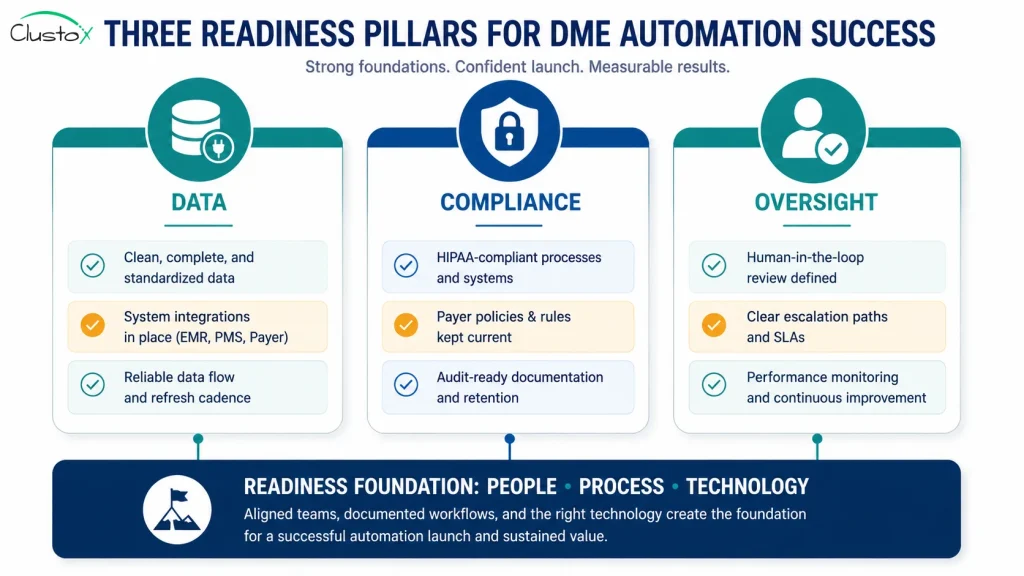
What should you verify before automating a DME workflow?
Strong results come from preparation, not from the model alone. Before you automate, check three things: your data and integrations, your compliance posture, and your oversight plan. Each one decides if a pattern will hold up in production.
The points below break down what to confirm in each area.
Data and integration readiness
Agents need clean inputs and a stable connection to your system of record. Confirm that your data lives in a platform with an API, such as Brightree or NikoHealth, rather than in PDFs or one person’s memory. Check that the fields the agent needs are populated and consistent. Weak data limits every pattern, so fix the inputs first.
Compliance and security
DME workflows touch protected health information, so security is not optional. Any automation must meet the HIPAA Security Rule, which requires administrative, physical, and technical safeguards for electronic PHI. Confirm that your vendor signs a business associate agreement and that data stays in approved, access-controlled systems. Build the audit trail in from day one.
Human oversight and accuracy
Every pattern in this guide keeps a person in the loop. Decide who reviews the agent’s output and how exceptions get routed. Set a confidence threshold so low-confidence cases reach a human. Track accuracy by workflow, and review it on a regular cadence so you catch drift early.
Use the table below as a quick pre-automation check.
| What to verify | Why it matters |
|---|---|
| System of record has an API | The agent needs a reliable way to read and write data. |
| Required fields are clean | Bad inputs produce bad output, no matter the model. |
| Business associate agreement signed | PHI handling must meet HIPAA before go-live. |
| Human review path defined | Someone must own approval and exceptions. |
| Accuracy metrics in place | You cannot improve what you do not measure. |
What Are the Real Limits of AI Automation in DME Operations?
AI automation is a tool, not a strategy. It produces strong results in workflow patterns that are high-volume, rules-based, and well-documented. It does not replace clinical judgment, compliance expertise, or relationship management with payers.
The following limitations are consistent across DME automation implementations and are worth stating plainly before you build your business case.
- AI performs as well as the data it processes. Poor documentation quality upstream means poor extraction quality downstream.
- Payer rule changes require model updates. An AI that was accurate last quarter may drift without a clear update and validation process.
- Automation reduces labor requirements for transactional tasks but does not eliminate the need for experienced billing and compliance staff.
- Edge cases in complex, multi-payer situations still require human review. Automation handles the standard path; your team handles the exceptions.
- Implementation timelines for DME-specific AI are longer than vendors often represent. Expect three to six months for a well-configured deployment that produces reliable results.
How do you start AI workflow automation in DME the right way?
Start narrow, prove value, then expand. The teams that succeed pick one painful workflow, measure a baseline, and ship a working result before they touch the next one. A long, open-ended project is the pattern to avoid.
Here is a sequence that keeps risk low and momentum high:
- Pick one workflow with a clear cost, such as prior authorization or denial recovery.
- Measure your current baseline: turnaround time, touches per task, and error rate.
- Confirm data, integration, and HIPAA readiness for that workflow.
- Ship a scoped pilot with a human review step and clear success metrics.
- Review accuracy and outcomes, then expand to the next workflow.
This approach gives you proof before you commit further. It also builds your team’s trust in the agent, which matters more than any single feature.
Conclusion
The seven patterns covered in this guide are not theoretical. They map directly to the workflows where DME providers consistently lose time and revenue: prior authorization, eligibility verification, documentation compliance, denial management, patient intake, resupply outreach, and coding accuracy.
You do not need to implement everything at once. Pick the two or three patterns that map to your biggest operational pain points today. Define what measurable success looks like for each one. Then configure, test, and validate before you scale.
The DME providers who are seeing real results from AI workflow automation in 2026 are not the ones who deployed the most technology. They are the ones who applied it precisely, in the right workflows, with clear success metrics.
You have seven patterns and one revenue cycle. We’ll tell you where to start
Clustox offers an AI workflow audit for DME providers. We map your current workflow against the seven patterns, identify your top two to three priority areas, and give you a concrete implementation roadmap.
Frequently Asked Questions
How long does it take to implement AI automation in a DME billing environment?
A realistic implementation timeline for a well-configured, DME-specific AI automation deployment is three to six months. The variance depends on your current software environment, data quality, and the number of patterns you are deploying simultaneously. Vendors who promise faster timelines should be asked to explain exactly what is included in that estimate.
Does AI automation require replacing existing DME software like Brightree or NikoHealth?
No. AI automation layers are designed to integrate with existing DME platforms, not replace them. The most common integration approaches use APIs, HL7 feeds, or document-level processing. Your team continues working in the system they know.
Which DME workflows benefit most from AI automation?
Prior authorization and eligibility verification consistently produce the fastest, most measurable results. These workflows are high-volume, rules-based, and have clear success metrics (turnaround time, first-pass approval rate). Denial management and pre-submission claim scrubbing follow closely in terms of ROI. Resupply outreach produces the strongest impact on recurring revenue.
What happens when AI makes an error in a prior auth or denial submission?
Well-designed AI automation systems flag low-confidence outputs for human review before submission. The critical design requirement is a clear escalation path and audit trail. Every AI-generated submission should be reviewable by your billing staff, and your vendor should provide error rate reporting that lets you track where the system is underperforming.
How do I calculate ROI on AI workflow automation for my DME operation?
Start with three inputs: current cost per prior auth or claim (staff time multiplied by loaded hourly rate), current denial rate and average cost per denial, and current resupply contact and conversion rates. Apply realistic improvement percentages from the pattern benchmarks in this guide. Compare the projected savings against vendor cost and implementation investment. A 12-month payback period is achievable for most DME providers who deploy two to three patterns well.